



Rewatching films offers comfort, nostalgia, and a new way of experiencing familiar stories.
Why do we rewatch films?

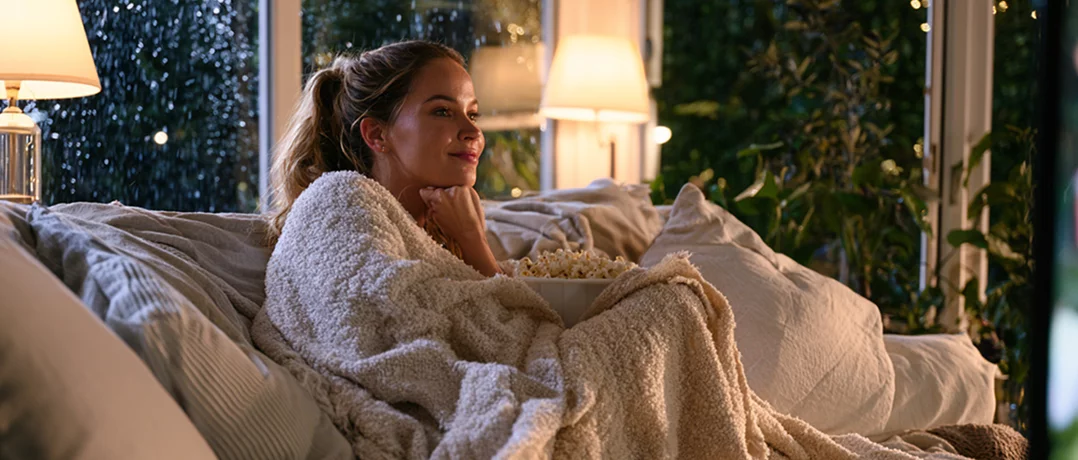
There is a particular kind of pleasure in pressing play on a film whose ending you already know no suspense, no risk, just the familiar shape of a story settling back into place. Streaming platforms have made this instinct newly visible, viewers regularly abandon an ocean of unseen content to rewatch something they've already finished, sometimes for the tenth time. Psychology calls this volitional reconsumption, and research suggests it isn't laziness or lack of imagination. It's a deliberate, psychologically useful choice, one that also changes how the film itself looks and feels the second time around.
The comfort it provides
Much of the research on rewatching draws on uses-and-gratifications theory, a framework in media psychology that treats consumption as something people actively choose for specific payoffs. A 2026 review published in Social and Personality Psychology Compass by researcher Perry Reed and colleagues, tracing decades of scholarship on what they term "volitional reconsumption," identifies consistent motivations, comfort and emotion regulation, social connection, identity continuity, and nostalgia. The same review notes that repeated exposure to familiar media can produce escalating enjoyment and deeper appreciation over multiple viewings, a finding at odds with the assumption that repetition simply breeds boredom.
This reflects a distinction media psychologists Mary Beth Oliver and Arthur Raney formalized in their influential research on entertainment motivation, driven by pleasure-seeking, versus eudaimonic consumption, driven by meaning-seeking. Rewatching a favorite film often satisfies both simultaneously, pleasurable in a simple, comforting sense, while also supporting reflection and a sense of belonging.
The nostalgia mechanism
Perhaps the most rigorously tested finding in this area comes from psychologist Constantine Sedikides and colleagues at the University of Southampton, whose 2016 study published in the journal Emotion ran six separate experiments on nostalgia's psychological function. Their research demonstrated that nostalgia fosters what they call self-continuity, a sense of connection between one's past and present self, primarily by strengthening feelings of social connectedness, which in turn produced measurable gains in eudaimonic well-being, operationalized in the study as subjective vitality.
Applied to rewatching, this research suggests that revisiting a film tied to an earlier chapter of someone's life functions as a tool for maintaining a felt connection between who they were then and who they are now, a mechanism the research shows is measurable, not merely anecdotal.
Why the ending being known doesn't ruin it
Counterintuitively, knowing exactly what happens transforms the experience. Cognitive research on familiarity and film processing has found that repeated exposure to a visual stimulus sharpens anticipation and makes narrative processing more efficient, freeing up cognitive resources previously spent tracking plot for other aspects of the viewing experience.
A striking demonstration of this comes from a 2025 study published in Communications Psychology using what researchers called the MEGA (Memory Episode Gaze Anticipation) paradigm. Across five experiments with 145 participants, the researchers found that upon repeated viewing of the same movie clips, viewers' eyes began anticipating salient events seconds before those events appeared on screen, a gaze pattern that directly indexed memory retrieval without requiring any verbal report. In other words, familiarity doesn't just change how viewers feel about a film, it measurably changes how their eyes move through it, seconds ahead of the story itself.
Watching a different film the second time
This is where rewatching becomes a perceptual experience. During a first viewing, attention is dominated by narrative tracking, the brain works to follow who these people are, what they want, and what happens next. Once that uncertainty resolves, attention has room to redirect.
Eye-tracking research on film viewing supports this shift at a measurable level. A widely cited 2007 study by researchers Goldstein, Woods, and Peli found that viewers watching a film for the first time exhibit strong gaze congruency, most eyes are drawn to the same salient points, largely dictated by the film's own editing, framing, and pacing. But a 2016 study by researcher Breathnach, cited in subsequent eye-tracking research on cinematic attention published in Behavior Research Methods, found the opposite pattern on repeat viewings, inter-observer gaze agreement measurably declined when the same movie clips were watched multiple times. Viewers' eyes, freed from the demands of following the plot for the first time, began exploring the frame more independently, drifting toward background details, a supporting actor's expression, or production design rather than the director's intended focal point.
In effect, the first viewing is guided by the filmmaker; the second is guided increasingly by the viewer's own curiosity. This helps explain why the same film can feel meaningfully different on a second watch without a single frame changing. The story hasn't moved, but the viewer's visual and cognitive priorities have, shifting from "what happens" to "how it was made to happen."
A story that changes because we do
Taken together, this research, spanning media psychology, nostalgia science, and eye-tracking studies of visual attention, points to the fact that rewatching is a documented, psychologically distinct mode of viewing, driven by comfort, self-continuity, and a brain finally free to look past the plot and into the craft beneath it. The film stays exactly the same. What changes, measurably, is us, and, with it, everything we're finally able to see.
-
-

-
The Beiruter
-
