

Nabatieh’s strategic and symbolic role in Hezbollah’s southern network makes it a key Israeli target with major regional consequences.
Why does Israel view Nabatieh as “the biggest earthquake”?
Why does Israel view Nabatieh as “the biggest earthquake”?
By Nakhle Odaime | June 09, 2026

Reading time: 6 min
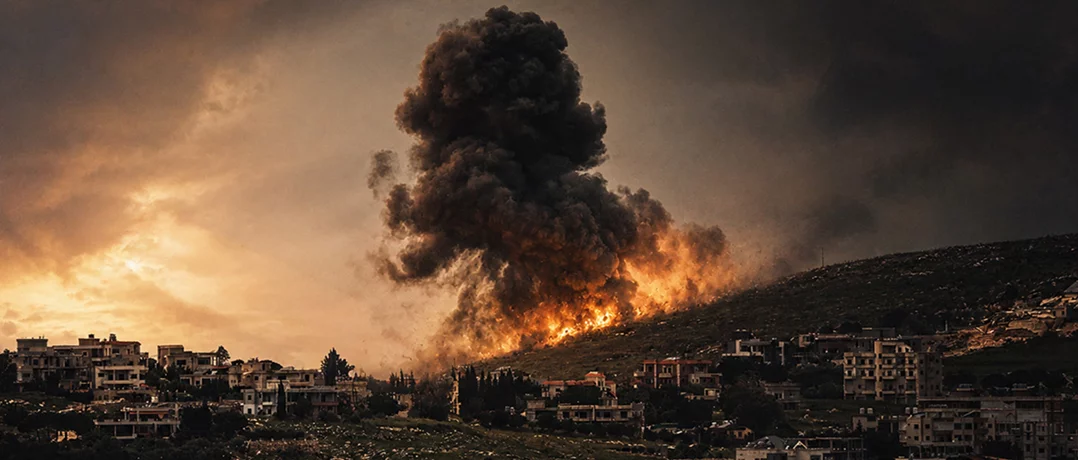
If Nabatieh falls, what remains of Hezbollah’s southern depth? The question is significant and alarming, especially as Israeli media has begun promoting the prospect of a “Battle of Nabatieh” and what may follow it. The Israeli news outlet Walla published a report, citing officers in the Israeli army, revealing that “Northern Command chief Major General Rafi Milo is pushing to destroy Hezbollah’s infrastructure in Nabatieh.” Walla also reported that the Israeli military has already begun a ground operation on the outskirts of the city of Nabatieh, employing various types of robots to locate explosive devices and uncover Hezbollah cells in the area. The outlet further argued that “the fall of Nabatieh, the largest stronghold in southern Lebanon, would be equivalent to an earthquake.”
The fortress Hezbollah fears losing
If Beirut’s southern suburbs represent Hezbollah’s political and popular center, then Nabatieh constitutes its strategic southern depth and the node linking Lebanon’s interior to the border sector.
For this reason, the Israeli military attaches exceptional importance to the city and its surroundings, viewing it as the link connecting the Litani region to the border sector, the Bekaa Valley to the South, and command and supply centers to frontline positions.
Nabatieh is not merely a major city in southern Lebanon; it is the historical capital of Jabal Amel and an administrative, economic, educational, and healthcare center. Since the 1980s, it has evolved into one of Hezbollah’s most important support bases, where the group has invested politically, socially, and militarily for more than four decades. Nabatieh’s military significance stems from its geographical location, situated at the intersection of key roads connecting the coast to the interior and linking Zahrani and Sidon in the north with Marjayoun, Khiam, and the Arqoub region in the east. It also serves as a natural gateway to the Hujair Valley, the Salouqi River, and the highlands overlooking the central sector of the border.
During the July 2006 War, the area stretching between Nabatieh and the Hujair Valley played a pivotal role in Hezbollah’s military operations. Israel, in turn, regarded fire control over this area as a prerequisite for preventing the reconstruction of Hezbollah’s military infrastructure in the South. Moreover, Nabatieh serves as a rear support hub for Hezbollah fighters deployed south of the Litani River. A substantial portion of the logistical infrastructure, support networks, supply routes, and communications systems on which the group relies in the central southern sector either passes through this area or branches out from it toward border villages.
A city of history and civilization
Beyond its military dimension, Nabatieh carries considerable symbolic value. The city is considered one of the most prominent centers of Jabal Amel, long associated with the history of Shiite political movements in Lebanon. Influential religious and political figures emerged from it, and for decades it served as a center of popular and organizational activity that Hezbollah leveraged to consolidate its presence in southern Lebanon.
For this reason, any Israeli advance toward the city’s outskirts or any attempt to target its military infrastructure is viewed in Israel not merely as a battlefield achievement but as a symbolic and psychological blow to Hezbollah in one of its most important historical strongholds.
This helps explain why some Israeli military circles describe Nabatieh as Hezbollah’s “largest fortress” in the South. The issue is not simply a city or a geographic location, but rather a region where history, symbolism, territorial control, and supply networks converge, making any change in its military status an event whose repercussions would extend far beyond southern Lebanon to the broader Lebanese landscape.
Why has Israel placed Nabatieh in its target bank?
Assuming the scenario discussed in some Israeli assessments materializes, the consequences of Nabatieh’s fall would extend far beyond the boundaries of a major southern city.
Militarily, it would mean Hezbollah losing one of the most important logistical hubs connecting its rear depth to the operational theater south of the Litani River. It would also fragment movement routes between the central and eastern sectors of southern Lebanon and place vast areas of Jabal Amel under direct Israeli fire surveillance.
On the ground, the fall of Nabatieh would render towns located between the Litani and Zahrani rivers more vulnerable to military pressure and provide Israel with an advanced position from which it could expand toward other areas or impose new security realities in the South.
However, the most significant impact may be psychological and political. The loss of Nabatieh would deal a blow to the narrative upon which Hezbollah has built its image as a force capable of defending territory and preventing Israeli advances into areas with a substantial Shiite population.
The south’s logistical hub and a symbol of Shiite influence
The major threat facing Nabatieh raises difficult questions within Hezbollah’s support base regarding the effectiveness of the military strategy that has led to the loss of positions that, until only a few years ago, were considered beyond any direct threat. After the loss of border positions and villages adjacent to the frontier, the transfer of battles to Nabatieh would appear to signify the war’s arrival at the very heart of the South’s strategic depth.
Historically, the city has not witnessed a comparable situation since the Israeli invasion of 1982. For this reason, Hezbollah views Nabatieh as a forward defensive line protecting its project and influence in the South. If the border villages represent Hezbollah’s first line of defense, then Nabatieh represents the core of its southern depth. Should it fall, the significance would not be measured by the number of kilometers advanced by the Israeli military, but by the scale of the blow inflicted on Hezbollah’s logistical, symbolic, and political infrastructure in southern Lebanon.
Between Israel’s battlefield advances and the “resistance axis” propaganda machine
In June 1967, the Arab defeat was not solely a military catastrophe; it was also preceded and accompanied by extensive media disinformation. At the time, the Voice of the Arabs radio station broadcast reports of victories while the fronts were collapsing.
Today, the scene appears to be repeating itself. Southern towns are reportedly falling one after another. Ghandourieh has fallen, operations have expanded toward Borj Qalaouiyeh and Srifa, and Israeli forces have reached the Nabatieh area after advancing along several axes, including toward Mefdoun and Aadchit. This is why the continued denial of realities and the prioritization of mobilizing narratives over candor and realism are viewed as particularly dangerous.
The truth that should be stated clearly is that protecting the South does not come through concealing facts or manufacturing media victories. Protecting the South begins with acknowledging losses, assessing the balance of power as it actually exists, and placing the interests of Lebanon and its people above all other considerations. History has taught us that defeats do not begin when armies retreat; they begin when truth is replaced by empty propaganda, facts by false slogans, and losses by imaginary victories.
