

How West Asia collapsing peace processes and eroding US security guarantees have pushed regional states toward heavier militarization and new defense alliances like the Mecca Agreement, India-UAE ties, and Greece-Israel cooperation.
Why is West Asia becoming more militarized?
Why is West Asia becoming more militarized?
By Peter Chouayfati | September 08, 2026

Reading time: 5 min
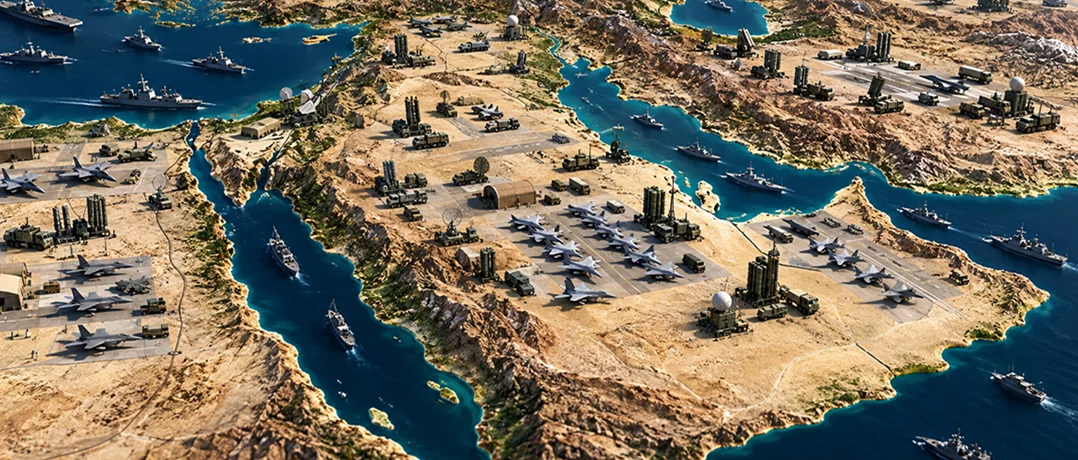
The short answer is the militarization of the region is a byproduct of peace not finding its course. Collapsed negotiations, broken ceasefires, and the continued genocide on Gaza have eroded confidence that diplomacy alone can guarantee security. Compounding this, Israel's expanding strikes reaching into Syria, Iran, Lebanon, Iraq, and even Qatar, have sent a clear signal to governments that no one can assume they are exempt from being targeted.
This shift has unfolded alongside the erosion of the United States' self-proclaimed role as the region's protector. Iran has exploited that vacuum, demonstrating its ability to threaten the Strait of Hormuz and repeatedly striking Gulf infrastructure and military installations. The war on Iran has become, in effect, the breaking point at which it became clear that no state in the region can consider itself safe by default.
According to the Stockholm International Peace Research Institute, peace processes in 2025 grew more fragmented, transactional, and coercive. Rather than pursuing comprehensive, inclusive settlements, mediators and combatants increasingly favored rapid deals, narrow ceasefires, and leader-to-leader bargaining. These arrangements proved fragile, contested, or incomplete, shaped more by short-term economic and strategic calculations than by durable reconciliation.
Widening geopolitical rivalries have also hollowed out multilateral peacekeeping and mediation efforts. The United States has shown declining willingness to sustain the multilateral system, and in 2025 took concrete steps to withdraw from, defund, and question the value of various UN bodies. Neither China nor the European Union has stepped in to fill that role. Into this vacuum have moved a set of middle powers most notably Brazil, Qatar, Saudi Arabia, Türkiye, and the United Arab Emirates, which now have greater room to substitute for, or supplement, multilateral security frameworks while simultaneously pursuing their own national interests.
Regional military expenditure reached an estimated $218 billion in 2025. While that marked only a marginal year-on-year increase of 0.1 percent, it represents a 36 percent rise over the 2016–2025 decade, driven by recurring conflicts and crises across the region.
The region's emerging alliances
Out of this environment, several new, and in some cases unlikely, security partnerships have taken shape.
The Mecca agreement: Saudi Arabia, Pakistan, and Türkiye
As reported by Azeema Cheema and Mohanad Hage Ali of the Malcolm H. Kerr Carnegie Middle East Center (August 13, 2026), Ankara and Islamabad moved quickly to position themselves as alternative security partners once it became clear that many in the Gulf now view the American military presence as more liability than asset. Türkiye and Pakistan, both excluded from the India–Middle East–Europe Economic Corridor (IMEC), recognized that a new regional security alliances could bring economic benefits and secure their place in the broader global development-corridor race. Both countries also saw an opportunity to grow their military-industrial sectors using Saudi financing.
While the Mecca accord is based directly on the earlier Pakistan–Saudi Strategic Mutual Defense Agreement (SMDA), signed just eight days after an Israeli airstrike targeted Hamas leadership in Doha in September 2025. The SMDA created a binding NATO-like defense commitment: an attack on either Pakistan or Saudi Arabia would be treated as an attack on both. This bilateral pact became the foundation for the trilateral Mecca agreement. Notably, neither the SMDA nor the Mecca accord names a specific adversary.
Although Ankara and Islamabad have no influence over Riyadh's relations with their own respective rivals, Greece and India, a shared interest in countering Israeli and Iranian regional ambitions may prove a durable enough foundation to sustain the partnership.
India and the UAE
India and the UAE have moved to deepen ties of their own, signing agreements on defense, energy, and shipping during Prime Minister Narendra Modi's visit to Abu Dhabi. The pacts commit both countries to closer defense-industrial collaboration, along with cooperation on innovation, advanced technology, training, joint exercises, maritime security, cyber defense, and secure communications.
Energy security featured prominently as well, with an agreement allowing crude oil storage in Fujairah, UAE, to count toward India's strategic petroleum reserve. The meeting followed UAE accusations that Iran had targeted Fujairah's coast with drones and missiles, sparking a refinery fire and injuring three Indian workers. Modi publicly condemned the strikes.
This India-UAE rapprochement is closely tied to Israel's own deepening relationships with both countries through the I2U2 Group, a minilateral partnership among India, Israel, the UAE, and the United States. Established in October 2021 and elevated to leader-level engagement in July 2022, I2U2 focuses on joint economic cooperation, infrastructure development, and technological innovation.
Greece and Israel
Greece has signed its largest-ever defense agreement with Israel: a $3.5 billion deal for a multi-layered air defense system, part of a broader effort to modernize the Greek military by 2030. Athens plans to spend roughly €28 billion ($32 billion) by 2036 on the system, known domestically as the "Achilles Shield", alongside the purchase of up to 40 F-35 fighter jets from the United States and additional frigates from France and Italy.
Analysts attribute Greece's buildup in part to growing unease over the fallout from the US-Israel confrontation with Iran, particularly as Tehran has struck at American allies across the Gulf. The timing also coincides with a marked cooling in Israeli-Turkish relations. Last April, Netanyahu and Modi jointly warned of an emerging "Sunni-Axis" led by Türkiye. Netanyahu has since floated the idea of a "hexagon of alliances", bringing together Israel, India, Greece, and Cyprus, alongside other unnamed Arab, African, and Asian states, as a coalition to jointly counter what he describes as "radical" regional adversaries.
Conclusion
How long these agreements will last, and how much real impact they will have, remain open questions. Even so, their emergence points to two clear conclusions. First, a regional order underwritten primarily by the United States is no longer viewed as a viable arrangement by the states of the region. Second, and is a direct consequence from the first, regional states are now scrambling to secure their own futures, whether through new coalitions, strategic hedging, or sharply higher military spending.
-
-

-
Peter ChouayfatiPolitical Analyst and Researcher
-
