



In this opening essay on transrational peace, an educator explores how cultivating the ability to perceive beauty is a vital step toward nonviolence, dignity, and social cohesion in Lebanon.
Why learning to see beauty matters

I work with schools across Lebanon. I am an educator, and I focus on the study of peace, violence, and nonviolence at the University of Cambridge. Over the course of the upcoming months, I invite you to explore these themes with me through a series of articles, discussing connected topics, leading to the timely question: What is transrational peace, and how can we work towards it?
This invitation is for anyone who wants to think actively about what peace means, to question it, test it, and relate it to your own experiences, relationships, and public life, as something we build together.
First, we begin by talking about beauty. I know it may sound misplaced or secondary, and so the following is my claim: without beauty, we cannot talk about peace.
Beauty here is an intuitive sense: innate, absolute, and timeless. It is part of culture and is cultivated through tactfulness, you recognise this kind of beauty before you can explain it.
Aesthetics is a different concept that I will expand on in the next article. It refers to standards about what looks “good” at a given time. It is heavily shaped by power, thus something can meet these standards perfectly and still feel empty or even ugly.
Think about beauty pageants such as Miss Lebanon or Miss Universe. Many people may claim that those who lose deserve to win because they are more beautiful. The justification is that, according to the metrics, the standards of the specific aesthetic have correctly determined who deserves to win. These aesthetic metrics inherently exclude short people, for example. Are we then saying that someone who is short cannot be considered beautiful?
Beauty is subjective, we should not concern ourselves with what is beautiful, but rather on strengthening our ability to see it and to appreciate it, allowing for a more inclusive world.
Let us focus on space to explain this further, taking two examples: (1) urban planning and (2) schools in Lebanon.
On urban planning, beauty, and violence
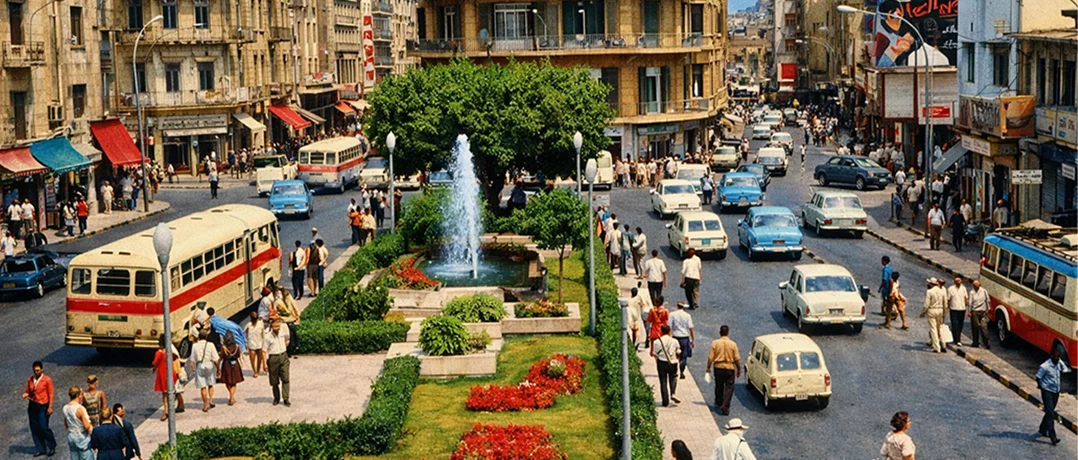
The city of Beirut has undergone different and varying phases of urban planning, from the period of Ottoman rule to the French Mandate, then independence, and later the post-civil war era and the reconstruction of the central business district. Standards have also differed from one area to another, depending on geopolitical, economic, and demographic factors.
There are, however, explicit recurring patterns.
Sharp’s (2020) research on Beirut’s post-war reconstruction shows how many visually impressive and carefully planned spaces were embedded in processes of dispossession and exclusion. More broadly, studies on place quality show that environments affect wellbeing and social relations. Spaces that are chaotic or emotionally empty are tiring to inhabit.
This brings me to an idea that has circulated widely in discussions about cities and behaviour.
In 1982, two American researchers, Wilson and Kelling, proposed what became known as the Broken Windows Theory. Their claim was simple: when people see signs of neglect in a place, broken windows, litter, damaged buildings, they are more likely to behave in harmful ways, as the environment signals that no one cares.
Later research showed that this claim was overstated. Large reviews found no solid evidence that physical disorder by itself causes crime or violence. Environments do not mechanically produce crime, but they do shape how people learn to read the world around them.
In Lebanon, this is visible in our everyday life: random planning, unlicensed buildings rising without coherence, garbage accumulating on streets, unrepaired potholes, sidewalks that are not walkable, and roads that are unsafe to cross. These are explicit failures and daily encounters with the absence of beauty.
Such environments lead to the disappearance of tact, rhythm, and consideration for others. Over time, this teaches people what to expect.
Think about driving in Lebanon, even with functional signals. It often feels like a war zone. I personally feel as if I am fighting for my right to get somewhere safely.
When a place feels careless, people learn to move through it defensively. We rush, and we assume conflict. When a place feels coherent and cared for, even in modest ways, people tend to slow down. We notice one another.
So the issue is not that disorder causes violence, it is that repeated exposure to spaces without beauty trains us to accept tension and indifference as normal.
We adapt.
We no longer expect beauty, we normalise its absence, and eventually we dismiss it.
It seems intuitive and like common sense, so what can we do to promote beauty within our environment?
On schools, beauty, and violence
Think back to your school years. What was beautiful within your school?
Foucault (1975) showed how modern schools developed within systems of discipline and surveillance similar to those found in prisons and factories, even though their purposes should be different.
Many students in Lebanon learn in overcrowded and under-resourced classrooms. I am not saying that these were built purposefully to harm children. We have limited resources, and the financial burden is beyond comprehension, particularly for public schools.
Nevertheless, this has effects on the wellbeing of children, on how they relate to themselves and others, and on what becomes the norm.
It is alright to push friends to buy from the dekene before the manoushe runs out. It is alright to draw on and scratch the desk, as it is the only medium where I can express myself. It is alright to look at the teacher standing on the little platform built into the classroom as if they are the higher source of power I must comply with. It is alright to litter, as everyone does it and the bin is far away. It is alright for me not to have a space to play or to sit in silence, and I should not expect too much from this world.
A fine line exists between resilience and passiveness, regulation and defeat. When a sense of beauty is repeatedly absent, people stop noticing its absence. Harshness, exhaustion, and indifference start to feel ordinary.
Yet, beauty has not disappeared.
I repeat my question to you: what was beautiful within your school?
The joys of playing with your friends, the happiness of being seen and spoken to by a kind teacher, the little flowers that grew between the concrete, sitting next to a window and looking outside, a fun book you got to read, a conversation, a seat, a place, a thought…
Through education, we can cultivate culture. It is not too late, seeing and appreciating beauty can be relearned.
It requires resisting the idea that exhaustion is maturity and that numbness is strength. It requires actively drawing our attention to what we can achieve, like teaching emotional regulation, learning how to take turns, finding joy when my friend gets the last manoushe and perhaps splitting it, and appreciating the beauty that still exists even if it is personal.
As naïve as it may sound, I truly believe that seeing and appreciating beauty is the first step towards a less violent reality. If peace is the goal, then let us start with perception.
For now, I leave you with one final reflective question:
Have you noticed beauty around you today?
-
-
-
Razan El HelouPhD researcher on peace education, storytelling, and politics
-
