As traditional homeownership becomes increasingly unaffordable in Lebanon, prefabricated homes are emerging as a faster, lower-cost alternative that could revive rural economies while also exposing the country’s deeper housing and financial crisis.




As traditional homeownership becomes increasingly unaffordable in Lebanon, prefabricated homes are emerging as a faster, lower-cost alternative that could revive rural economies while also exposing the country’s deeper housing and financial crisis.

For decades, owning an apartment in Lebanon often began at the bank: a down payment, a housing loan stretched over 20 or 30 years, and eventually a home that gradually became the family’s own. Today, that equation has been turned on its head. Banks no longer play the same role, housing loans remain limited, and property prices have begun rising again in several areas, while the incomes of a large segment of the Lebanese population have failed to keep pace.
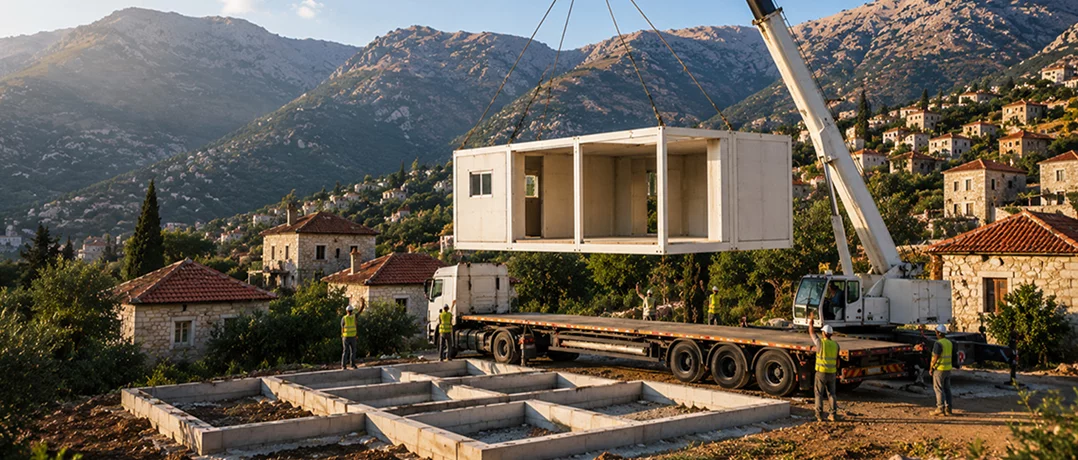
In a real estate market that has become heavily dependent on cash, a growing number of young people and families are considering a different option: if a traditional apartment is out of reach, why not build a prefabricated home on land the family already owns in its village?
This is how prefab homes have begun carving out a larger space in Lebanon’s housing market. Yet behind the rise of this sector lies an economic paradox: is this an emerging industry offering new opportunities for Lebanon, or is it primarily another indicator of the declining purchasing power of Lebanese households?
Ali Masri, President of the Lebanese-Chinese Business Council and owner of a company specializing in prefabricated homes in Lebanon, tells The Beiruter that “a large number of citizens are turning to these homes because of their price and ease of construction, and they are placing them particularly in their towns and villages.”
He also points to demand from people looking to establish guest houses and chalets across different parts of Lebanon, reflecting the growing use of prefab structures in the tourism sector.
According to Masri, who says the company is an agent for Ecosystem prefabricated homes in Lebanon, which are witnessing growing demand, a 220-square-meter house can be installed in just five days.
As for the cost, he says a 100-square-meter prefab home costs only around $50,000, and comes fully finished “from tiles to paint, aluminum and lighting, as well as other essentials and even luxury features.”
Masri stresses that these homes “last longer than a human being lives” and are resistant to earthquakes, wind and fire. He adds that there are three main types of prefab homes, wood, Ecosystem and steel, and that they come with warranties.
The term “prefabricated home,” however, does not necessarily mean a small or inexpensive house.
A survey by The Beiruter of several models of homes manufactured using precast concrete panels showed that prices start at around $50,000 and can exceed $300,000, depending on size and specifications.
A modern-design home spanning 280 square meters, with three bedrooms and four bathrooms across two floors, costs around $185,000.
A 165-square-meter home inspired by the traditional Lebanese mountain house, featuring three bedrooms and four bathrooms over two floors, costs approximately $155,000.
The price rises to around $298,000 for a 390-square-meter villa with four bedrooms and five bathrooms across two floors.
Costs can rise further with the addition of insulated glass, upgrades to the type of wood used inside the house, particularly for doors, as well as the type of ceramic tiles, bathroom packages, the inclusion of a kitchen, air-conditioning systems and lighting, in addition to the location of the property.
For economist and financial expert Dr. Layal Mansour, the growing demand for prefabricated homes cannot be separated from Lebanon’s economic reality.
She tells The Beiruter that, economically, these homes are classified as a “second-tier alternative” and are typically sought “when income decreases and citizens can no longer afford what they used to buy.”
Mansour goes further, arguing that the expanding demand represents “clear indicators of Lebanon’s financial decline, falling incomes, shrinking growth, and Lebanese people resorting to forced alternatives because of worsening poverty.”
Official data reinforces the scale of this structural shift. According to the latest World Bank reports, poverty rates in Lebanon more than tripled over a decade to reach around 44%, remaining elevated at levels exceeding 36% through 2026, while the Lebanese economy has paid a steep price, recording a sharp cumulative contraction of nearly 40% compared with 2019.
Despite the economy recording modest growth of 3.5% and a decline in the overall inflation rate, rents and service prices saw dramatic increases exceeding 27%, effectively pushing rental housing in urban centers beyond the reach of middle, and lower-income households.
Against this backdrop, and amid the soaring cost of traditional construction, owning land in a village becomes both an economic advantage and a genuine lifeline. A family can remove the high cost of purchasing land from the housing equation and direct its limited cash toward installing a prefabricated home on ancestral property.
Mansour, however, warns against interpreting the spread of prefab homes as a sign of economic prosperity.
“If the Lebanese economy returned to what it was before the crisis, everyone who bought a prefab home might go back to traditional construction or buying an apartment,” she says, adding that these homes “are not an alternative under normal circumstances, but rather under abnormal conditions.”
Mansour traces the core problem back to the lack of financing, stressing that “no economy grows without banks, and the bank’s primary role is to provide loans, which allows economic growth to multiply.” She considers this one of the negative realities highlighted by the rise of prefabricated homes.
At the same time, she notes that traditional real estate booms are not always synonymous with healthy economic growth. She points to Lebanon’s real estate boom between 2005 and 2008, arguing that the abundance of real estate activity at the time contributed to exaggerated economic growth.
She explains that real estate projects do not employ large numbers of “brains” and specialists in the same way factories, companies and productive investments do. Millions of dollars can be spent on a property employing only a limited number of engineers and workers, whereas establishing a factory with the same amount could employ a much broader range of workers, employees and specialists.
The trend also has a more positive side.
Mansour believes prefab homes “certainly contribute to the prosperity of the villages and towns where they are established,” in addition to serving as an alternative housing option.
Families moving onto land they already own in their hometowns generate additional demand for furniture, maintenance, services and local shops. Meanwhile, the spread of guest houses and chalets adds tourism activity that can create new income streams in rural areas.
But according to Mansour, the economic benefit becomes greater if the homes themselves are manufactured in Lebanon.
“These homes provide a roof over families’ heads and are a good solution for many people, but what is most important for the national economy is for these homes to be made in Lebanon, which would increase jobs and boost local industries,” she says.
If they are manufactured abroad, however, she sees a clear downside: “The housing solution is imported from abroad.”
Talal Hijazi, Director General of the Association of Lebanese Industrialists, points out that prefabricated-home manufacturing is not new to Lebanon.
“The manufacture of prefabricated concrete homes in Lebanon has existed for years and is not new, and there is more than one specialized factory,” he tells The Beiruter, confirming that demand has increased recently, although precise statistics on the size of the market are not available.
Hijazi says Lebanese manufacturers are ready to meet demand if it increases. More importantly, he says, is “reviving the entire economic and industrial cycle related to reconstruction and the sale of these homes, in terms of furniture, paint, tiles and all kinds of household supplies.”
Prefab housing could therefore evolve from a mere housing alternative into a broader production chain that generates activity across multiple sectors, provided that the share of locally manufactured homes increases.
The economic and social importance of these homes has grown further amid the widespread destruction in southern Lebanon.
The Higher Relief Council sent the first batch of prefabricated homes to the town of Zawtar al-Gharbiyeh, at the direction of Prime Minister Nawaf Salam, to serve as temporary housing that would allow residents and displaced families to return to their land while awaiting the launch of comprehensive reconstruction efforts.
Each unit consists of two rooms, a small kitchen and a bathroom. The units were secured through the local market and donations in cooperation with the Council for the South.
Housing needs are enormous. In the latest damage assessment published in June 2026, the United Nations Development Programme estimated direct damage to buildings in southern Lebanon at around $1.38 billion through April, with 11,095 buildings completely destroyed, affecting 17,891 housing units. Another 5,219 units were partially damaged, while 18,282 sustained minor damage.
The World Bank’s broader estimates of war-related damage had already ranked housing as the hardest-hit sector, with losses estimated at around $4.6 billion, while total recovery and reconstruction needs across sectors reached approximately $11 billion.
Against figures of this magnitude, a prefabricated home can offer a rapid transitional solution for a family seeking to return to its village but unable to wait years for reconstruction.
Despite this, Hijazi says there has not yet been a major surge in demand linked to reconstruction.
There is interest in this type of housing in the South, he says, “but everyone is waiting for real stability, and there is fear of renewed war. Therefore, we have not yet seen strong demand in this field, pending greater clarity in the political and security situation.”
Even a house that can be installed within days first requires confidence that the land on which it will stand is safe.
For Hijazi, Lebanese industry is ready for the next phase, but war itself represents a loss that reconstruction spending can never truly compensate for.
He sums it up by saying: “Wars have set us back, and we would have preferred the money to be spent on restoring prosperity rather than on reconstruction.”
Prefab homes offer a real alternative in today’s Lebanon: lower costs, faster construction, the ability to build on family-owned land, and an opportunity to bring economic activity back to villages. If developed into a stronger local industry, they could also create jobs and stimulate sectors ranging from furniture and tiles to paint and household equipment.
Yet their growing popularity also reveals a deeper economic reality. When young Lebanese shift from searching for a mortgage to buy an apartment to looking for family land on which to build a prefab home, the nature of housing demand itself is changing. Shrinking incomes, limited bank financing and the declining ability of the middle class to afford traditional homes are all driving this shift.
Between opportunity and necessity, Lebanese are returning to an asset many families have long possessed: land in their villages. And instead of waiting years for Lebanon’s banking crisis to be resolved and housing loans to make a meaningful comeback, they may now need to wait only a few days... to have a home of their own standing on their land.

Focusing on economy and social affairs.
