How Lebanon’s heavy reliance on VAT, fuel taxes, customs duties and import charges places a disproportionate burden on lower and middle-income households.




How Lebanon’s heavy reliance on VAT, fuel taxes, customs duties and import charges places a disproportionate burden on lower and middle-income households.

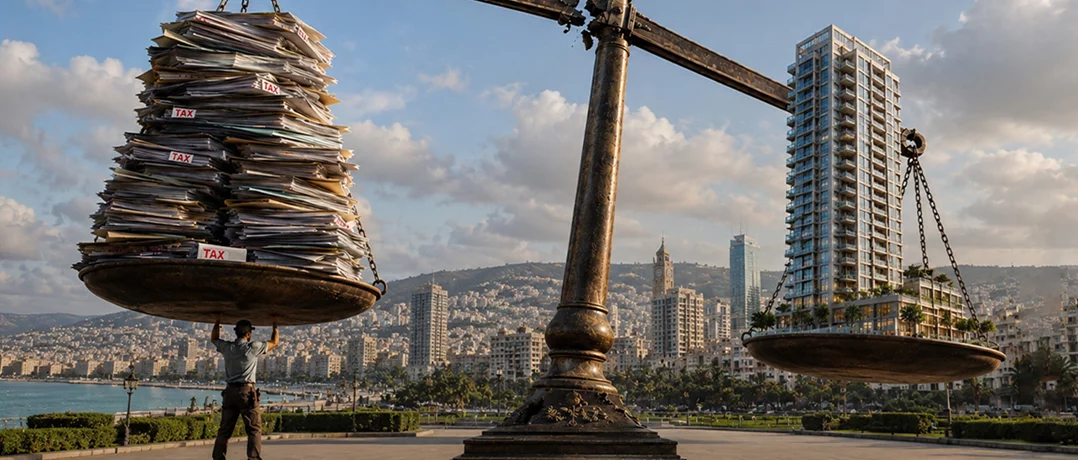
VAT, fuel taxes, customs duties and administrative fees underpin much of the Lebanese state’s revenue. The result is a system in which a low-income worker and a millionaire often pay the same tax on everyday purchases. Many economists argue that the structure has become one of the country’s most deeply entrenched sources of inequality.
Filling up a car with fuel. Buying bread, a refrigerator or a mobile phone. Paying a telephone bill or settling administrative charges. At every step, Lebanese citizens pay taxes.
Yet unlike many developed economies, where government revenues rely heavily on income and wealth taxation, Lebanon derives a significant share of its fiscal revenues from indirect taxes levied on consumption. These taxes apply equally to all consumers, regardless of income, making the burden disproportionately heavy for lower-income households.
For many economists, the system has become increasingly inequitable, a trend that has intensified since the country’s financial collapse in 2019.
In most advanced economies, governments finance public spending primarily through income taxes, corporate taxes and, in some cases, wealth taxes. Lebanon follows a different model. A substantial portion of public revenues comes from value Added Tax (VAT), fuel taxes, customs duties, administrative fees and import-related charges.
The key issue is that these taxes affect all consumers in the same way.
A family earning $500 per month pays exactly the same VAT on a litre of milk or a mobile phone as a household earning $10,000 per month.
While the amount paid may be identical, the financial impact is radically different.
Lebanon’s VAT rate currently stands at 11%. In practical terms, a consumer purchasing a product worth $100 contributes $11 to the state. The problem is straightforward: the tax takes no account of an individual's income.
Consider two consumers. A worker earning $600 per month purchases a household appliance costing $500. A business executive earning $20,000 per month buys the exact same product. Both pay $55 in VAT. For the worker, that represents almost 10% of monthly income. For the executive, it amounts to less than 0.3%.
Economists describe this as a regressive tax: the lower a person's income, the heavier the effective burden becomes.
Fuel provides one of the clearest illustrations of the problem. The price paid at the pump includes: the cost of fuel itself, transportation costs, VAT and a range of additional taxes and levies.
When fuel prices rise, the consequences extend far beyond motorists.
Higher fuel costs feed into transportation, food prices, services, private electricity generators and ultimately the broader economy.
For lower-income workers who rely on their vehicles to reach their jobs, the impact is particularly severe.
In proportional terms, they often bear a far greater burden than wealthier households.
Lebanon officially operates a progressive income tax system. Tax rates increase alongside income levels and can exceed 20% for top earners. In practice, however, several factors limit the effectiveness of the system: the large informal economy, weak tax enforcement, tax evasion, aggressive tax optimization and the under-reporting of income.
As a result, the state struggles to collect taxes efficiently from higher-income groups while continuing to rely heavily on consumption taxes that are relatively easy to enforce.
Lebanon imports the vast majority of the goods it consumes. Food products, medicines, household appliances, clothing, vehicles and construction materials all enter the country through import channels. Before these products even reach shop shelves, many have already accumulated: customs duties, port charges, various administrative fees and VAT. These costs are ultimately passed on to consumers.
In other words, a significant share of taxation remains largely invisible, embedded directly into retail prices.
According to many economists, Lebanon’s middle class has become the principal victim of the current fiscal structure.
Lower and middle-income households spend a large proportion of their earnings on essential consumption.
Every increase in VAT, fuel taxes or customs duties therefore has a direct impact on purchasing power.
By contrast, wealthier households typically allocate a smaller share of their income to everyday consumption and often have greater flexibility in managing their tax exposure.
Since Lebanon’s financial collapse in 2019, these disparities have become more pronounced.
The gradual dollarization of the economy, higher taxes on certain services and rising import costs have all increased the weight of indirect taxation.
At the same time, household incomes have declined sharply.
The result is that a growing share of disposable income is now absorbed by taxes embedded in the prices of goods and services.
For many experts, the issue is not necessarily the level of taxation but its distribution. Economists have repeatedly called for more effective taxation of high incomes, stronger action against tax evasion, a broader tax base, greater transparency and reduced reliance on consumption taxes.
The objective would be to create a fairer system while enabling the state to increase revenues without placing additional pressure on already struggling households.
Many Lebanese citizens feel they pay taxes without always realizing it.
Today, a substantial share of taxation is embedded in the prices of fuel, food products, telecommunications, imported goods and countless everyday services.
This is the essence of Lebanon’s fiscal paradox.
Those who earn the most are not always the ones who contribute proportionally the most. Instead, the heaviest burden often falls on households that spend the largest share of their income simply to maintain their standard of living in a country still grappling with one of the most severe economic crises in modern history.
