In Lebanon, Easter is celebrated twice as different Christian communities follow separate calendars, reflecting a shared faith expressed through parallel traditions.




In Lebanon, Easter is celebrated twice as different Christian communities follow separate calendars, reflecting a shared faith expressed through parallel traditions.

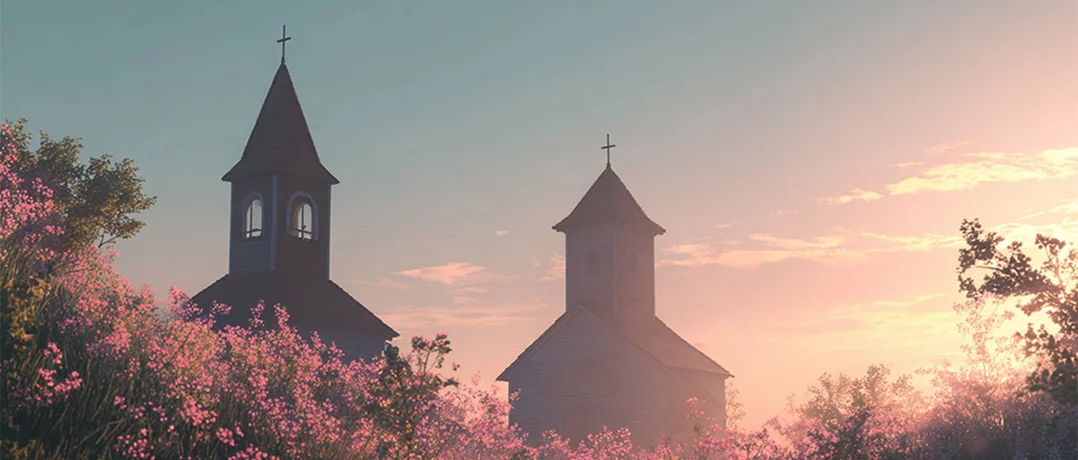
Why do Christians celebrate Easter twice? In Lebanon, the answer unfolds in real life.
One Sunday, church bells echo: “Christ has risen.” The week after, villages move in a different rhythm, walking the Way of the Cross, step by step.
At first glance, it feels like a contradiction. In reality, it is something else entirely.
Easter, the most important feast in Christianity, marks the resurrection of Jesus Christ. Across denominations, its meaning does not change. What changes is the way time is measured.
Both Catholic and Orthodox Churches follow the same rule, established at the First Council of Nicaea: Easter is celebrated on the first Sunday after the first full moon following the spring equinox.
The principle is shared. The outcome is not.
In 325 AD, Christian leaders gathered at the First Council of Nicaea to unify belief and practice across the Church. Among the issues addressed was a growing inconsistency: different communities were celebrating Easter on different dates. To resolve this, the council established a rule that still governs Easter today. The feast would be celebrated on the first Sunday after the first full moon following the spring equinox.
This formula ties Easter to both the solar year and the lunar cycle. The equinox is fixed as March 21, the full moon must occur after that date, and Easter falls on the Sunday that follows. Because it depends on these moving elements, the sun, the moon, and the weekly cycle, Easter does not have a fixed date, but shifts each year between late March and late April.
The divergence seen today emerged centuries later. By the 16th century, the Julian calendar had drifted from the solar year, slowly misaligning religious dates from the natural seasons. In 1582, Pope Gregory XIII introduced the Gregorian calendar to correct this shift. The Western Church adopted it, while the Eastern Church retained the Julian calendar. What followed was not a rupture, but a gradual divergence, two systems moving forward side by side, measuring the same sky differently.
The difference between the two calendars is small in theory but significant over time. The Julian calendar runs about 11 minutes longer than the actual solar year. Over centuries, this has accumulated into a gap of 13 days. As a result, what is considered March 21 in one calendar does not correspond to the same actual day in the other.
This affects the entire calculation. The equinox is effectively shifted, the full moon is determined differently, and the Sunday that follows changes as well. Both Churches follow the same rule, but from different reference points.
In Lebanon, this difference takes on a deeply human dimension.
The country is home to a mosaic of Christian communities, Maronite, Greek Orthodox, Greek Catholic (Melkite), Armenian Orthodox, Armenian Catholic… each carrying its own liturgical calendar and traditions.
The result is a rare phenomenon:
Easter is not a single moment. It unfolds.
In mixed families, one part fasts while the other prepares for feasts.
Shops sell Easter chocolates twice. Churches fill, empty, and fill again.
Good Friday processions move through villages more than once, sometimes along the same streets, carried by different communities, on different dates. And yet, there is no sense of contradiction.
There is familiarity in repetition. A quiet acceptance that faith here does not move in a single line, but in parallel rhythms.
Some years, the calendars align. The calculations converge. They remind us that the division is not fixed. That beneath different systems, there remains a shared origin.
Pope Francis has repeatedly called for a common date, insisting that Easter “belongs to Christ, not our calendars.”
Still, the effort to unify the date endures. In some places, it has already taken shape through local initiatives, quiet reflections of a deeper longing for unity in faith.
The question is not why there are two Easters.
It is how one story continues to move across different timelines, without ever losing its meaning; that after death, there is resurrection; after darkness, light; and after every ending, the possibility of beginning again.

