

Rising tensions between Israel and Hezbollah raise fears that Beirut’s southern suburbs could face devastation similar to Gaza amid escalating military strikes and evacuation warnings.
Will Beirut’s southern suburbs face Gaza’s fate?
Will Beirut’s southern suburbs face Gaza’s fate?
By The Beiruter | March 06, 2026

Reading time: 4 min
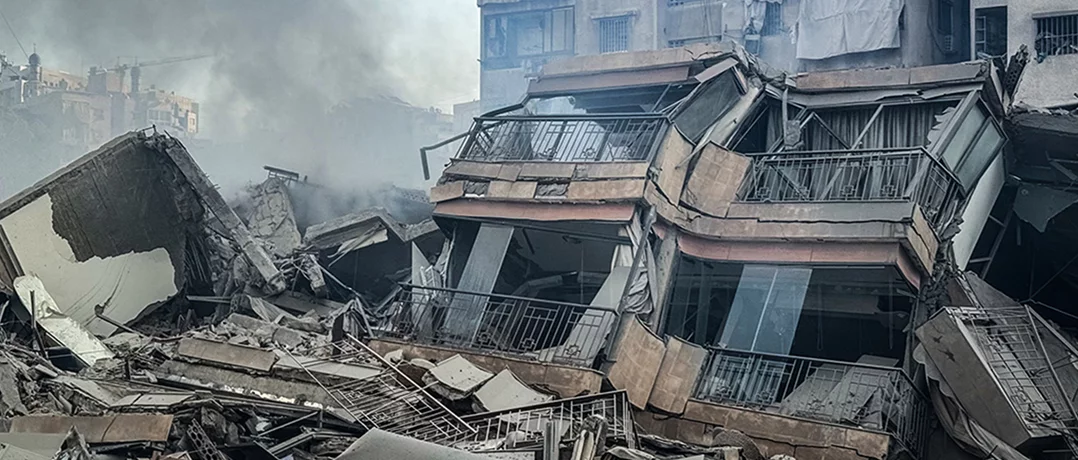
As the confrontation between Israel and Hezbollah intensifies, a growing question is haunting many Lebanese observers: could Beirut’s southern suburbs face the same level of devastation seen in Gaza during Israel’s war with Hamas?
The issue has moved from speculation to a serious national concern following recent Israeli evacuation warnings directed at all residents of the densely populated Dahiyeh, followed by a wave of airstrikes and increasingly severe rhetoric from Israeli officials.
For many Lebanese, particularly within the country’s Shiite community, the warning signals a dangerous new stage in the conflict. The southern suburbs of Beirut, home to hundreds of thousands of residents and widely considered a political and social stronghold of Hezbollah, have long been viewed as a potential target in any large-scale confrontation with Israel. Recent developments suggest that the risk of a major campaign against the area may now be closer than ever.
Escalating threats and evacuation warnings
The crisis intensified when the Israel Defense Forces (IDF) issued urgent evacuation orders to residents in several neighborhoods of Beirut’s southern suburbs. Civilians were instructed to leave their homes immediately and move either north toward Tripoli or east toward Mount Lebanon, while being warned not to travel south.
The warnings triggered widespread panic throughout the district. Within hours, residents rushed to leave the area, creating massive traffic congestion at the entrances to the southern suburbs. Families scrambled to gather belongings while attempting to reach safer areas in Beirut, Mount Lebanon, or further north.
Such evacuation orders have become a familiar feature of Israeli military operations in Gaza, where residents were frequently warned to leave areas before large-scale bombardment. For many Lebanese observers, the similarity in tactics has raised fears that the same military strategy could now be applied to Dahiyeh.
These concerns were amplified by statements from Israeli officials suggesting that the campaign against Hezbollah could escalate significantly if hostilities continue, with Israeli Minister of Finance Bezalel Smotrich warning, “Very soon, Dahiyeh will resemble Khan Younis.”
Airstrikes and military escalation
Shortly after the evacuation warning, Israeli aircraft carried out a series of intense airstrikes on targets within the southern suburbs. Reports indicated that multiple locations were hit overnight, part of a broader military campaign that has included dozens of waves of strikes since the beginning of the current confrontation.
The strikes came amid a wider escalation across Lebanon. Israeli forces have increased attacks in southern Lebanon and reportedly conducted ground movements near the border, signaling a potential expansion of military operations.
Israeli leaders have framed the campaign as part of a broader effort to dismantle Hezbollah’s military capabilities. The Israeli military leadership has stated that operations in Lebanon will continue until what it describes as the “threat” posed by the group is removed.
The political and strategic significance of Dahiyeh and the escalation
Beirut’s southern suburbs hold deep political, social, and symbolic importance within Lebanon. The area is not only densely populated but also serves as a major political and administrative center for Hezbollah, which maintains offices, institutions, and networks of social services there.
For Israel, this makes Dahiyeh a central target in any effort to weaken the group’s influence. During the 2006 July War, the district was subjected to heavy Israeli bombardment, leaving large parts of it destroyed (under the so-called “Dahiyeh Doctrine”) before reconstruction efforts began in the years that followed.
However, the scale of destruction seen in Gaza during the 2023-2025 war has raised concerns that any future campaign in the southern suburbs of Beirut could be far more devastating than previous confrontations.
For the Shiite population of Lebanon, which forms the majority of residents in the southern suburbs and large parts of southern Lebanon, the threat carries profound implications. The large-scale assault on Dahiyeh has displaced hundreds of thousands of civilians and created a humanitarian crisis in a country already struggling with economic collapse and political instability.
The situation also places the Lebanese state in a difficult position. Targeting an area adjacent to the capital and inflicting a massive humanitarian crisis would pressure the government, according to what Israelis perceive, to crack down of Hezbollah and achieve monopoly of arms across all Lebanese territories.
Such an escalation could also deepen sectarian tensions and further strain the country’s fragile political system. Large-scale displacement from the southern suburbs would place additional pressure on cities and regions already struggling to absorb waves of displaced people from southern Lebanon.
The possibility of reciprocal escalation also remains high. Hezbollah has already responded with rocket attacks and similar evacuation warnings directed at Israeli settlements near the border.
In conclusion, the question of whether Beirut’s southern suburbs could face the same fate as Gaza reflects the growing sense of alarm within Lebanon as the confrontation with Israel intensifies. The combination of evacuation warnings, heavy airstrikes, and increasingly severe rhetoric from Israeli officials has heightened fears that the conflict may be entering a far more destructive phase. Whether diplomacy and international pressure can prevent such a scenario remains uncertain.
-
-

-
The Beiruter
-
