



Iraq’s moves to place armed factions under state authority have revived debate over whether Hezbollah could eventually follow a similar path.
Will Hezbollah follow Iraq’s path on disarmament?
Will Hezbollah follow Iraq’s path on disarmament?
By The Beiruter | June 03, 2026

Reading time: 4 min
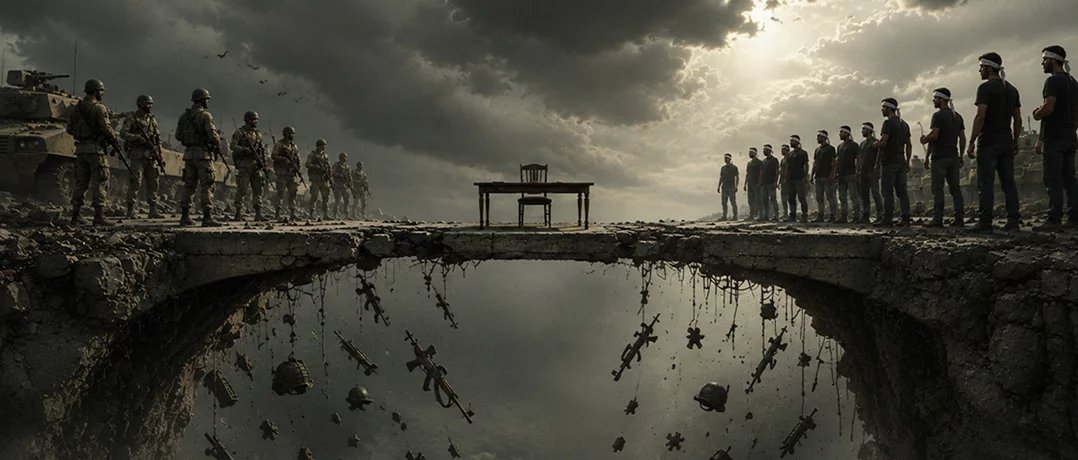
For decades, non-state armed actors have existed and proliferated in the Middle East, including in Lebanon and Iraq, establishing parallel structures that challenge state authority and legitimacy.
However, recent developments in Iraq have reignited this debate after several influential Shiite factions, including Asaib Ahl al-Haq and Saraya al-Salam, announced their willingness to place their weapons under state control and severe ties with the Popular Mobilization Forces (PMF).
From here, as Baghdad appears determined to ensure a monopoly over the use of force and strengthen state institutions, this consequently raises a parallel question in Lebanon: could Hezbollah eventually follow a similar path and agree to place its military capabilities and the decision regarding war and peace under the sole authority of the Lebanese state?
Iraq’s push for state consolidation
When Ali al-Zaidi was named Iraq’s prime minister-designate on 27 April 2026, he has made the issue of disarming all non-state armed actors and restoring state authority a cornerstone of bis political agenda. Indeed, he argued that Baghdad faces a fundamental choice between strengthening state institutions or allowing parallel military structures to continue operating outside government control.
His calls have resonated across various influential Shiite religious and political powers in the country. In Najaf, for instance, Grand Ayatollah Ali al-Sistani was among the first notable supporters, in line with his long-standing stance concerning the enhancement of state sovereignty across all territories. Nevertheless, the major breakthrough and turning point came as the influential Shiite cleric Muqtada al-Sadr, who leads a powerful movement in Iraq, announced that his Saraya al-Salam faction has dissociated from the PMF and would begin integrating into state institutions by handing over its weapons to the legitimate authorities. Soon after, Asaib Ahl al-Haq (headed Qais al-Khazali), Badr Organization (headed by Hadi al-Ameri), Kataib Sayyid al-Shuhada, Kata’ib al-Imam Ali, and Thar-Allah movement followed suit by announcing the possibility of their disarmament, but remained vague over how this objective would be achieved.
Nevertheless, Hussein al-Sheihani, member of the Sadiqoon movement’s politburo, the Asaib Ahl al-Haq’s political wing, said the ruling pro-Iran Coordination Framework “is preparing a draft decision that organizes the process to limit possession of weapons.”
However, major groups such as Kata’ib Hezbollah and Harakat al-Nujaba continue to reject disarmament, arguing that their weapons remain necessary as long as foreign military forces maintain a presence in Iraq.
What triggered this change of course?
The intentions proclaimed by the aforementioned Iraqi factions have not occurred in isolation. They are the result of a combination of domestic and foreign pressure, as well as changing regional dynamics.
First, some Iraqi factions increasingly view political participation and institutional influence as more sustainable than maintaining independent military structures. By integrating into state institutions, they can preserve political relevance while reducing the risk of direct confrontation with the government or international actors.
Second, Washington has repeatedly linked military cooperation and economic support to efforts aimed at limiting the power of Iran-backed factions operating outside formal state structures. Indeed, the appointment of United States (U.S.) Ambassador Tom Barrack as special envoy to Iraq will likely increase the pressure of P.M. Zaidi to effectively tackle the disarmament dilemma. In this context, Barrack praised the armed groups’ move to return their weapons to state authority, describing the decision as “a moral and patriotic stance that contributes to restructuring the rule of law and order.”
Third, the regional balance of power has shifted significantly over the past 3 years; namely in the aftermath of the 7 October attack in 2023 and the fall of the Assad regime in Syria in late 2024. The setbacks and considerable losses suffered by Iran and its regional allies (primarily Hamas and Hezbollah) have prompted many actors to reassess their policies and positions, creating a momentum for state consolidation of sovereignty and authority. Additionally, Iraqi leaders have become increasingly concerned that the continued existence of autonomous armed groups could expose Iraq to external pressure, economic consequences, and internal instability.
The Hezbollah dilemma in Lebanon
Although notable differences exist between Hezbollah and the aforementioned Iraqi factions, one can draw certain similarities between the two arenas.
Following the 2023 armed conflict between Hezbollah and Israel, the group has suffered from various losses; including with regards to its leadership, military personnel, and even the territorial losses incurred by Lebanon. This was only compounded when Hezbollah launched a support front for Iran on 2 March 2026 against Israel, whereby the latter expanded its military occupation in southern Lebanon from 5 posts to over 50 villages (amidst ongoing advances north of the Litani River). In this context, internal and external pressure have increased against Hezbollah and Iran; evident through the growing rhetoric in favor of state monopoly of arms and Iranian sentiments.
From here, and given the futility of war in achieving the intended outcomes (namely ensuring Israeli withdrawal from Lebanese territories, strengthening state institutions and sovereignty, and enhancing security and stability in Lebanon as a whole), supporters of Hezbollah’s disarmament point to Iraq as evidence that non-state armed groups can transition toward state structures without necessarily disappearing from political life. They argue that integration could preserve political representation while reducing the risks and anomalies associated with parallel military institutions.
Hence, the developments unfolding in Iraq represent a significant example of sincere efforts to restore state authority over non-state armed groups and reduce the influence of parallel military structures. Whether Hezbollah will eventually follow a similar path remains uncertain. Thus, the key question is whether Lebanon will replicate the Iraqi model, through political consensus or, if deemed necessary, coercive measures, benefitting from the changing domestic and regional dynamics.
-
-

-
The Beiruter
-
