



How one designer helped turn Beirut into the Arab world's couture capital, dressing Sabah, Georgina Rizk, Majida El Roumi and the stars who defined a generation.
William Khoury and the rise of Beirut couture

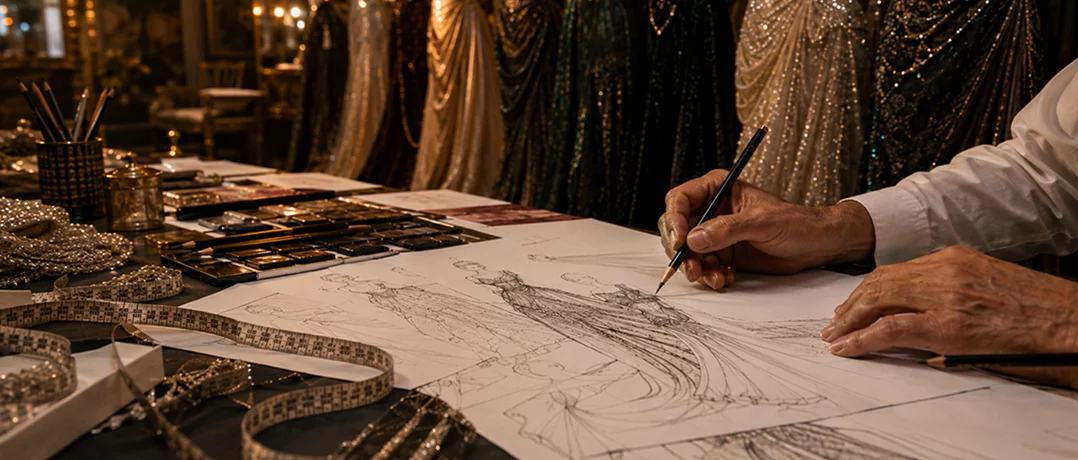
Throughout the 1960s and early 1970s, the Lebanese capital was one of the Arab world's busiest couture hubs. Performers, actresses and beauty queens would arrive with one request, a dress made in Beirut.
Among the designers they sought out was William Khoury. For nearly forty years, his creations shaped the image of the region’s most celebrated performers, from Sabah to Majida El Roumi, and even Georgina Rizk, leaving a mark on an entire generate
on and helping cement Beirut’s reputation as the Arab world’s couture capital.
The man behind Sabah's wardrobe
No partnership in Lebanese fashion history is more emblematic than Khoury’s collaboration with Sabah. Beginning in the 1960s, he crafted more than 400 gowns for the legendary performer, outfitting her for concerts, television appearances, films, and international tours.
Sabah was famous for never settling for ordinary stagewear. She often changed outfits several times during a single concert, and Khoury's atelier continuously produced new creations to match her larger-than-life presence. His embroidered evening gowns, extravagant abayas, richly embellished kaftans and bold silhouettes became inseparable from her public image, earning her a reputation as one of the Arab world's most elegant performers.
Long after many of those performances had ended, Khoury remained deeply attached to his work. He preserved around 100 of Sabah's dresses and later curated an exhibition at the Beiteddine Festival, selecting 25 gowns that traced the evolution of her career. More than a fashion exhibition, it became a tribute to one of the most celebrated collaborations in Lebanese cultural history.
Dressing Beirut's golden age
William Khoury's rise coincided with a period when Beirut had become the cultural capital of the Arab world. During the 1960s and early 1970s, the city attracted the region's biggest singers, actors and entertainers. Films were being produced in Lebanon, concerts filled venues like the Baalbeck International Festival and Casino du Liban, and Lebanese television reached audiences across the Middle East. Alongside music and cinema, Beirut's couture houses were flourishing.
Khoury quickly established himself as one of the city's leading designers. While his decades-long collaboration with Sabah made him a household name, his clientele extended far beyond a single star. He dressed some of the Arab world's most celebrated women, including Majida El Roumi, Salwa Katrib, Najwa Karam, Najah Salam, Samira Tawfik, and Iran's Empress Farah Diba, helping cement Beirut's reputation as a destination for haute couture.
His signature was the kaftan. Rather than treating it as traditional attire, Khoury transformed it into evening couture through rich embroidery, luxurious fabrics and bold silhouettes, earning him the nickname "The King of the Kaftan." His distinctive abayas became equally sought after, and together they reflected a style that blended Middle Eastern heritage with the elegance of European couture.
At a time when Lebanese fashion was beginning to reach audiences beyond the region, William Khoury was among the first generation of designers to give Beirut an international reputation, years before Lebanese names became fixtures on the world's fashion capitals.
When Lebanon captured the world's attention
In 1971, Lebanese fashion stepped onto the global stage when Georgina Rizk was crowned Miss Universe, becoming the first, and still the only, Lebanese woman to win the title.
One of the competition's most memorable moments was her appearance in a striking emerald gown by William Khoury. Bold, elegant and unlike the more conventional pageant dresses of the time, the design complemented her green eyes and quickly became one of the defining images of the 1971 Miss Universe competition. Decades later, it is still cited among the pageant's most iconic looks.
Rizk's victory placed Lebanon in headlines around the world, but it also drew international attention to Beirut's flourishing couture industry. At a time when the city was emerging as the Arab world's fashion capital, William Khoury's creations were already dressing some of the region's biggest stars. The gown worn by Georgina Rizk became another milestone in that story, proving that Lebanese couture could command the world's attention long before the country's designers became regular names on Paris runways.
A legacy stitched into Lebanon's fashion history
William Khoury's career extended beyond the Arab world. In 1980, at Paris' Gala de l'Élégance, legendary Lebanese hairstylist Loutfi Berberi won the competition's Grand Prix with a model wearing one of Khoury's creations, another sign that Lebanese couture was attracting international recognition long before today's fashion houses.
Much of that legacy, however, was lost during the Lebanese Civil War. Countless gowns disappeared as ateliers, private collections and archives were destroyed or scattered. What remains today survives largely through the work of collectors and historians such as Joe Challita, whose Lebanese Fashion History archive has helped preserve photographs, garments and magazines from that era.
William Khoury died in 2016, but his work remains woven into the story of Lebanese fashion. Long before names like Elie Saab and Zuhair Murad brought Lebanese couture to the world's biggest red carpets, designers like Khoury had already established Beirut as one of the Arab world's great capitals of elegance.
-
-

-
The Beiruter
-
