



The comeback of the Women’s Lebanon Cup marks a small but significant step in restoring women’s football in Lebanon, offering much-needed competitive matches after years of crisis and interruption.
Women’s Lebanon Cup returns

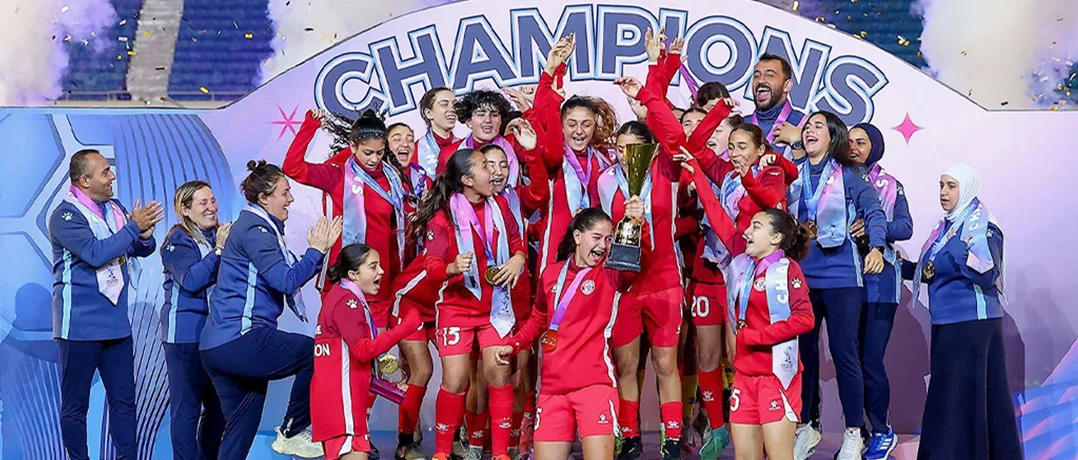
After four seasons in limbo, the Women’s Lebanon Cup is set to return, marking a cautious but meaningful revival for women’s football in the country. The tournament is back on the calendar of the Lebanese Football Association, with eight teams scheduled to compete in a straight knockout format starting February 15.
The last edition of the competition was held in 2022, when Eleven Football Pro claimed the title after a tense final against Beirut Academy that was decided by penalties. This year’s format maintains a high-pressure structure: single-match elimination in every round, no extra time, and penalty shootouts immediately determining the winner in the event of a draw. The preliminary round will be based on last season’s league standings, with winners advancing to the semifinals and, ultimately, the final.
Match dates and venues will be announced gradually by the LFA’s Competitions Committee. Even so, the broader message is clear: competitive women’s football is returning to the pitch.
Years of disruption, slow steps toward stability
The Cup’s return follows a prolonged period of disruption. According to Wael Gharzeddine, the LFA’s women’s technical director, the women’s game has been affected by overlapping crises that made continuity difficult to sustain.
“Political instability, the financial collapse, and last year’s war all played a role,” Gharzeddine said. “Competition periods were shortened, club budgets were extremely limited, and at the same time we had national team commitments with a fragmented calendar. It was very hard to maintain momentum.”
This season, he noted, conditions have improved, though only partially. “There is relatively more stability in some areas, and the calendar is clearer,” he said. “That gave us the space to start reorganizing competitions again, including the Cup.”
A young national team, short on minutes
Lebanon’s women’s national team reflects both the promise and the fragility of the domestic system. The squad’s average age stands at 19.2 years, even with experienced players such as captain Natalie Matar included in the group.
“The senior players raise the level, but overall, we’re dealing with a very young team,” Gharzeddine said.
Match fitness remains the team’s most pressing challenge. Several players were sidelined by injuries, and the domestic league has not been active since May 2025, leaving players without competitive football for approximately seven months.
“That lack of game time is one of our biggest challenges,” he said. “But it’s also why we’re optimistic. If these players keep preparing and get more minutes, they can become genuinely competitive in the coming years.”
At the youth level, the outlook is more encouraging. “In the U15, U17 and youth categories, when we compete within proper age groups, we’re competitive regionally and able to impose ourselves,” he added.
What the game needs most: stability
Asked what women’s football in Lebanon needs in order to grow, Gharzeddine pointed first to stability.
“You need a stable league, something close to a semi-professional structure,” he said. “Players need exposure, sponsors and continuity. They need to feel there’s a future, a sports career they can actually build.”
Within that context, the Women’s Lebanon Cup represents more than a single trophy. “It gives players additional competitive matches,” he said. “Playing for titles creates motivation and keeps players engaged and confident.”
Growing the base
Lebanon currently has 12 women’s teams, though not all compete at the senior level. Nine teams are active in the Women’s League. This season will also mark a first with the launch of an Under-15 girls’ championship. The competition will begin at the governorate level, with regional winners later advancing to a mini national league.
“That’s a crucial step for the pipeline,” Gharzeddine said, emphasizing that clubs remain the backbone of organization and development.
Standards, commitment and pathways
Selection for the national team, Gharzeddine said, is based on commitment as well as technical ability.
“Technical level matters, but so does commitment,” he said. “A talented player with low commitment is a problem. We’re setting standards, on the pitch and off it.”
For young girls entering the sport, pathways typically begin early. Many start in mixed academies with boys before transitioning to women’s teams between the ages of 11 and 12. The federation also organizes annual talent-identification festivals, particularly around International Women’s Day, in Beirut, the South and the Bekaa.
“These festivals help us increase participation and spot talent we can refer to clubs,” he said.
Rebuilding, one competition at a time
A broader development strategy, implemented in cooperation with the Asian Football Confederation and European partners, aims to raise standards, strengthen league structures and expand participation, particularly among younger age groups.
For women’s football in Lebanon, the return of the Cup is not a breakthrough moment. It is, however, a necessary one — a step toward rebuilding a game that has endured years of interruption and is gradually finding its footing again through structure, patience and long-term investment.
-
-

-
The Beiruter
-
