



Xi Jinping’s Egypt visit deepens strategic cooperation while testing Cairo’s balancing act between China, the United States, and regional interests.
Xi’s Egypt visit aims at shaping a strategic partnership
Xi’s Egypt visit aims at shaping a strategic partnership
By The Beiruter | September 02, 2026

Reading time: 5 min
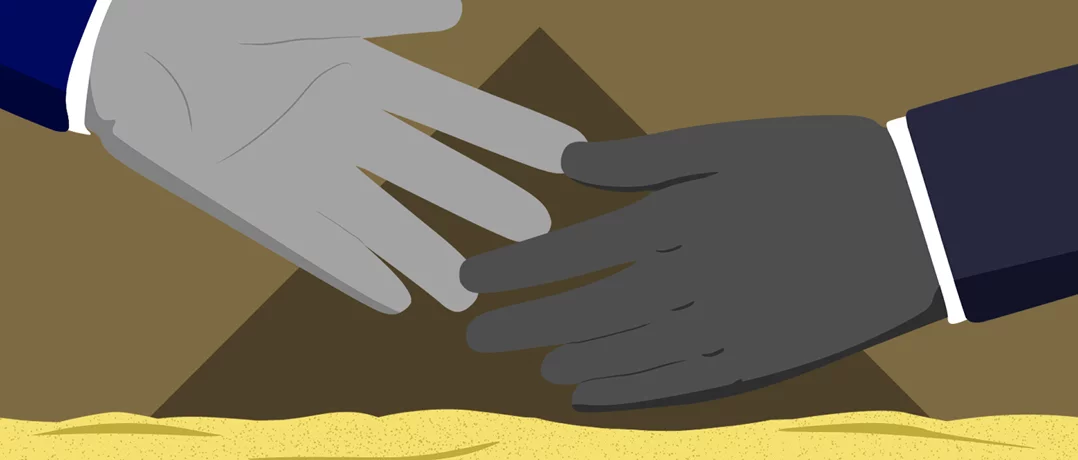
Illustration by Karim Dagher
Chinese President Xi Jinping’s state visit to Egypt, his first in more than 10 years, represents a significant milestone in the evolution of Sino-Egyptian relations. Taking place as the two countries commemorate 70 years of diplomatic ties, the visit comes at a time of heightened geopolitical competition between China and the United States (U.S.) and amid profound conflict and ongoing developments in the Middle East.
For Cairo, the visit is about far more than protocol or symbolism. It reflects Egypt’s long-standing strategy of maintaining balanced relations with major international powers while maximizing economic, political, and security opportunities. The visit therefore illustrates both the opportunities and challenges facing Egyptian foreign policy in an increasingly multipolar world.
Expanding economic and technological cooperation
Economic cooperation is expected to dominate discussions during Xi’s visit. Egypt hopes to attract additional Chinese investment in strategic sectors including renewable energy, electric vehicles, electronics manufacturing, logistics, artificial intelligence, and advanced industrial production.
Chinese companies increasingly view Egypt as a regional production hub due to its strategic geographic position connecting Asia, Africa, Europe, and the Middle East. The Suez Canal remains particularly valuable within China’s Belt and Road Initiative, serving as one of the world’s most important maritime trade corridors.
The two governments are also exploring greater use of local currencies in bilateral trade, expanded industrial cooperation, increased Egyptian exports to Chinese markets, and additional investments in infrastructure and logistics networks.
Such initiatives could help Egypt reduce pressure on foreign currency reserves while strengthening its role as a regional manufacturing and distribution center.
Growing defense cooperation and Israeli concerns
Beyond economics, military cooperation has become an increasingly visible aspect of Sino-Egyptian relations.
Shortly before Xi’s arrival, Egypt and China conducted the second edition of the joint air exercise “Eagles of Civilization 2026,” involving advanced multi-role combat aircraft operating from several Egyptian air bases. The deployment of modern Chinese fighter aircraft to North Africa demonstrated Beijing’s expanding military reach while highlighting Cairo’s policy of diversifying its defense partnerships.
Speculation has also intensified regarding possible Egyptian interest in Chinese defense systems, including J-10C fighter aircraft and long-range air-to-air missiles. Although no official procurement decisions have been announced, the discussions themselves have attracted considerable regional attention.
Israel has closely monitored these developments, expressing concern that expanding Egyptian-Chinese military cooperation could gradually narrow Israel’s long-standing qualitative military advantage. Israeli commentators have also highlighted China’s growing technological presence in Egypt, particularly regarding artificial intelligence, digital infrastructure, and strategic industries.
From Cairo’s perspective, however, diversification of military suppliers reflects a broader effort to strengthen national defense capabilities while reducing excessive dependence on any single source of advanced military equipment.
Balancing relations with Washington
Despite the expanding partnership with Beijing, Egypt continues to regard the U.S. as a critical strategic partner.
The two countries maintain extensive cooperation in military assistance, counterterrorism, regional security, diplomacy, and economic engagement. Egypt also continues to value its long-standing defense relationship with Washington, including access to advanced military technology and joint security coordination.
For this reason, Egyptian policymakers consistently stress that stronger ties with China are intended to complement, not replace, relations with the U.S.
Maintaining this balance, however, is becoming increasingly challenging as U.S.-China rivalry intensifies across technology, investment screening, artificial intelligence, and global supply chains. Decisions regarding sensitive technologies, telecommunications infrastructure, or advanced weapons acquisitions may increasingly require Cairo to navigate competing expectations from both powers.
Strategic balance as the foundation of Egyptian foreign policy
Since President Abdel Fattah El-Sisi assumed office in 2014, Egypt has increasingly described its foreign policy through the concept of “strategic balance.” Rather than aligning exclusively with one global power, Cairo has pursued diversified partnerships based on national interests, economic development, and political independence.
This approach allows Egypt to deepen cooperation simultaneously with China, the U.S., the European Union (E.U.), Russia, Gulf countries, and other Asian partners without formally joining rival geopolitical blocs. Egyptian officials argue that strategic balance does not mean equal distance from every power but instead maintaining multiple partnerships that enhance Egypt’s room for diplomatic maneuver and reduce dependence on any single partner.
Xi’s visit provides one of the clearest tests of this doctrine, as competition between Washington and Beijing has expanded beyond trade into technology, security, investment, and regional influence.
70 years of growing bilateral relations
Egypt occupies a unique place in China’s Middle East diplomacy. In May 1956, it became the first Arab and African country to establish diplomatic relations with the People’s Republic of China (PRC), laying the foundations for a relationship that has steadily expanded over 70 years.
Relations entered a new phase in 2014 when President El-Sisi and President Xi agreed to establish a Comprehensive Strategic Partnership. Xi subsequently visited Cairo in 2016, during which dozens of cooperation agreements covering infrastructure, transportation, energy, telecommunications, finance, and technology were signed.
Since then, bilateral engagement has accelerated considerably. China has become Egypt’s largest trading partner, with bilateral trade reaching approximately $20.8 billion in 2025. Chinese investment has expanded significantly within the Suez Canal Economic Zone, particularly around Ain Sokhna, where hundreds of Chinese companies now operate manufacturing and logistics facilities aimed at serving African, European, and Middle Eastern markets.
For Egypt, attracting Chinese investment supports industrialization, technology transfer, employment creation, and export diversification; which are key priorities under Egypt Vision 2030.
As international competition increasingly shapes regional politics, Egypt’s ability to sustain this multidirectional diplomacy will remain one of the defining features of its foreign policy. Xi’s visit therefore represents not only an important chapter in Sino-Egyptian relations but also a broader demonstration of Cairo’s effort to navigate an evolving international order through pragmatism, diversification, and the pursuit of national interests.
-
-

-
The Beiruter
-
