

Yemen’s government forces launch new offensives against the Houthis, reshaping battlefield dynamics and intensifying the struggle over strategic regions.
Yemen’s forces launch push to retake the country
Yemen’s forces launch push to retake the country
By The Beiruter | September 09, 2026

Reading time: 5 min
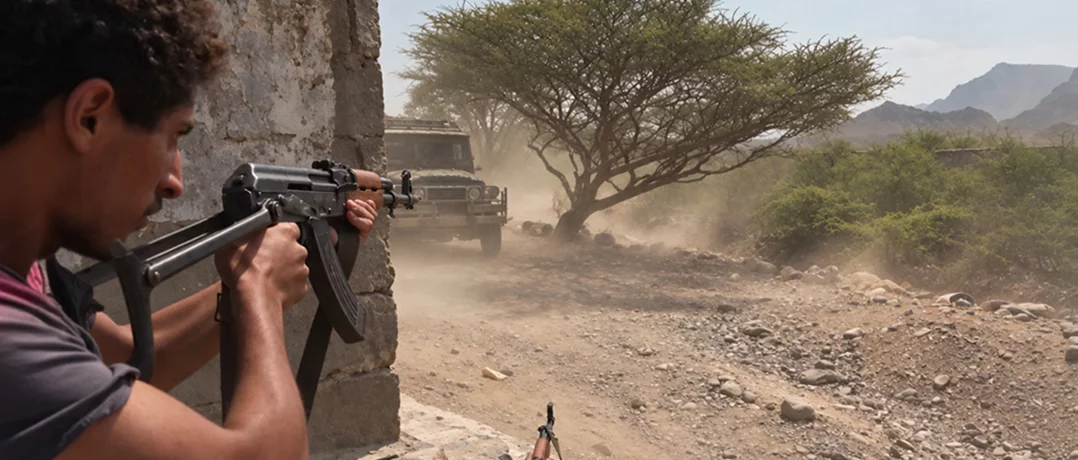
Yemen has entered a new phase of military escalation after government forces expanded their operations against the Houthi movement across several front lines, opening new battlefields in the northern and central parts of the country while continuing counterattacks along the western coast and in Taiz.
The latest developments mark a significant shift from defensive operations aimed at containing Houthi advances to coordinated military actions seeking to regain strategic positions. The most notable developments have taken place in Al-Jawf province, where government forces launched an operation to retake territory controlled by the Houthis, alongside a new offensive in Al-Bayda aimed at securing key mountainous areas and disrupting Houthi supply routes.
Government forces open new front in Al-Jawf
The most significant development occurred in Al-Jawf province, northeast of Sana’a, where Yemeni government forces announced the launch of a large-scale military operation aimed at reclaiming the province from Houthi control.
Government forces reported regaining control of the Al-Labanat military camp and surrounding areas east of Al-Hazm, the provincial capital, which has been under Houthi control. The area holds strategic importance due to its location near major military routes connecting Al-Jawf with other northern provinces.
The operation was reportedly carried out by units affiliated with the Sixth Military Region, supported by additional military formations. Houthi positions suffered significant setbacks during the fighting, with several fighters killed or captured. Among the fatalities were members of the Somali “Al-Shabaab” movement participating in the ranks of the Houthis, according to the military media of the government’s National Resistance.
The advance toward Al-Hazm represents a major military objective for government forces, as controlling the city would provide access to important supply routes and alter the balance of power in northeastern Yemen.
The operation was accompanied by calls from the Yemeni military leadership urging Houthi fighters to abandon their positions and surrender their weapons in order to avoid further casualties.
New battlefront emerges in Al-Bayda
At the same time, government forces opened a new front in Al-Bayda province, a strategically located region connecting several areas of northern, central, and southern Yemen.
Military officials announced that troops had captured several key locations, including the strategic heights of Haid Al-Khazzan and Al-Fulaihan, while advancing toward Al-Nasifa district and nearby villages.
The government forces’ progress in Al-Bayda focused heavily on controlling elevated terrain overlooking the Al-Zaher district. These positions provide military advantages because of their ability to monitor surrounding areas and influence movement between different fronts.
The importance of Al-Bayda extends beyond its local geography. The province borders 8 other governorates, including Marib, Shabwa, Abyan, Lahj, Al-Dhalea, Ibb, Dhamar, and Sana’a. Its location makes it a key corridor for military movements and supply networks.
For the Houthis, maintaining influence in Al-Bayda provides strategic depth and allows movement between central and southern fronts. For government forces, gaining control of the province could weaken Houthi connections between several battlefield areas.
Fighting continues along the western coast and in Taiz
While operations expanded in Al-Jawf and Al-Bayda, fighting continued along the western coast and in Taiz province.
Government forces and allied formations maintained pressure on Houthi positions in areas including Al-Barh, Maqbana, Sukam, and Al-Kadahah. One of the key objectives has been securing the road connecting Taiz city with the coastal city of Mokha, an important route linking inland areas with the Red Sea.
Government forces regained control of strategic locations, including Jabal Al-Koura in the Al-Kadahah front, after clashes with Houthi units.
The fighting in western Taiz has been particularly significant because of the area’s proximity to the Bab al-Mandab Strait, one of the world’s most important maritime passages. Control over surrounding highlands allows forces to influence movement toward the coast.
Government forces also reported intercepting Houthi reinforcements heading toward frontline positions, including military vehicles and equipment intended to support operations in western Taiz.
Meanwhile, fighting in several areas has created new displacement. Local residents from parts of Taiz province fled their homes due to artillery exchanges and clashes, with humanitarian organizations reporting thousands of families affected by renewed violence.
Strategic importance of the new offensive
The expansion of military operations across multiple fronts reflects an attempt by government forces to prevent the Houthis from concentrating their strength in a single area.
Al-Jawf, Al-Bayda, Taiz, and the western coastline represent interconnected battlefields where control over territory affects supply routes, military mobility, and access to strategic locations.
Al-Bayda, in particular, has gained renewed attention because of its geographical position between northern and southern Yemen. A successful government advance there could place pressure on Houthi positions in surrounding provinces and disrupt movement between several fronts.
However, controlling territory remains only one part of the challenge. Previous phases of the conflict have shown that maintaining captured areas requires effective coordination, reliable supply lines, unified command structures, and cooperation with local communities.
With new operations launched in Al-Jawf and Al-Bayda, alongside continued battles in Taiz and the western coast, Yemen’s conflict has entered a more active military phase. The government’s efforts to regain strategic positions are aimed at reversing recent Houthi advances and reshaping battlefield dynamics, while the Houthis continue to defend areas considered vital to their military and political influence.
As fighting spreads across multiple regions, the outcome of these battles could have major implications for Yemen’s internal balance of power and the wider security situation surrounding the Red Sea and Bab al-Mandab maritime corridor as well as Iran’s waning influence in the Middle East.
-
-

-
The Beiruter
-
