



How South Lebanon’s cultural scene is being reshaped by Zefta Arthouse in Nabatieh, an initiative of the Dar Zefta Foundation spotlighting local artists and community-driven creativity.
Zefta arthouse marks a shift in South Lebanon’s cultural landscape
Zefta arthouse marks a shift in South Lebanon’s cultural landscape
By The Beiruter | February 06, 2026

Reading time: 3 min
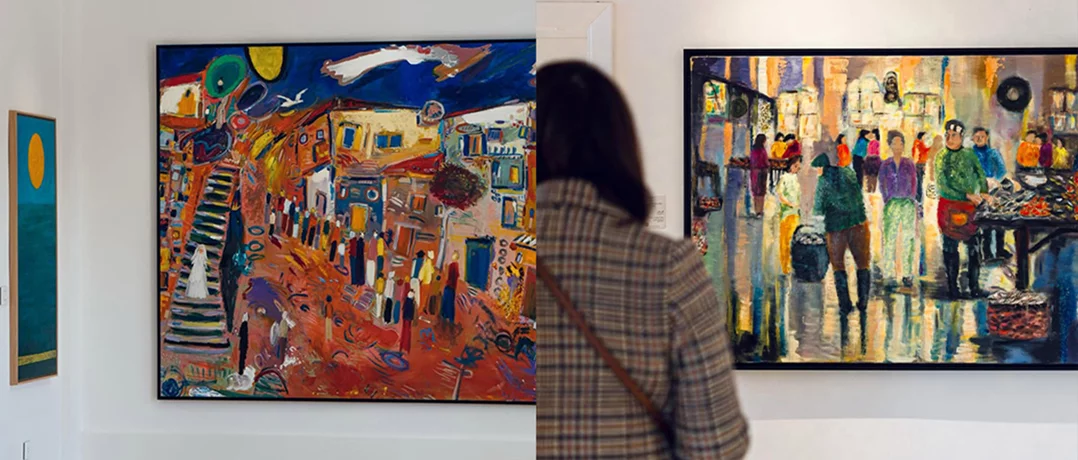
Cultural life in South Lebanon has long unfolded at the margins, formed by geographic distance, limited infrastructure, and, more recently, the shadow of war. While the region has consistently produced artists, collectives, and deep creative traditions, Lebanon’s contemporary art scene has largely orbited Beirut, where galleries and cultural institutions have historically been concentrated.
Experiencing or exhibiting art typically requires traveling to the capital, placing cultural life out of reach for many. Coverage of the south today often centers on destruction and displacement, leaving little room for its artistic production to come into public view.
It is against this backdrop of underrecognized cultural energy that the recent opening of Zefta Arthouse in Nabatieh marks a notable shift in Lebanon’s creative terrain. An initiative of the Dar Zefta Foundation, a nonprofit focused on community renewal, Zefta Arthouse reflects a broader commitment to advancing cultural development across South Lebanon. Project coordinator Mohammad (Mowie) Aoun described the space as an effort to connect the south to the wider country and the world, and to highlight forms of beauty that often go unnoticed. “Art is the softest power,” he said. “It is a way of living and should be integrated into our lives.”
Aoun stressed the importance of creating cultural opportunities for residents who may not have the means to regularly leave the south, arguing that they should also be part of a broader creative movement. That urgency was echoed by Nour Ballouk, one of the exhibition’s curators and a gallery owner in Nabatieh. Although the south is home to numerous art collectives, she noted that many artists are forced to sell or exhibit their work in Beirut due to the lack of local galleries. Since the 2019 economic crisis shuttered most cultural spaces in the area, Ballouk said, even attending an exhibition has become a kind of “cultural trip” for residents, an event in itself rather than an everyday possibility.
Zefta Arthouse aims to establish what Aoun described as a “creative engine” capable of generating a new cultural wave in the south. At its core, he views the project as an act of cultural empowerment, intended to inspire communities, cultivate hope, and encourage further artistic production. “Communities are built on art and culture,” he said. “We should encourage our communities to create more.”
Art From the South Takes Center Stage
The opening exhibition at Zefta Arthouse featured 80 works by 24 artists, all with roots in South Lebanon, and sought to activate the space ahead of the arthouse’s first residency, scheduled to begin in March. The artists represented a wide range of experience, from early-career practitioners to long-established figures. Rather than imposing an overarching theme, the exhibition invited participants to present their work independently.
Even without a unifying concept, conversations with several of the artists revealed how deeply Lebanon’s south informs their work. “Being from the south makes my art colourful,” said Rola el Hussein, an artist originally from the town of Al-Loubieh. While el Hussein does not view her work as socio-political and emphasizes that she never mixes “ideology and art,” she cited the region’s nature, colors, and sunlight as central influences.
Hussein Hussein, another participating artist and an art instructor at the Lebanese International University, offered a similarly grounded perspective. Originally from Ain Baal, he described his landscape paintings as explorations of “layered time” and a way of expressing places in constant evolution. His subjects, he said, are all around him. Through color, light, and shifting sunlight, he reflects the wadaa al-janub the lived “situation in the south” in each composition.
For Darwiche Chamaà, an artist from Nabatieh, the landscape and daily rhythms of the south are equally central. He described his process as moving beyond reproduction, using the landscape instead as a lens through which ideas and emotions take shape. “What I see and fear can all be reflected in the landscape,” he said.
Chamaà, whose work has been exhibited internationally in France, New York, and Miami, noted that art exhibitions remain rare in South Lebanon. Challenging prevailing perceptions of the region, he emphasized the importance of making visible both artists and artistic production in the south. “We have to show to other Lebanese and countries that here in the south we can find artists who are educated and love life and art,” he said.
The works of el Hussein, Chamaà, and Hussein alongside those of the other 21 artists featured in the opening exhibition underscore the need to restore a fuller narrative of the south, one rooted not in destruction but in creation. The region’s cultural life has always been present. What it lacked was a space willingness to recognize it and bring it into view.
-
-

-
The Beiruter
-
