

From cafés to co-working spaces, a growing preference for low-effort connection is reconfiguring how social life is structured and experienced.
“Ambient socializing” and the rise of low-effort connection
“Ambient socializing” and the rise of low-effort connection
By The Beiruter | April 27, 2026

Reading time: 4 min
The last six years since the outbreak of the Covid pandemic have redefined not only how people connect, but what they expect from connection. In 2024, the American Psychological Association reported that younger adults continued to experience higher levels of stress and social disconnection than older cohorts, even as in-person activity had largely resumed.
Two years later, that pattern has not fully reversed. Recent studies on hybrid work and co-working environments point to a growing preference for communal spaces that do not require direct interaction. The trend is often described as “ambient socializing,” a term that has emerged in recent years to capture forms of low-intensity connection built on shared presence rather than conversation. What appears as a shift in behavior, patterns across post-pandemic work and social environments suggest, reflects a broader adjustment in how social life is approached.
Presence without pressure
Although the term itself is recent, the dynamics ambient socializing describes are not entirely new. The concept draws on established ideas in sociology and psychology, including “co-presence,” associated with Erving Goffman, and “third places,” introduced by Ray Oldenburg to describe informal public settings where social life unfolds beyond the home and workplace. In these frameworks, social value is not derived solely from interaction, but from the experience of being among others. Ambient socializing extends this logic, adapting it to contemporary conditions in which attention is more divided and interaction less expected.
Where traditional social life is built around participation, requiring attention, responsiveness, and a degree of social performance, ambient socializing removes those expectations. Individuals sit alongside others while working, scrolling, or resting, with no obligation to speak.
What makes this shift notable is not just the behavior itself, social psychologists have noted, but the appeal. In an environment where social interaction can feel demanding, being able to opt into presence without committing to engagement offers a lower threshold for connection.
The appeal of low effort connection
Low-effort forms of connection are not simply a preference, but a response to changing social conditions. A 2026 international study led by researchers at Washington University in St. Louis found that nearly half of young adults report feeling lonely, even as opportunities for in-person interaction have largely returned. Digital communication has enabled constant, low-stakes contact, while more flexible work and study environments have normalized extended time spent in shared but non-interactive settings.
Research helps explain why this dynamic persists. In a series of experiments conducted by researchers at the University of Chicago, participants were asked to initiate brief conversations with strangers in everyday settings such as trains and waiting rooms. Most anticipated that the interaction would be awkward or unwelcome. In practice, both parties reported the opposite. Conversations were consistently rated as more enjoyable than expected.
The researchers concluded that people “systematically underestimate” how positive these interactions will be. That miscalibration creates a gap between expectation and experience, making avoidance more likely even when the outcome would be positive. Ambient socializing can be understood, in part, as a response to that gap, offering a way to remain socially present without confronting the perceived costs of interaction.
Why being around others still works
Even without direct interaction, the presence of others continues to carry measurable social effects. Research on post-pandemic work and study environments has pointed to the continued importance of shared physical space, even in the absence of interaction. A 2023 study on hybrid work patterns, published in Nature Human Behaviour, found that individuals who incorporated regular time in shared environments reported stronger feelings of connection and engagement than those who remained fully isolated, despite similar levels of digital communication.
What is notable is how participants described the effect. The benefit was not tied to conversation or collaboration, but to awareness. Several described a “background sense of others,” while others framed it more plainly as feeling “less alone” without necessarily being social. These descriptions point to a distinction between interaction and co-presence. The former involves exchange, while the latter operates more subtly, affecting attention, mood, and a sense of belonging without requiring active participation.
A recalibrated social life
For Gen Z, this model of connection reflects a broader recalibration of social life, where interaction is no longer assumed but engaged in selectively. As these patterns suggest, the result is a form of social participation that places less emphasis on conversation and more on proximity.
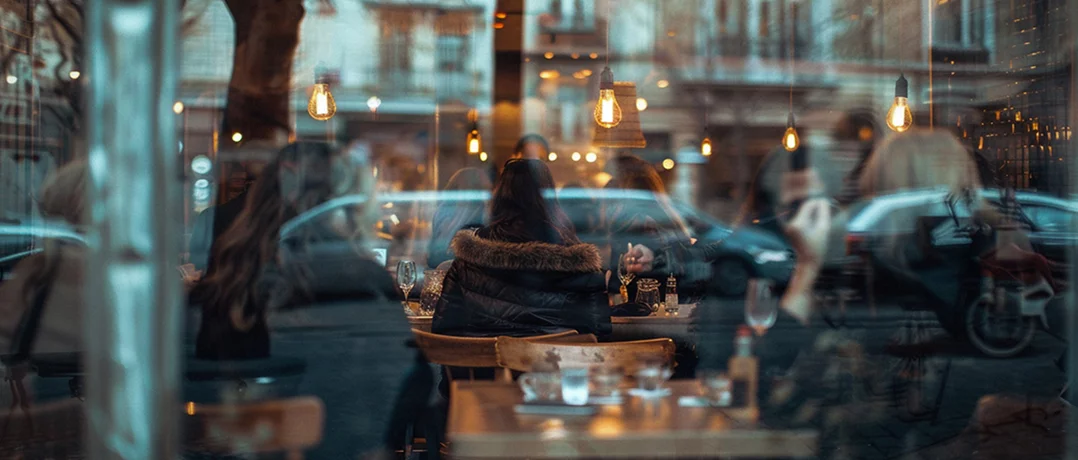
In everyday settings, a crowded café where no one is speaking may appear disengaged, but often reflects a different understanding of what it means to be social. Rather than replacing traditional socializing, ambient socializing therefore functions as a complementary alternative to it, one that aligns with changing expectations around time, attention, and social energy.
-
-

-
The Beiruter
-
