



“Saraya al-Thabat” signals a new escalation phase, exposing Lebanon’s deep sovereignty crisis as armed factions expand operations, turning the country into a fragmented battleground shaped by external agendas and conflicts.
“Saraya al-Thabat”: a new front for an existing axis
“Saraya al-Thabat”: a new front for an existing axis
By The Beiruter | April 10, 2026

Reading time: 4 min
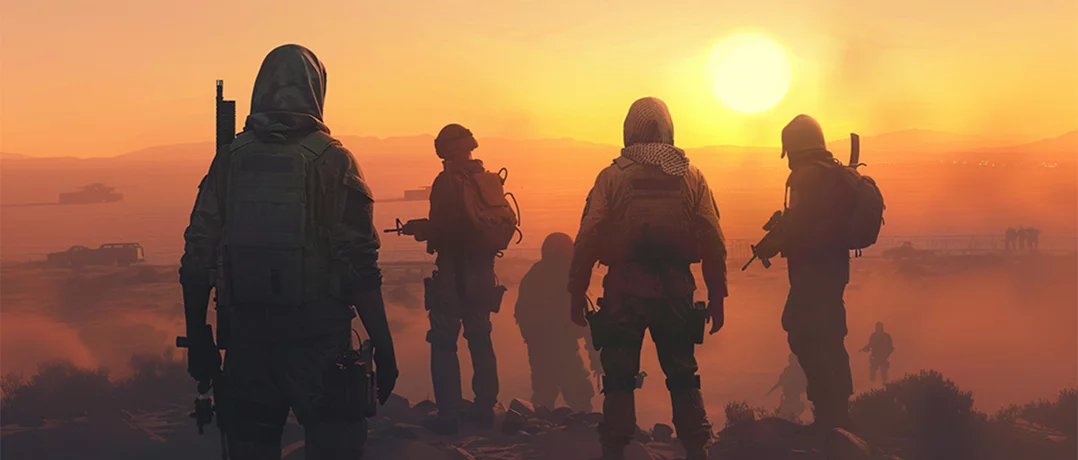
Source: Nida Al Watan – Tarek Abou Zeinab
Lebanon’s exclusion from any understanding cannot be separated from a deep sovereignty crisis, as the decision of war and peace is no longer in the hands of the state but has become hostage to de facto powers. With “Hezbollah” continuing to operate as a military force linked to Iran’s Revolutionary Guard, the state has lost its ability to impose an internal balance that would allow it to sit at the negotiating table as an independent party.
This structural imbalance has turned Lebanon into a card in the hands of others, used when needed and discarded during settlements. It is neither a partner in decision-making nor insulated from its consequences, placing it in an extremely dangerous position with every regional escalation.
The most notable development lies in the announcement by the faction “The Islamic Resistance in Syria – Saraya al-Thabat” of carrying out military operations against US forces in Lebanon and Syria, in addition to Israeli targets. According to field data, this faction operates from the Lebanese-Syrian border, in clear coordination with Hezbollah and Iran’s Revolutionary Guard.
This development reveals a new phase in conflict management, based on multiple fronts and a distribution of roles, whereby the scope of operations is expanded without assigning the full political cost to a single party. It is a known strategy, but its danger today lies in its use from within Lebanese geography.
Messages beyond borders
Notably, the faction did not limit itself to announcing its operations, but also confirmed the use of loitering attack drones that accurately struck their targets. This is not merely a technical detail, but an indication that the conflict is moving to a more complex level, where technology plays a fundamental role in shaping deterrence equations.
More dangerously, these operations are conducted outside the framework of the Lebanese state, meaning that any response to them may affect Lebanon, even if the decision was not Lebanese. Here, the country becomes an arena for responses rather than a decision-making actor, exacerbating its fragility and placing it under constant threat.
Lebanon as an open platform for factions
What is happening today goes beyond the presence of a single faction or a military operation. We are witnessing a reality that is gradually taking hold: Lebanon as an open platform for armed factions tied to regional agendas, foremost among them the Quds Force.
This multiplicity of factions does not strengthen Lebanon but fragments its sovereignty and turns its territory into a space of continuous confrontation. With overlapping agendas, it becomes difficult to distinguish between what is a Lebanese decision and what is an extension of external conflicts, in a scene that reflects the collapse of political boundaries in favor of an imposed security reality.
A paralyzed state… and mounting pressures
In light of this situation, the Lebanese state appears incapable of keeping pace with the challenges. A suffocating economic crisis, weak institutions, and political divisions obstruct any decisive action. With every regional escalation, the likelihood increases that Lebanon will turn into a theater of direct or indirect confrontation.
This reality also opens the door to growing international pressure, which may take the form of sanctions or political interventions under the banner of restoring internal order, particularly with regard to militia weapons and the role of legitimate institutions.
Inside the circle of explosion
Lebanon’s exclusion from any regional settlement does not mean neutrality; quite the opposite. It remains exposed to all the repercussions of conflict without possessing the ability to influence its course. This is the most dangerous paradox: a country outside the solutions, yet at the heart of crises.
This reality entrenches a dangerous equation: the closer the region moves toward de-escalation, the greater the risk of an explosion within Lebanon, as it remains the weakest link that can be used to release tensions.
The moment of decision
Lebanon today faces two choices with no third option: either to continue as a platform for others’ conflicts or to reclaim its sovereign decision by restoring the role of the state and its institutions. But this choice is no longer theoretical; it has become a matter of time in light of rapidly unfolding regional developments.
Delaying the resolution of this structural imbalance will make any future explosion more costly, not only in security terms but at the level of the state’s very existence. States that lose their decision-making power gradually lose their position, then their role, and ultimately their ability to exist outside the will of others.
The picture today is clear to those willing to see: Lebanon is not only outside ceasefire agreements but outside the entire equation of decision-making. It is a country governed more from the outside than from within, used in conflicts over which it has no control.
The danger is no longer a possibility but a reality gradually taking shape. If this trajectory continues, the question will no longer be when the situation will explode, but how… at what cost… and who will pay the highest price.
-
-

-
The Beiruter
-
