



From Saint Helena and the story of the Cross to bonfires, fireworks, scouts, choirs and village traditions, this article looks at how Eid el-Salib has grown into one of Lebanon’s most distinctive celebrations of history, culture and community.
Why Lebanon lights its mountains for Eid el-Salib
Why Lebanon lights its mountains for Eid el-Salib
By Michella Rizk | September 13, 2026

Reading time: 6 min
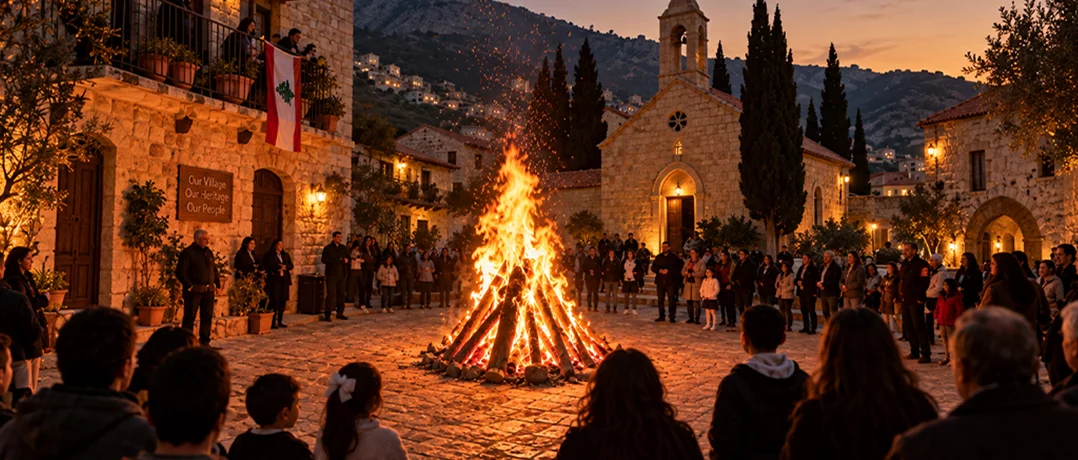
Every September, as summer begins to loosen its hold on Lebanon, fires appear across the mountains.
On the evening of September 13, flames rise from church courtyards, village squares, rooftops and hilltops. Children gather around them, families come outside, church bells ring, and from one village, another fire can sometimes be seen burning across the valley.
The following day, Christians celebrate the Feast of the Exaltation of the Holy Cross, known across Lebanon simply as Eid el-Salib.
For many Lebanese, the feast is inseparable from those fires. But behind one of the country's most recognizable religious traditions lies a story stretching back nearly 1,700 years, from fourth-century Jerusalem to the churches and mountains of Lebanon.
At its heart, according to Father Neemtallah Moukarzel, is a distinction that is easily lost: Christians are not celebrating suffering.
"We call it the Feast of the Exaltation of the Cross, not simply the Feast of the Cross," Father Moukarzel told The Beiruter. "We are not celebrating pain itself, nor are we glorifying the instrument of suffering on which Christ died."
Instead, he said, the meaning lies in what the Cross came to represent.
We do not venerate the Cross because it was an instrument of torture. We venerate it because Christ transformed it from a symbol of death and humiliation into a symbol of love, salvation, life and resurrection.
From an instrument of death to a symbol of life
Crucifixion was one of the Roman world's most brutal forms of execution. Christianity would eventually take that instrument of punishment and place it at the center of its faith.
For Father Moukarzel, that transformation is at the heart of the feast. The Cross, he said, represents “the victory of love over evil, forgiveness over hatred, and life over death”, the meaning behind its Exaltation.
The celebration itself traces its roots to fourth-century Jerusalem.
Christian tradition holds that Saint Helena, the mother of Roman Emperor Constantine, travelled to the Holy Land in search of sites associated with the life, crucifixion and resurrection of Jesus Christ.
Around 326, excavations near Golgotha are said to have uncovered three crosses. According to church tradition, the Cross believed to be that of Christ was identified through a miraculous sign, including in one account the healing of a gravely ill woman.
Constantine later commissioned a church complex at the site of Christ’s tomb and Golgotha. The Basilica of the Resurrection, part of what became the Church of the Holy Sepulchre, was dedicated in 335, and September 14 became associated with the public elevation and veneration of the Cross.
"By the sixth century, we already have homilies by Church Fathers in Antioch about the Feast of the Exaltation of the Cross on September 14," Father Moukarzel said. "That tells us how old this feast is in our Church and in the East."
In 614, Persian forces captured Jerusalem and carried away the relic venerated as the True Cross. It remained in Persian hands for years before Byzantine Emperor Heraclius recovered it and returned it to Christian possession. The restoration of the Cross to Jerusalem became another event remembered in connection with the September feast.
But in Lebanon, the story of the Cross became tied to something far more visible: fire.
Why does Lebanon light fires?
Ask many Lebanese why fires are lit for Eid el-Salib, and a familiar story follows.
One popular Lebanese tradition holds that, when Saint Helena discovered the Cross in Jerusalem, fires were lit on mountain peaks to relay the news toward Constantinople, where her son Constantine was emperor.
One flame signaled to the next, and then to another, creating a chain of light across the landscape.
In Lebanese tradition, the country's mountains became part of that story.
Father Moukarzel recounts the custom in the same way: "It was a sign," he said, "a sign of joy that the Cross had been found."
Its symbolism, however, remains powerful.
"The fire is always connected to light," Father Moukarzel said.
Today, that fire also symbolizes the light of Christ, the light of his Cross.
It is perhaps why the practice has survived so visibly.
In many villages, fire once served purposes beyond celebration. Older generations recall lighting fires when the first snow reached the high peaks, a signal to neighboring villages that winter was on its way. Long before phones and weather forecasts, light on a distant mountain could carry a message across the valley.
That same geography gives Eid el-Salib much of its character. On September 13, preparations often begin hours before sunset. Scouts and youth groups collect branches and wood for the bonfire, while parish communities prepare the evening program around the church.
What was once a simple gathering around the flames has, in many places, grown into a larger community celebration. Choirs rehearse hymns and worship songs, youth groups prepare dances of praise, and families gather in church courtyards and village squares for prayers, music and activities before the fire is lit.
In some villages, the night also takes on a playful competitive edge, with neighboring communities trying to outdo one another with larger bonfires and more elaborate fireworks displays. Bursts of color rise above the hills as one village answers another across the valley.
The younger generation is often at the center of it all: carrying the wood, organizing the celebration and continuing a tradition they first experienced as children.
And when darkness falls, the landscape still plays its part. From one village, another fire can often be seen glowing on a neighboring hill, keeping alive an old Lebanese habit of using the mountains themselves to pass light from one community to the next.
The timing of Eid el-Salib has also made it a marker of transition in Lebanon. By mid-September, mountain evenings begin to cool, summer gatherings wind down and families turn toward autumn, winter preparations and the mouneh. For the Maronite Church, September 14 also opens the Season of the Holy Cross, carrying the liturgical year through the autumn before the Church turns toward the Annunciation.
Carried beyond Lebanon
Lebanese communities abroad have carried parts of the tradition with them as well. In Maronite parishes across the diaspora, the feast is still marked by the Divine Liturgy, the elevation of the Cross and community gatherings.
Where bonfires are possible, some communities recreate the practice; elsewhere, candles and smaller celebrations preserve the symbolism and offer families another link to the villages and churches they left behind.
“Not every pain is a cross”
For Father Moukarzel, however, Eid el-Salib ultimately goes beyond fires, traditions and historical memory.
“The Cross is a school of love,” he said. “I want to love even when love is costly. I want to forgive even when forgiveness is difficult. I want to remain faithful to what is good even when I do not see an immediate result in my life.”
That message, he believes, is particularly important when speaking to younger generations.
The Christian idea of carrying one’s cross, he stressed, should not be understood as seeking out suffering or accepting pain for its own sake.
“The Cross does not mean that I go looking for suffering,” he said.
It means that I refuse to allow suffering to turn me into someone who no longer loves.
Then comes the distinction he considers essential.
“Not every pain is a cross,” Father Moukarzel said. “Pain becomes a cross when, through that pain, I continue to live love and find strength through God.”
-
-

-
Michella RizkContent Manager/WriterFocusing on social affairs.
-
