



A cathedral built in Tyre around 315 AD left behind more than stones: through Eusebius of Caesarea’s words, it reveals Lebanon’s deep Christian roots, its forgotten architectural legacy and a history stretching back seventeen centuries.
The Cathedral of Tyre: Seventeen centuries of faith
The Cathedral of Tyre: Seventeen centuries of faith
By Dr. Elie Elias | September 13, 2026

Reading time: 6 min
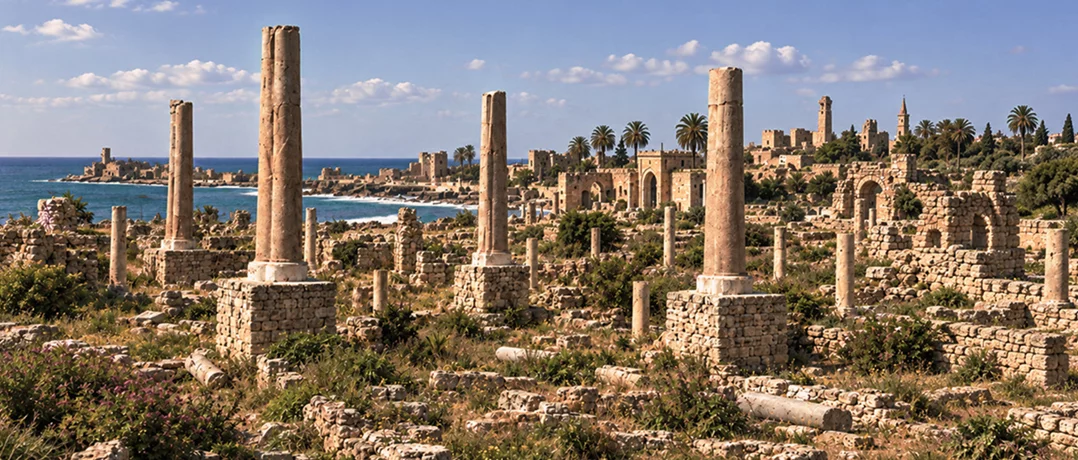
Around 315 AD, on the coast of what is now south Lebanon, a city dedicated a new cathedral. Someone gave a speech at the ceremony. That speech survives, and it is the oldest surviving description of a church interior anywhere in the world. It describes a church in Lebanon, more than three hundred years before the Arab conquest reached these shores.
Picture Tyre in that year. The Roman Empire has just stopped killing Christians and has not yet decided what to do with them instead.
The city's bishop, Paulinus, has finished an enormous building project - a basilica so large and so richly finished that visitors will still be describing it a century later. Bishops have travelled in from across the region for the dedication. Everyone of rank gives an address.
One of them is a bishop from Caesarea named Eusebius. He is about fifty-five. He will become the most important historian of the early Church. And when he writes up the day, he introduces himself with the smoothest false modesty in late antiquity: "a certain one of those of moderate talent." He then speaks for what would take the better part of an hour.
To understand why a building could carry that weight, rewind twelve years.
In 303, Diocletian's first edict ordered church buildings demolished and the scriptures burned. Tyre took it hard. The city's own bishop, Tyrannion, but Eusebius was personally present in Tyre and watched some of the executions in the arena.
He set it down in Book VIII of his Ecclesiastical History: five men, scourged, then pushed out in front of a bull goaded with hot irons, then leopards, bears, boars. When the animals would not finish the work, soldiers used swords. The bodies were thrown into the sea rather than buried.
So the man consecrating a cathedral in 315 had stood in that same city a decade earlier and watched people die for the faith the building was raised to.
Paulinus, Eusebius notes with open admiration, could have built somewhere easier. Other plots were available in the city. He chose the old site instead - the one his enemies had buried under rubble - and cleared it. Rebuilding on the ruin was the entire point.
Then comes the passage historians of architecture treasure, because nobody else from that century thought to write it down. A wall enclosing the whole compound. A high entrance porch facing the rising sun, deliberately open enough that passers-by could see straight through to the interior; Eusebius says the sight itself was meant to draw strangers in. A colonnaded courtyard open to the sky, with fountains, so that no one entered the sanctuary with unwashed feet. Three doors into the church proper, the central one plated in bronze and iron-bound, made taller and wider than the others so that they flanked it, in his phrase, as guards for a queen. Carved windows above. Marble paving in every variety. Thrones and benches set in order, and at the centre the altar, fenced with carved wooden latticework.
And the roof was cedar. Eusebius cannot resist it: he quotes the Psalm about the trees of the Lord and the cedars of Lebanon which he has planted. A Lebanese cedar roof over a Lebanese church, and the preacher makes the connection himself, in 315.
Then he does something a building dedication does not prepare you for. He spends the second half of the sermon arguing that the building is not the point.
The true temple, he says, is made of people - living and moving stones. He walks through the congregation as though it were architecture: the ordinary faithful are the outer wall, those who welcome newcomers are the vestibule, the catechumens are the side aisles, the mature are the inner columns. The altar is not the marble; it is the soul of the priest who serves it.
It is a strange and beautiful piece of preaching, and it lands harder once you remember that he had watched that congregation slaughtered.
Eusebius was born around 260 and died around 340. His teacher - the man who formed him and whom he called his father - was Pamphilus, a scholar from Beirut who settled in Caesarea and built a great library there. Pamphilus was arrested in 307 and martyred. Eusebius survived, and spent the rest of his life writing.
His Ecclesiastical History is the reason we know most of what we know about the first three Christian centuries. He sat at the Council of Nicaea in 325. He delivered the official address for Constantine's thirtieth anniversary in 335. Historians argue about his credulity and his politics - he swallowed some obvious forgeries, and he wavered over Arianism - but nobody argues about his importance. The Tyre sermon sits in Book X, the final book, the one he wrote as a witness rather than a compiler.
Tyre was not a lucky outpost. It was a metropolitan see governing fourteen bishoprics. When the bishops gathered at Nicaea in 325, the delegation from the province of Phoenicia included the bishops of Tyre, Sidon, Tripoli and Beirut. Ten years later the emperor convened a full council at Tyre itself, the one that condemned Athanasius of Alexandria. And the city kept building: two centuries after Paulinus, the acts of a synod held at Tyre in September 518 are still naming its churches one by one.
Origen, the towering theologian of the third century, died around 253, most probably at Tyre; local tradition long placed his tomb behind the cathedral altar, though that belongs to tradition rather than to the record. And the coast had been Christian ground well before any of it. Paul stopped at Tyre for a week on his way to Jerusalem and found believers already there, in the 50s AD. The Gospels place Jesus himself in the district of Tyre and Sidon.
Now do the arithmetic. Cathedral dedicated, around 315. Arab conquest of the Phoenician coast, 636 to 640. That is more than three hundred and twenty years of organised, institutional, cathedral-building, council-hosting Christianity in these cities before the conquest - and close to six hundred if you start counting from Paul's visit. Three centuries is not a footnote.
Tyre is an episcopal seat three times over today - Maronite, Melkite Greek Catholic, Greek Orthodox - three archbishops in one small city on the same coast. Its Maronite cathedral, Our Lady of the Seas, was raised beside the harbour in the nineteenth century on the foundations of an older church: exactly the instinct Paulinus had, to build on the old ground rather than take the easier plot. The Christian quarter still stands in the heart of the old city, still lived in. When evacuation orders reached Tyre in the latest war, its bishops wrote jointly and publicly, asking that the old quarter be spared.
Seventeen centuries. Persecution, conquest, earthquake, occupation, war, and evacuation order.
Eusebius said that day was that the building had never been the church. The church was the people.
-
-
-
Dr. Elie EliasUniversity Lecturer & Political Historian
-
