



Jezzine’s centuries-old knife-making tradition lives on through the artisans who carve its iconic phoenix handles, even as the craft faces the threat of disappearing.
The artistry behind Jezzine’s phoenix knives
The artistry behind Jezzine’s phoenix knives
By The Beiruter | September 13, 2026

Reading time 4 min
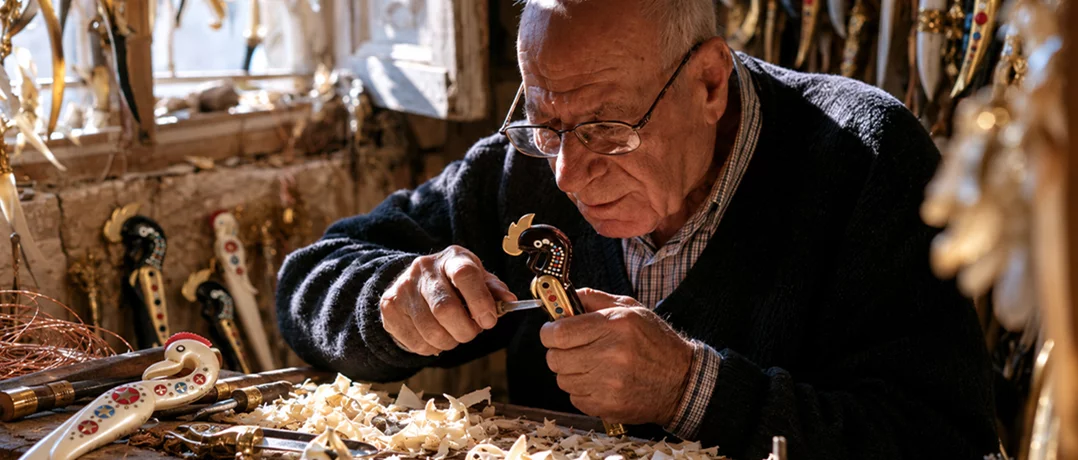
In the hill town of Jezzine in southern Lebanon, cutleries, traditionally carved from horn or bone and decorated with copper and brass, carry a distinctive figure, a phoenix with its wings spread across a surface no bigger than a matchbox. For generations, the craft of carving these handles was passed from father to son and master to apprentice, with knowledge learned almost entirely through observation and repetition. There were no manuals or formal classrooms. The workshop was the school, and the hands of an experienced craftsman were the textbook.
Today, the tradition is under pressure. Manufactured knives are faster and cheaper to produce, while the painstaking work required to carve a traditional Jezzine handle makes it increasingly difficult for craftsmen to earn a living from the trade. Two men who learned the craft in Jezzine offer different perspectives on its decline. Elias Aziz continues to practice it, carrying forward a skill inherited from his family. Georges Bou Rached spent years working as a craftsman before eventually leaving the trade.
Learning the art
For Elias, the process was never something that could be separated from practice. “You cannot learn this craft from a book,” he said. “You have to sit beside someone who knows it and repeat the work until your hands understand it.” The process begins with the handle itself. Traditionally, horn or bone is selected carefully, since the material has to be strong enough to withstand carving while remaining suitable for the fine details of the design. The raw piece is cut and shaped to the proportions of the knife before being carefully smoothed.
Elias considers this preparation essential. If the material is not properly shaped and even from the beginning, the carving will not produce the desired result. Only then does the phoenix begin to emerge. The design is first marked onto the surface before being carved gradually with small hand tools. The craftsman removes the material little by little, defining the body, wings and finer details of the bird.
“You cannot rush this part,” Elias explained. “If you remove too much material, you cannot put it back.” The difficulty lies in the precision. The finished handle may appear simple from a distance, but the details are extremely small, and the design must remain balanced. Too much pressure can damage the horn or remove more material than intended.
Years of repetition teach the hand how much pressure to apply and how to guide the tool, but Elias said the work never becomes automatic. Each handle still requires concentration.
Copper and brass are added toward the final stages, carefully fitted into the carved design without damaging the surface beneath. The handle is then polished until the metal and the original material form a unified surface before the finished handle is assembled with the blade.
"A simpler knife can be completed relatively quickly", Elias explained, while an elaborate traditional piece may take several days, with much of that time dedicated to the carving.
When a craft becomes difficult to make a living from
Georges learned the same craft in Jezzine. “There was no formal training,” he said. “You learned by doing the same movement hundreds of times until you understood the material.” Georges remembers the preparation of the handle as an important part of the process. The horn or bone had to be selected, cut and shaped carefully before any carving could begin. But it was the phoenix that demanded the greatest precision. “The phoenix is what gives the knife its character,” he said. “Every proportion and every line has to be right.” The carving required patience because every movement was irreversible. A tool pressed too hard against the horn could crack it, while removing too much material could permanently alter the design.
For Georges, the work was rewarding precisely because of that level of concentration. But over time, the economic realities of the craft became harder to ignore. He eventually stopped making knives, not because he had lost his connection to the work, but because he could no longer make a sustainable living from it.Materials were becoming increasingly expensive, while the time required to produce a handmade knife made it difficult to compete with mass-produced alternatives. “A handmade knife cannot compete with something produced cheaply and quickly if the customer is only looking at the price,” he said.
Leaving the craft also meant stepping away from a tradition that had depended on transmission from one generation to the next. “I still remember many of the movements and techniques,” Georges said. “But knowing how to do something and doing it every day are different things. Your hands need practice.” For him, this is part of what makes the disappearance of the craft particularly concerning. The knowledge may remain in someone's memory, but without continued practice and teaching, it gradually becomes harder to pass on.
Keeping the phoenix alive
Shaped by hand from horn and bone and brought to life through copper and brass, each handle carries the marks of an artistic tradition built on patience, precision and repetition. Across knives, forks and daggers, these objects have become part of Jezzine’s visual identity, connecting the communities that made them with the generations that inherited them.
Preserving the craft means safeguarding the artistic knowledge, techniques and human hands that give the object its meaning. As fewer artisans continue to practice the craft, keeping this tradition alive depends on ensuring that the phoenix remains something that can still be carved, rather than simply something that can be remembered.
-
-

-
The Beiruter
-
