



More than six months into the war, Tyre has become the center of an improvised civilian life in southern Lebanon, where displacement, disrupted schooling and damaged infrastructure are becoming harder to treat as temporary.
Tyre at the edge of Lebanon’s shrinking south
Tyre at the edge of Lebanon’s shrinking south
By Katharine Sorensen | September 13, 2026

Reading time: 8 mins
You don’t need to look long in Tyre before you come across rubble. It appears around corners and between buildings, often abruptly amid otherwise intact blocks. Some of the buildings were damaged in 2024. Others are remnants of the latest 2026 war between Israel and Hezbollah. The rubble, for the most part, has been swept from the streets and gathered inside the plots where the buildings once stood. Reconstruction has been more sparing. Most residents don’t trust that what they rebuild will remain standing. Abou Deeb, a beloved shawarma restaurant in Tyre, had its windows blown out in 2024. The owner replaced them, figuring boarded-up storefronts would be bad for business. Less than two years later, a particularly powerful strike one street over shattered the new panes. Sheets of nylon now cover the windows. Glass had become a gamble.
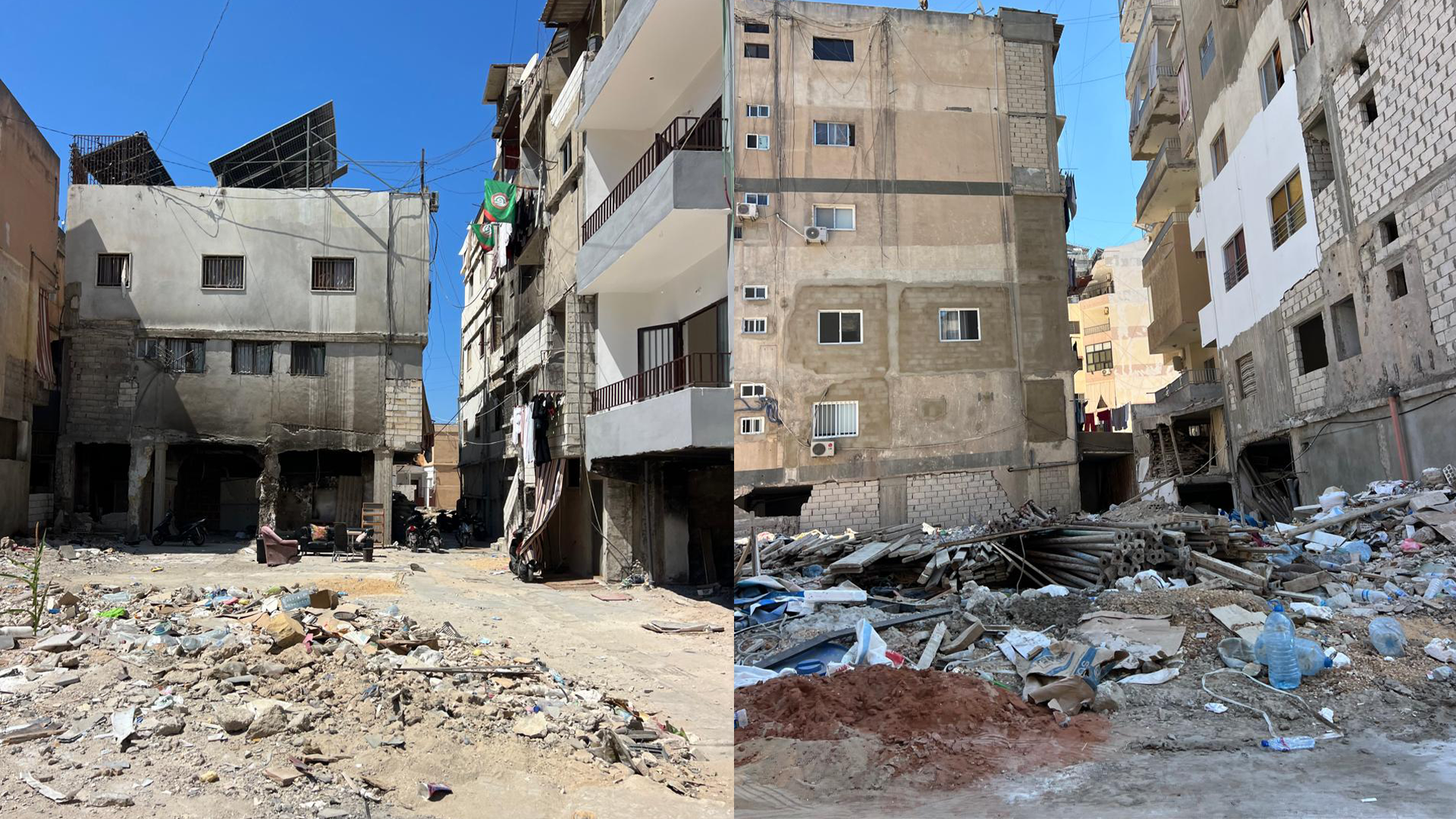
Rubble lies outside damaged buildings in Tyre. Source: The Beiruter.
The damage from the two wars now bleeds together, creating a mosaic of rubble across a city that has become the principal refuge for civilians displaced from a southern Lebanon whose inhabitable geography is steadily contracting.
And with public schools set to reopen on September 15, that displacement is about to carry into another academic year.
A narrowing map
More than six months after the 2026 war began on March 2, Tyre remains crowded with people who have nowhere farther south they consider safe enough to live.
A U.S.-brokered framework reached in June called for an Israeli withdrawal alongside the disarmament of Hezbollah, but implementation has stalled. Israeli troops continue to occupy swathes of southern Lebanon inside a self-declared security zone, while airstrikes have reached well beyond it, into towns around Nabatieh and farther north.
In recent days, the fighting has again intensified. Israeli strikes on Kfar Rumman this week killed civilians, including children, in one of the deadliest attacks since the June agreement. On Thursday, Israel said it had destroyed a Hezbollah underground complex extending more than two kilometers beneath Ali al-Taher ridge, roughly 15 kilometers from the border.
The Israeli military said it had established operational control of the ridge above and below ground. Prime Minister Benjamin Netanyahu and Defense Minister Israel Katz said troops would remain there to prevent Hezbollah from re-establishing its presence, declaring the operation the completion of Israel's security zone in southern Lebanon.
For many of the people now living in Tyre, each shift in the military map carries consequences for where they can live.
Lodi, Samar, Raneem, “the two Fatimas” and “four Zeinabs” come from villages such as Naqoura, Dhayra, Ramiya and Blida, where Israel has ordered residents not to return. They have been living in Tyre’s shelters since the war began.
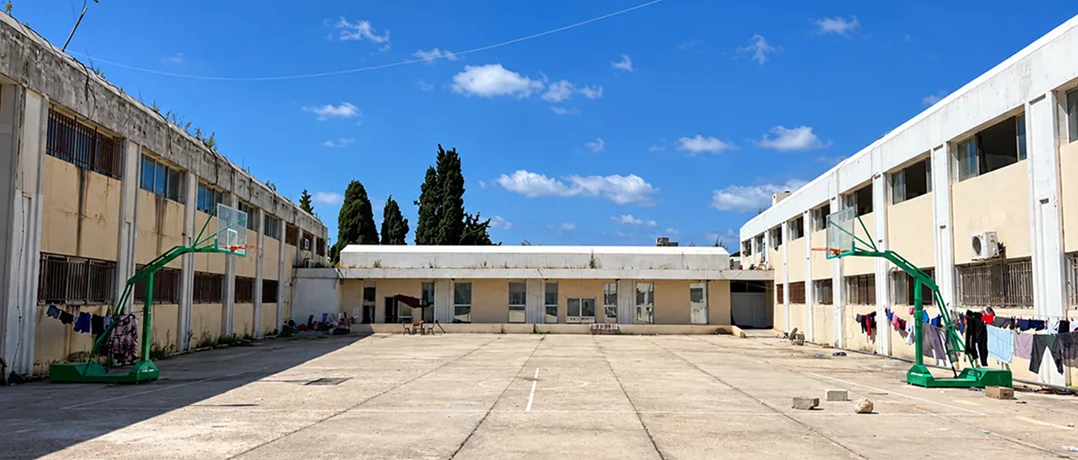
On Thursday morning, they were gathered near the Tyre Technical School, one of ten collective shelters still operating across the district, sitting in a circle and plucking leaves from stalks of molokhia, a leafy green used widely in Lebanese cooking. Small leaves went into one bucket, larger ones into the container beside it.
Molokhia is easy to store, they said. It can be kept without refrigeration, an advantage where electricity is unreliable, before being sent to a nearby community kitchen that prepares hot meals for displaced families and others in need.
Their morning’s work is part of a cash-for-work program run by the local NGO SHEILD, alongside Norwegian People’s Aid.
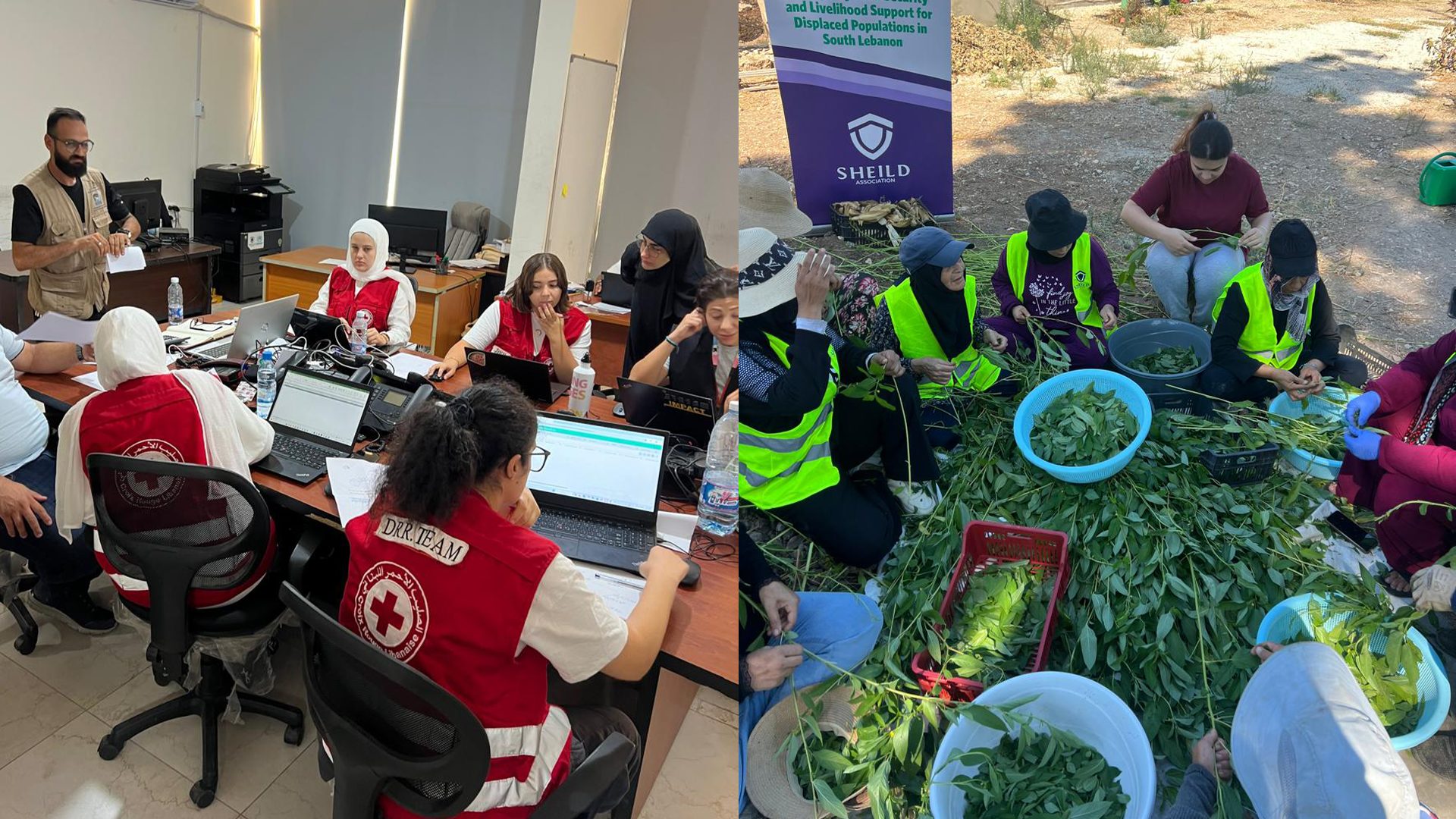
Left: Staff at Tyre’s Disaster Risk Management unit. Right: Displaced women prepare molokhia as part of a cash-for-work program. Source: The Beiruter.
Paid work has otherwise become scarce, the women explain, and many businesses have closed. If you came to Tyre before the wars, shops would remain open until 2-3am. Fancy a late night meal, and you would have had no shortage of places to choose from. Now, most businesses shut by 9 p.m.
“Work is difficult to find,” said one of the four Zeinabs. “None of us has any money and everyone wants to work.”
A haphazard return to school
With the beginning of the public school year quickly approaching, displaced children face vastly different prospects for returning to class. All the women, except Raneem, are mothers. Lodi has five children, all of whom are thirteen and younger.
“The schools from our villages are closed,” she said.
It’s hard for the kids to focus during a war. When we first came here, they couldn’t concentrate. They’ve been under a lot of stress.
Fourteen-year-old Aseel from Marwahin, roughly a 10-minute drive from the Israeli border, counts herself among “the lucky few” able to return to the classroom. She is due to begin school in Borj el Chmali, on the outskirts of Tyre.
Getting there, however, will bring another expense. With fuel prices high, her mother worried about how they would afford transportation each day. Aseel, for her part, was simply eager to be back in a classroom.
“I am so happy to finally go to school,” she said. “Now I have a way to fill up my time.”
Aseel had spent much of the morning playing improvised games in the parking lot beside the school. With little shade and gravel underfoot, the games could only last so long.
Others will return to school without entering a classroom, logging on to schools in villages that no longer exist or remain inaccessible.
Mohammad, 16, and Ahmad Hamaid, 13, are on the other side of that divide. The brothers will start the school year online.
“Education is difficult for everyone in the south,” said Sukna Hamaid, the boys’ mother. “Attending school in person is better. Children understand more, and there is a routine.”
For the brothers, the first obstacle is simply getting online at the same time.The school provides internet data, but the only device available to the brothers is their mother’s phone. When their lessons overlap, both cannot attend.
“Try studying online in a collective shelter on your mother's phone,” said Saeed Alnatour, an employee at SHEILD.
They’ve destroyed education for the children.
Managing a crisis with no end in sight
Across the parking lot from the school, about a dozen people sat waiting inside the offices of Tyre’s Disaster Risk Reduction unit. They had come to register as displaced, a designation that determines access to food and other forms of aid.
Outside, seven French UNIFIL soldiers, part of the international peacekeeping force deployed across southern Lebanon, stood near the entrance. Registration can be completed online, but poor internet access and difficulties navigating the form mean many still come to the office in person.
Upstairs, the registrations feed into a much larger operation. Years of successive emergencies have refined their procedures, incorporating what SHEILD executive director Eva Homsi called “lessons learned from the last war.” Staff track shelter capacity, dispatch search-and-rescue teams, and work with medical crews across the district
They also manage the dead.
Their work now reaches families from 272 municipalities, dispersed across 71 host communities. In all, 34,699 people from 8,679 families remain displaced. Another 111,559 are classified as returnees, residents who initially fled the area before subsequently returning.
Intact basic services are rare. Across the 61 municipalities assessed by the DRR, electricity networks are fully operational in just seven, water in six, and sewerage in nine. Twenty municipalities have no functioning electricity network at all, while 18 have no functioning water network.
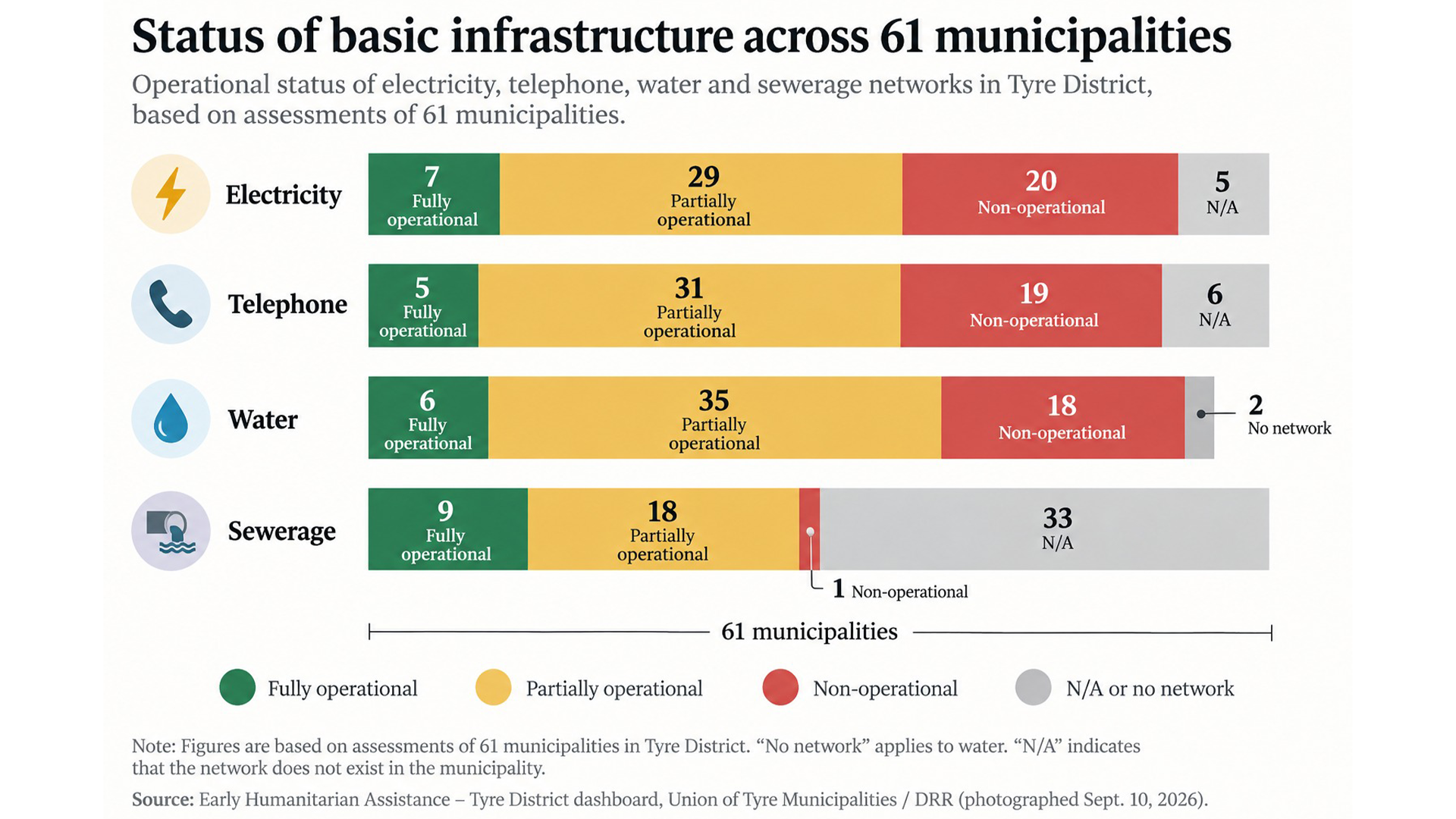
Operational status of basic infrastructure across 61 municipalities assessed in the Tyre district. Source: Union of Tyre Municipalities Disaster Risk Reduction Unit, Early Humanitarian Assistance dashboard, photographed Sept. 10, 2026.
The DRR has also recorded damage to 60 schools, 57 municipal buildings, and 41 health centers. Of the 61 municipalities surveyed, all but one reported damage to their roads.
With so many schools damaged, some of those still standing will have to serve simultaneously as classrooms and shelters.
“This set-up will create an odd dynamic between the students and the displaced,” said Homsi.
At Tyre Technical School, families will continue living on the first floor while classes resume one floor above. Students arriving for class will pass through spaces occupied by displaced families, leaving little separation between the school day and the private lives of those sheltering there.
Outside, signs of the coming season were arriving despite the September heat. In the parking lot where Aseel had spent much of the morning playing, men were unloading thicker mattresses from a van for families in the shelters.
“It won’t be this warm forever,” Aly, one of the men unloading the mattresses, said.
No one expects to be home by winter.
-
-

-
Katharine SorensenReporterSpecializing in global affairs, technology and economics, with a focus on on-the-ground investigative reporting.
-
