



From the Baltic to the Arctic, a new Nordic nuclear arc is emerging, adding another layer of deterrence and ambiguity to NATO’s northern flank.
The Nordic nuclear arc

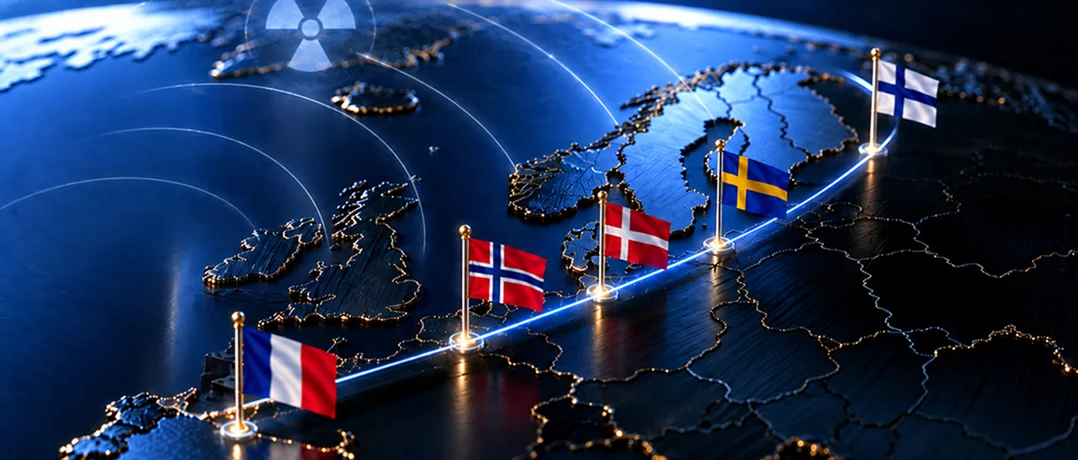
On 10 September, after talks with French President Emmanuel Macron at the Élysée Palace, Finnish President Alexander Stubb declared that “Finland and France are closer than ever before.” Four days later, those words acquired greater strategic weight as Helsinki announced that it was joining France’s forward nuclear-deterrence initiative.
Finland’s move also sharpened the outline of a much larger transformation unfolding across northern Europe. From the Baltic to the Arctic, a new nuclear dimension is taking shape across the Nordic security landscape, adding another layer to a region already at the center of Europe’s confrontation with Russia. The emerging Nordic nuclear arc is still taking form, but its strategic significance is becoming increasingly difficult to ignore.
A north built around nuclear restraint
The Nordic approach to nuclear weapons predates the current security order by more than six decades. During the Cold War, the region occupied an increasingly important position between the Soviet Union and the West, yet its countries repeatedly sought to limit the nuclear dimension of that rivalry.
Norway and Denmark joined NATO but adopted policies in 1957 rejecting the peacetime stationing of nuclear weapons on their territory. Sweden maintained military nonalignment while considering its own nuclear arsenal, an option it abandoned in the late 1960s. Finland developed an especially restrictive approach under the constraints of its postwar relationship with Moscow.
These policies also produced a wider Nordic vision. In 1961, Swedish Foreign Minister Östen Undén proposed that non-nuclear states commit themselves against acquiring or hosting nuclear weapons. Two years later, Finnish President Urho Kekkonen proposed a Nordic nuclear-weapon-free zone.
The proposal never materialized, but nuclear restraint, nonproliferation and arms control remained deeply embedded in Nordic strategic thinking.
The shock of 2022
Russia’s full-scale invasion of Ukraine in February 2022 accelerated a transformation that decades of gradual cooperation with NATO had never produced. Within three months, Finland and Sweden abandoned military nonalignment and applied to join the Alliance. Finland became NATO’s 31st member on 4 April 2023, followed by Sweden on 7 March 2024, bringing Denmark, Norway, Sweden and Finland under the same collective defense framework for the first time since the age of the Kalmar Union, more than four centuries earlier.
NATO membership introduced nuclear deterrence more directly into Finnish and Swedish defense policy. Sweden supported NATO’s strategic deterrence while maintaining its opposition to peacetime nuclear deployments and permanent foreign bases. Arms control and nonproliferation remained part of Stockholm’s policy as Sweden assumed the obligations of a nuclear alliance.
Finland’s adjustment went further. Finnish law had prohibited the import, transport, transfer or possession of nuclear explosives. In June 2026, Helsinki amended that legislation to permit such activities when connected to national defense, NATO collective defense or international defense cooperation. The government maintained its opposition to stationing nuclear weapons on Finnish territory while removing the legal obstacle to their presence under specified defense circumstances.
The change was also visible in Finnish strategic language. In August 2026, Stubb described deterrence as a “relatively new and perhaps unfamiliar concept” in Finland and defined NATO deterrence as combining conventional forces, missile defense and nuclear weapons. Nuclear deterrence was becoming an explicit component of Finnish defense thinking rather than an external feature of allied strategy.
What France is actually building
The architecture Finland was moving toward had been set out months earlier in Paris. On 2 March 2026, at the Île Longue submarine base, Macron unveiled what he called “forward deterrence,” a framework extending French nuclear deterrence through deeper cooperation and potential deployments across allied territory.
Macron described it as a series of progressively deeper levels of cooperation. Partners could join French deterrence exercises and strategic signaling beyond French territory, while their conventional forces could support French nuclear activities. At the furthest stage, elements of France’s Strategic Air Forces could deploy temporarily to allied countries. Macron called the resulting dispersion an “archipelago of forces,” intended to give French deterrence greater strategic depth and complicate an adversary’s calculations.
France also envisaged bilateral mechanisms for exchanging threat assessments and intelligence, establishing dedicated communications and developing a shared understanding of escalation. Sweden and France held their first Nuclear Steering Group meeting in Paris on 23 April. Norway entered the process in May, while Finland’s September agreement provides for its own Nuclear Steering Group and cooperation on strategic signaling and escalation management below the nuclear threshold.
Control of the arsenal remains entirely French. The president alone retains the decision to employ nuclear weapons and define France’s vital interests. Macron also rejected a rigid automatic guarantee, arguing that uncertainty over the circumstances that could trigger a French response forms part of deterrence itself.
From the Baltic to the Arctic
The significance of Nordic participation becomes clearer on a map. Denmark, Sweden, Finland and Norway form a connected strategic space stretching from the Baltic entrances through Scandinavia into the Barents Sea and Arctic.
NATO has increasingly organized its northern defenses around the same geography. In December 2025, Denmark, Finland and Sweden moved under Joint Force Command Norfolk, joining Norway, Iceland and the United Kingdom in a command focused on the North Atlantic and High North.
Denmark sits across the maritime approaches linking the Baltic with the North Sea. Sweden occupies the center, with Gotland Island strategically positioned inside the Baltic. Finland carries the arc eastward to Russia’s northwestern frontier, while Norway extends it into the Arctic and Barents Sea.
The northern end carries particular nuclear significance. Immediately beyond Finland and Norway lies the Kola Peninsula, home to Russia’s Northern Fleet and one of the country’s most important concentrations of strategic military power. Much of Russia’s sea-based nuclear deterrent is based there, including strategic submarines central to Moscow’s second-strike capability.
Beyond Kola, the Arctic itself is acquiring greater strategic value. Retreating seasonal sea ice is opening northern waters to increasing maritime traffic: the number of ships operating in the Arctic rose by 40 percent between 2013 and 2025. The U.S. Geological Survey estimates that roughly 22 percent of the world’s undiscovered technically recoverable oil and gas resources lie north of the Arctic Circle. Emerging trade routes and access to energy and critical minerals are adding an economic dimension to the growing importance of the High North.
Two layers of deterrence
The French initiative is taking shape alongside NATO’s existing nuclear architecture.
Denmark, Norway, Sweden and Finland all take part in NATO’s Nuclear Planning Group, even as several retain restrictions on peacetime nuclear stationing. The United States remains the Alliance’s central nuclear guarantor, backed by forward-deployed weapons and allied infrastructure in Europe. Britain and France contribute independent strategic nuclear forces.
France is NATO’s only member outside the Nuclear Planning Group and retains complete national control over its arsenal. Forward deterrence therefore adds bilateral relationships linking European allies directly to Paris, which France describes as complementary to NATO’s existing arrangements.
The result is a layered deterrence structure in which Nordic governments participate in NATO nuclear consultation while developing separate mechanisms with France. Nuclear authority remains divided between Washington, London and Paris, adding strategic ambiguity to the system.
From the Baltic to the Arctic, separate national choices are converging into a Nordic deterrence arc that any adversary must now calculate into a crisis.
-
-

-
Nami El KhazenJournalistFocusing on geopolitics and international affairs.
-
