



Oil prices above $100 once threatened economic crisis, but decades of declining oil intensity, diversified energy supplies and strategic reserves have made the global economy more resilient to petroleum shocks.
Why $100 oil no longer breaks the world economy
Why $100 oil no longer breaks the world economy
By Katharine Sorensen | September 20, 2026

Reading time: 5 min

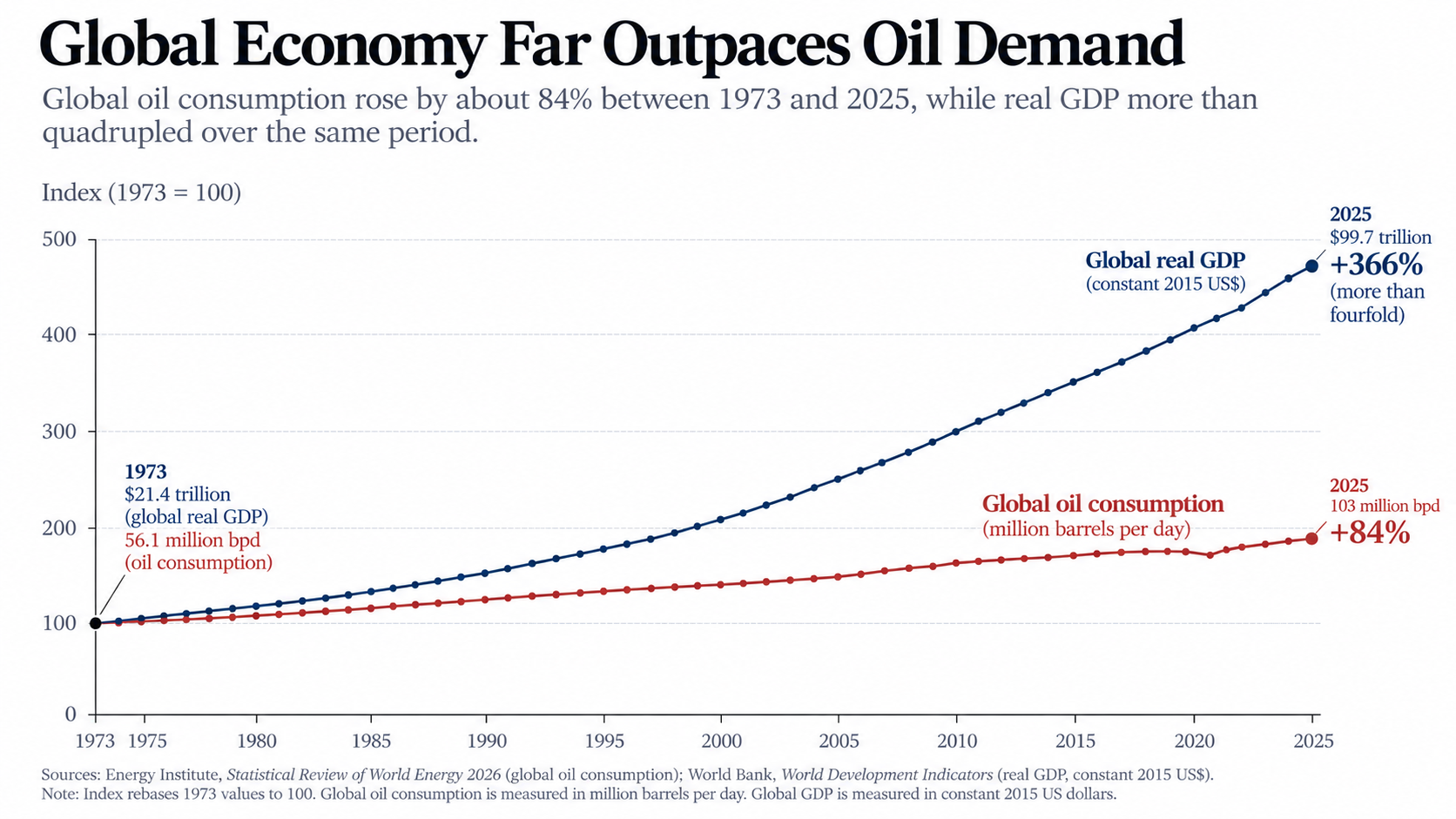
A disruption on the scale now confronting global oil markets would once have threatened an economic crisis almost immediately. The effective closure of the Strait of Hormuz cut global oil supply by an estimated 10 million barrels a day in March, the largest recorded supply loss, according to the World Bank’s Commodity Markets Outlook. Brent crude, the international oil benchmark, jumped from $72 a barrel at the end of February to $118 at the end of March. The shock remains consequential. In April, the World Bank lowered its 2026 growth forecast for emerging and developing economies by 0.4 percentage point and projected a four-year high for inflation. Yet the relationship between oil and economic activity has changed markedly since the crises of the 1970s, when sharp increases in energy costs reverberated through economies heavily dependent on petroleum. A calculation by The Beiruter using the Energy Institute’s authoritative global oil-consumption dataset and World Bank real GDP data finds that the global economy has become substantially less oil-intensive In 1973, the world consumed about 958 barrels of oil for every $1 million of output in constant 2015 dollars, compared with about 377 barrels in 2025, a decline of roughly 61%. Oil nevertheless remains critical, but a more diversified energy system, strategic reserves and alternative supplies provide greater protection against disruptions. The first oil shock struck a global economy in which petroleum was far more closely tied to economic growth. In 1973, oil supplied 46% of world energy, according to the Energy Institute’s Statistical Review of World Energy 2026. Before the crisis, global oil consumption had been growing by 7.8% a year. Afterward, growth slowed to 2.2% until the second shock in 1979. The adjustment was severe but lasting. Global oil consumption fell after 1979 and took a decade to regain its previous level. In the European Union, Britain, and Japan, which together accounted for 34% of world oil consumption in 1979, demand has never returned to that year’s level. In the United States and Canada, recovery took 20 years. Energy use per unit of GDP fell 3.3% in 1980, the largest one-year decline in the Energy Institute’s series beginning in 1965. The changes continued long after prices stabilized. Fuel-efficiency standards reduced petroleum use in transport, while oil lost ground to coal, gas and nuclear power in electricity generation. Renewables and electrification have since added alternatives. Oil consumption eventually resumed its rise, but economic growth accelerated far faster. Global demand increased from 56.1 million barrels a day in 1973 to 103 million in 2025, while World Bank data show real GDP rising from $21.4 trillion to $99.7 trillion in constant 2015 dollars. Oil consumption therefore increased by about 84% while the world economy grew more than fourfold, according to The Beiruter’s calculation. Global GDP has far outpaced oil consumption since 1973. Sources: Energy Institute, World Bank. Oil remains indispensable in transport, aviation and petrochemicals, but economic growth no longer translates into petroleum demand as directly as it once did. Before 1979, global GDP and fossil-fuel supply grew closely together, according to the Energy Institute. Over the past decade, however, fossil-fuel consumption increased by an average of 1% annually while GDP expanded by 2.7%. The institute attributes the divergence partly to greater efficiency, particularly in transport, changes in the power sector, the growth of renewable energy and the expanding role of services in the global economy. Recent consumption trends reinforce that divergence. According to the International Energy Agency’s (IEA) Global Energy Review 2026, oil demand increased by 650,000 barrels a day in 2025, less than half the annual average of 1.4 million between 2010 and 2019. China offers a striking example. Its economy grew by 20% between 2021 and 2025, according to the IEA, while gasoline and diesel consumption has recently plateaued. Electric vehicles, natural gas trucks and high-speed rail have allowed passenger and freight transport to expand without a corresponding increase in oil consumption. The transition is far from uniform. Emerging and developing economies accounted for nearly all the increase in global oil use in 2025, led by Asia-Pacific and Africa. Oil dependence has not disappeared, but growth in demand has shifted toward economies where populations, incomes and transport needs are still expanding. Governments also possess defenses that scarcely existed in 1973. The IEA was created after the embargo, while strategic reserves became a tool for cushioning disruptions. Those reserves give governments something their counterparts lacked when the 1973 embargo began: a stockpile that can temporarily replace lost commercial supply while markets adjust. The US Strategic Petroleum Reserve, for instance, was established after the crisis and first filled in 1977. US Energy Information Administration data show that it contained 415 million barrels at the end of February 2026. By June, after releases during the Middle East disruption, the reserve had fallen to 322 million barrels. Supply is also more geographically dispersed. The Energy Institute reports that US oil production reached 21.1 million barrels a day in 2025, almost equal to Saudi Arabian and Russian production combined. The Middle East nevertheless remained the largest producing region, accounting for 31% of global output. Diversification cannot eliminate geography. Before the current conflict, the Strait of Hormuz carried close to 35% of global seaborne crude trade and 20% of refined petroleum trade, according to the World Bank. Spare pipelines could reroute only part of those flows. The experience of 2026 therefore points to greater resilience rather than independence from oil. The global economy produces more output from each barrel, draws on a more diverse energy mix and holds strategic reserves against supply emergencies. Expensive oil can still raise transport and production costs and feed into food and fertilizer prices, but the link between oil prices and global growth has weakened. A $100 barrel carries a different economic weight than it did in earlier crises, requiring a larger or more persistent shock to exert comparable pressure on a considerably less oil-intensive economy.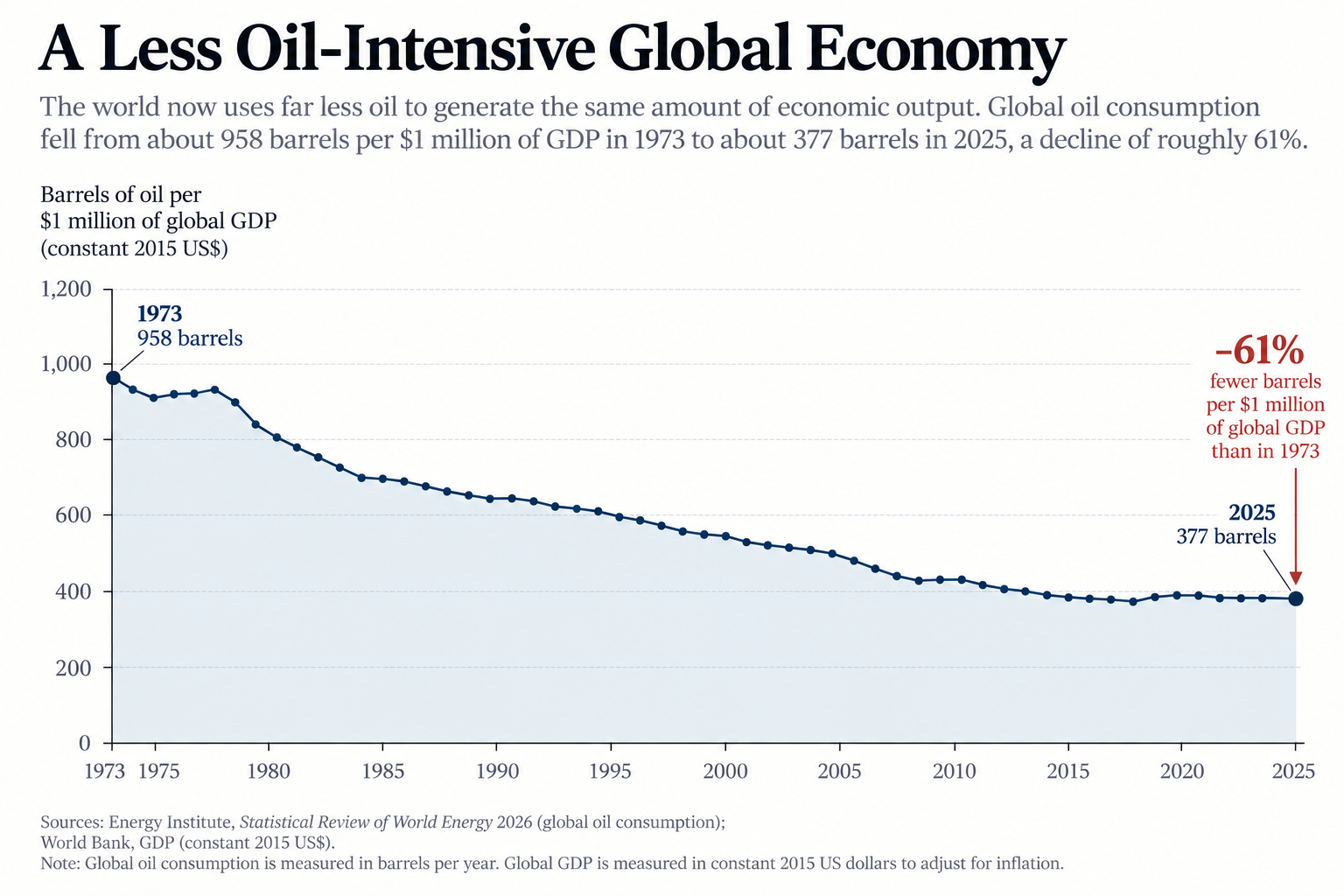 Global oil intensity fell roughly 61% between 1973 and 2025. Sources: Energy Institute, World Bank.
The lesson of the 1970s
Growth without the same appetite for oil
A larger arsenal against shortages
-
-

-
Katharine SorensenReporterSpecializing in global affairs, technology and economics, with a focus on on-the-ground investigative reporting.
-
