



Lebanese authors and educators are using literature to help students confront the human experience of war while the country still lacks a unified curriculum covering its modern history.
How books are teaching students what history class won't
How books are teaching students what history class won't
By Vanessa Kallas | September 18, 2026

Reading time: 7 min
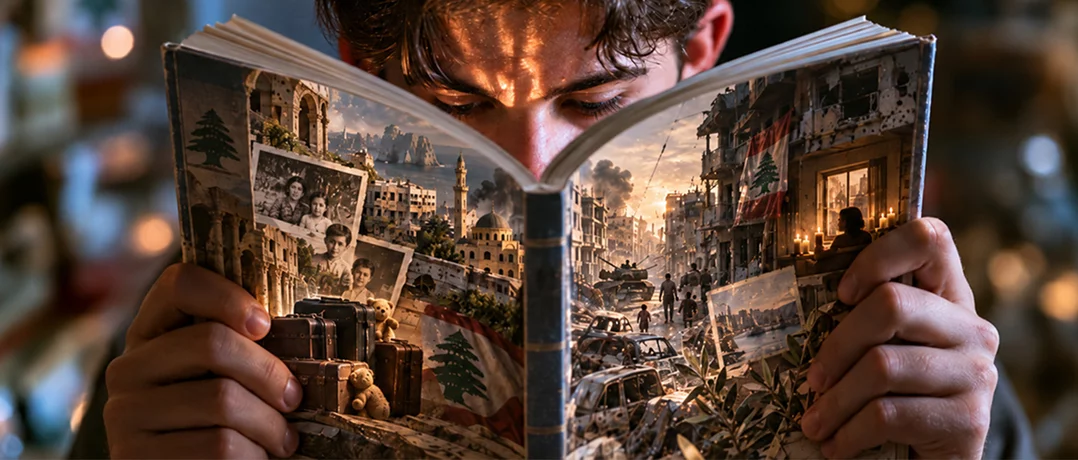
In some Lebanese classrooms, French teachers have assigned students a book that tackles a subject most schools avoid: the civil war. The book is L'École de la guerre (The School of War), by Lebanese lawyer and author Alexandre Najjar, and is part of the curriculum in some schools. For students who read it, the book is unlike anything usually covered in class, built around a subject rarely addressed in Lebanese schools. Its cover pairs smiling children with a title as grim as “The School of War,” a contrast that runs through the book.
Ten years after the book entered some classrooms, the 2024-2026 war gave another generation of Lebanese students their own memories of shelling, echoing what their parents and grandparents had endured decades earlier. Krystel Tyan, a French teacher who teaches Najjar's book, went on to write her own book about her six-year-old son's experience of that recent war.
Although teachers are finding new ways to teach modern history, gaps remain. More than three decades after the civil war ended, Lebanon still has no unified national curriculum or textbook covering the period, largely because sectarian communities have never agreed on a single account of what happened or who was responsible. Schools are generally left to decide how much of the war, if any, to teach, often along sectarian lines. Where the classroom stays silent, literature has increasingly stepped in to fill the gap.
A book without hatred
One of the earliest memories of The School of War book sets the tone for everything that follows. Najjar was eight the first time he heard shelling, and his mother told him it was only fireworks in the distance. The explanation held, until it couldn't anymore, until the sound came too often and too close for a child not to know better. Najjar endured the brutality of the civil war through his entire childhood and early adulthood. For readers with no direct memory of that war, aside from a few stories passed down by parents, Najjar's details make it feel like a lived experience.
Najjar didn't want to write a book of grievance, and that choice shapes everything in it.
I did not want to write a book of hatred or accusation. I wanted to show, through the eyes of a child and then a young man, what war does to ordinary life: the fear of bombardments, the shelters, the electricity cuts, the checkpoints, the shortages, but also school, football, friendship, love, family life and even moments of humor.
That contrast, between terror and the ordinary, is what he considers the real subject of the book: "You hear shelling, then you go to school; you hide in a shelter, then you play football; you are frightened, but you continue to fall in love and to live."

He traces that restraint back to French author Albert Camus, quoting him directly: "What in this world could answer the terrible persistence of crime, if not the persistence of testimony?"
He recalls growing up during the war: "I was eight when the war began and twenty-three when it ended," adding that a single day without shelling, a single night without a blackout, "acquired an extraordinary value" he might never have discovered otherwise.
A dragon's hiccup for the youngest readers
That book, Le Hoquet du Dragon (The Dragon's Hiccup), follows a boy who invents his own explanation for the sounds of war outside his window: a dragon, hiccupping so loudly that the noise shakes the walls of Beirut. It tells a similar story to Najjar's, from the other direction: it isn't Krystel searching for a way to explain the shelling, it's her son Nicolas who invents one himself.
Krystel Tyan wrote The Dragon's Hiccup for a younger reader than Najjar's, though she resists pinning it to one age group. "I wrote The Dragon's Hiccup for children first, but without wanting to lock it into a precise age bracket. I'd say it speaks especially to children from age seven upward, while still leaving room for teenagers and adults," she said.
She wrote it while the 2024-2026 war was still recent, arguing that children shouldn't have to wait for an event to become History before they're allowed to talk about it:
Memory shouldn't have to wait for pain to be forgotten before it can begin to take shape.
When her own son asked her what the word "war" meant, she didn't reach for a dictionary, but took refuge in poetry, writing "War is like a wind that blows so hard it carries everything away with it, even the stars," referring to that line as the seed of the book.

One memory in particular convinced her that fear crosses sectarian lines faster than politics ever could: "I will never forget a day when my students jumped in fear hearing a loud 'Boom!'. In that instant, I understood that in the face of fear, what unites us is far stronger than what divides us."
Najjar's book has already made it into classrooms. Tyan's is next: Le Hoquet du Dragon is expected to enter the curriculum of some schools in the coming period.
Pushing for war related books into classrooms
Neither of the older books arrived in a classroom easily. A publisher had to push to put them there, and the schools that eventually taught them didn't do so without resistance first. Éditions Hatem, which publishes The School of War alongside author Zeina Abirached's graphic novel Le Jeu des hirondelles (A Game for Swallows), sees its role as something larger than moving books off a shelf. Abirached's book, based on her own childhood, follows a young girl and her brother waiting through a single night of shelling in their apartment building, alongside neighbors who take refuge in the safest room of the house until the danger passes.
"It was never simply about publishing 'war books.' It was about collective memory," said Bernard Hatem, the house's CEO. "There is a paradox: younger generations continue to inherit the consequences of the war while often knowing very little about the war itself. I believe this is dangerous." Getting Le Jeu des hirondelles approved was never going to be a purely literary conversation, he said.
"Schools naturally ask questions: Is the book politically balanced? Could certain families interpret it differently? Could it reopen tensions? Is the subject appropriate for the students' age?" What made the difference, in his account, was that the book doesn't take sides, but "approaches the war largely through the eyes of civilians and through the intimate world of a child. It is not trying to establish who was right and who was wrong." Both The School of War and A Game for Swallows got past that resistance and are now taught in Lebanese schools, not because the resistance disappeared, but because someone was willing to confront it directly.
The history Lebanon still won't teach
Underneath those books is a history Lebanon still won't teach in its own classrooms. The country doesn't formally address its civil war, let alone the wars of 2024 and 2026, and Hatem is direct about what that silence costs.
"If we teach our children only to remember who fought whom, we preserve the war. But if we teach them why a society reached the point of war, what it cost, and what mistakes allowed it to happen, then perhaps memory can help prevent history from repeating itself."
That said, neither Najjar nor Hatem is arguing that these books can replace an actual history curriculum. Hatem draws the line plainly: "History establishes facts, chronology and context. Literature gives those facts a human face." Najjar makes the same point from his side: "I would not suggest that literature should replace the teaching of history. A book like mine has a different function. It allows students to approach history through human experience." A novel can make a student feel what fear or displacement were like, but it can't tell them when the war started, who was involved, or how it ended, and a country that only reaches its own history through fiction risks knowing the feeling of war without knowing the war itself.
That's exactly why these books need to be pushed harder into classrooms rather than left to the chance of which school, or which teacher, a student happens to have. Reading is no longer the default habit it once was for teenagers, competing against phones and shrinking attention spans, which makes it harder for a book to hold a 15-year-old's attention, especially on a topic as heavy as war.
Najjar's book and Abirached's are already inside some classrooms, and Tyan's is on its way in. But "some schools" isn't "most schools," and a subject this central to what Lebanon is shouldn't depend on which school a student happens to attend. Najjar himself, describing his own restraint on the page, invoked Hemingway's belief that no experience of war is ever wasted on a writer. But Hemingway also wrote something else, in A Farewell to Arms: that the world breaks everyone, and that afterward, many are strong at the broken places. These three books suggest one way a country gets there. Literature gives a generation the words to name what broke it; history gives it the facts of how it happened. Neither alone is enough, but together, they're what it takes for a country to actually grow strong at the place where it broke, instead of just living around the crack.
-
-

-
Vanessa KallasJournalistCovering socio-political, environmental, and human rights issues.
-
