



The human touch behind Lebanon’s mosaic tiles
The human touch behind Lebanon’s mosaic tiles
By The Beiruter | September 19, 2026

Reading time 4 min
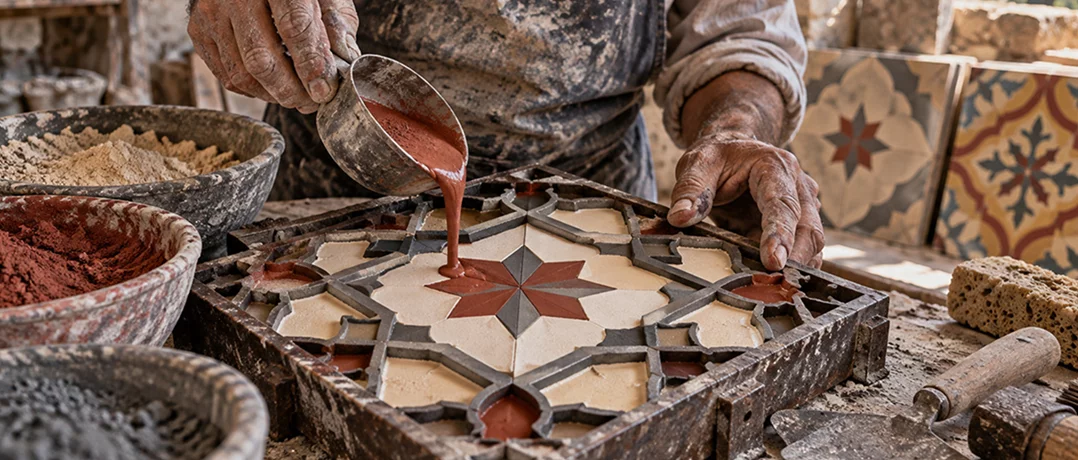
In Lebanon, the floor has always spoken. Before polished concrete and factory-made ceramics became commonplace, Lebanese homes expressed their identity through mosaic tiles, floral, geometric, starry and vine-like patterns that carried traces of family, faith and place. Today, as artisans and designers work to keep the craft alive, two makers, Maya Daher in the Chouf and Nadim Khoury in Zahle, describe a tradition shaped by patience, precision and cultural memory.
“A story underneath your feet”
For Maya Daher, (58), mosaic tile artisan from Chouf ,the value of “blat libnéné” lies in the history it preserves. “For me, blat libnéné is memory. When you enter an old Lebanese house… you look down. The floor tells you who lived there,” she said. To Daher, mosaic tiles were never simply decorative. Their motifs often drew from gardens, flowers, the sea and religious architecture, while colors reflected Lebanon’s landscapes. “Lebanese people always brought meaning into the things they built,” she explained. A pattern could even reveal something about the family that commissioned it. “Sometimes you can see a family’s taste from the pattern they chose.”
That meaning is closely tied to the way the tiles are made. Unlike industrial flooring, where designs can be mechanically reproduced, traditional Lebanese mosaic tiles are built through a painstaking process. “People sometimes think you are simply making a drawing on cement. It is much more delicate than that,” Daher said.
The process begins with a metal mold. Pigments are prepared and mixed by hand before being carefully poured into their designated sections. “If you pour too quickly, they can mix. If you are not precise, the pattern changes.” The layers are then compressed using cement and a hydraulic press before the tile is dried, polished and sanded.
The result is a product that carries subtle differences from one piece to another. “Even when you use the same mold and the same colors, your hands will never produce exactly the same tile twice,” Daher said. Those variations, rather than being imperfections, are evidence of the maker. “That is the human signature.”
This is what distinguishes handmade tiles from mass-produced alternatives. “A machine can give you perfection, but it cannot give you that feeling.” Yet the craft nearly disappeared. The rise of inexpensive, rapidly produced ceramic flooring made traditional tiles less practical for many households. “Once ceramic flooring became cheaper and faster, people naturally started choosing it,” she explained.
War compounded the decline by destroying historic buildings and workshops. “The war destroyed so many old buildings,” Daher said. “Entire streets disappeared, and with them disappeared floors, molds and workshops.” She does not believe handmade tiles need to replace modern flooring. Instead, she stresses the importance of preserving the knowledge behind them. “The point is that there should still be someone who knows how to make them.”
That knowledge becomes particularly important in restoration. An old floor is part of a building’s original character, and reproducing its appearance with a modern substitute cannot necessarily recreate its history. “The original was made by hands. It belonged to that house,” she told The Beiruter. Daher has also seen Lebanese mosaic tiles find an audience outside the country, with interest from France, Italy, the United States and the Gulf. Their appeal, she believes, lies partly in their warmth and individuality. “They do not want everything to look like it came out of the same factory.” Her hope is that younger generations will see the craft as something more than an outdated trade.
It is an art. A Lebanese tile can survive for decades… If we continue making it, it can outlive us too.
“The slowness is part of the product”
Nadim Ibrahim, (41), Zahle mosaic tile designer, approaches Lebanese mosaic tiles through their combination of design, material, technique and history. “They are looking at several layers at once,” he told The Beiruter. “There is the design… but there is also the material, the technique and the history behind it.” One of the defining characteristics of the traditional process is the way color becomes part of the tile itself. “These tiles are poured and pigmented. They are not printed onto a surface like many modern ceramic tiles. The color becomes part of the tile itself,” Ibrahim explained. This creates a depth that is difficult to reproduce through industrial printing.
He identified three elements at the heart of the process: “the mold, the pigment and the hand.” Even with identical materials and molds, the result varies between makers. “You can give ten people the same mold and the same colors, and they will not produce ten completely identical tiles.” Every stage affects the finished piece, from preparing the pigments and arranging the colors to hydraulic pressing, drying, polishing and sanding. The process is deliberately slow. “It is a slow process, but the slowness is part of the product,” Ibrahim said.
The visual language of Lebanese mosaic tiles also reflects the country’s position at the crossroads of different cultural influences. Ibrahim pointed to Ottoman decorative forms, Mediterranean design and local architecture, which developed into patterns of “geometric shapes, flowers, vines and stars.” “You cannot separate it from the history of the Levant,” he said. In historic Lebanese neighborhoods, the floor was an architectural element in its own right. “When you walk through old neighborhoods in Beirut, Tripoli, Zahle or Saida, you realize that the floor was part of the architecture.”
The designer links the craft’s decline to industrialization and war. “Speed and cost. That is usually what happens with handmade crafts,” he said. As cheaper alternatives became widespread, workshops struggled to survive. “Workshops closed, buildings were demolished and families stopped passing the techniques down.”
The disappearance of a craft can happen gradually, he explained, through the loss of practitioners, molds, patterns and specialized knowledge. “You can lose a craft without realizing it.” In recent years, however, artisans and designers have begun approaching mosaic tiles differently. Some have recovered old molds and recreated traditional patterns, while others have developed contemporary designs using the same techniques. “You preserve the technique, but you allow it to live in the present,” Ibrahim said.
That approach has also helped Lebanese mosaic tiles find international interest. Their handmade variations and Mediterranean character have attracted clients for cafés, hotels, kitchens and courtyards in France, Italy, the United States and the Gulf.
“Absolutely,” Ibrahim said when asked whether imperfections contribute to their appeal. “With handmade mosaic tiles, you want to see evidence of the person who made them.” For him, international demand can also serve as a form of cultural transmission. “It means that a piece of Lebanese visual culture is travelling with them.” A tile does not need to carry a national emblem to communicate where it comes from. “A pattern, a color combination, a technique can carry history by itself.”
We are not only recreating something from the past. We are giving it another life.
Preserving a living language of floors
Together, Daher and Khoury present Lebanese mosaic tile making as both a technical craft and a form of cultural memory. Their accounts show how the process depends on careful handwork, from preparing pigments and filling molds to pressing, polishing and sanding each tile.
The craft’s decline was driven by the rise of cheaper industrial flooring and compounded by the destruction of workshops and historic buildings during Lebanon’s wars. Its revival, however, is allowing traditional patterns and techniques to enter contemporary homes and international spaces.
For both artisans, preserving the craft means keeping the knowledge alive while allowing the designs and techniques to evolve. Beneath Lebanon’s changing architecture, these tiles continue to carry a visual language of flowers, stars, geometry and color, shaped by the hands that made them.
-
-

-
The Beiruter
-
