



A discussion between geneticist Pierre Zalloua and scholar Nassim Nicholas Taleb asks how much shared identity Lebanon needs to remain one country, and who gets to define it.
The Lebanese identity question

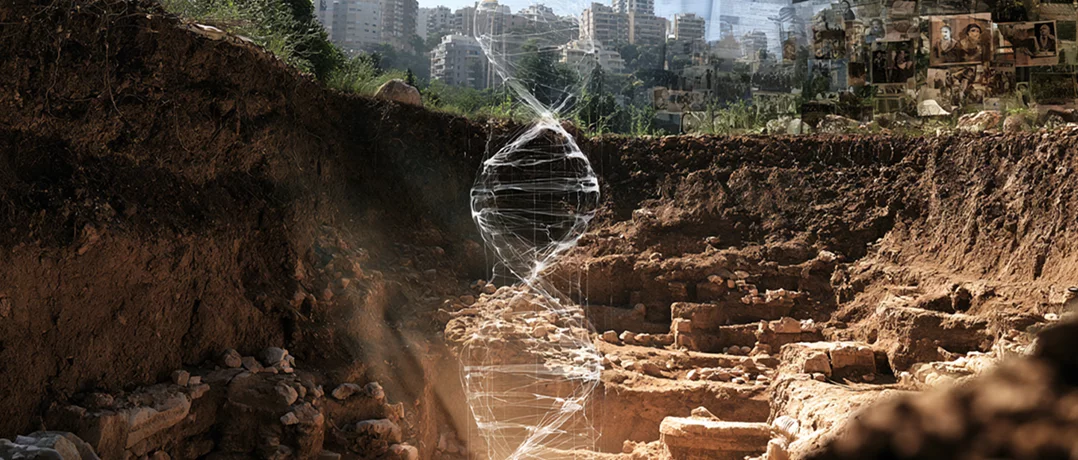
Lebanon’s recurring argument over its origins has long carried implications for how the country understands itself. Claims of Arab, Phoenician or Canaanite belonging have carried competing ideas about Lebanon, turning questions of ancient ancestry into arguments over culture, political allegiance and the basis of a common Lebanese identity. Modern genetics might appear to offer an answer. A landmark 2017 study co-authored by Lebanese geneticist Pierre Zalloua found that more than 90 percent of the ancestry of 99 present-day Lebanese sampled could be modeled as deriving from a population related to Bronze Age inhabitants of Sidon, evidence of substantial population continuity across thousands of years. Yet the finding also exposes the limits of what ancestry can settle. “You cannot escape genetics entirely if you want to discuss ancestry in relation to identity,” Zalloua said during a recent discussion with scholar and author Nassim Nicholas Taleb. The discussion used that tension between ancestry and identity as a starting point for a wider examination of Lebanese belonging, nationalism and the state. It also raised questions with consequences far beyond how Lebanese describe their origins. Should the state have any role in defining that identity? How much should history determine present belonging, and can religious and cultural differences coexist with a common political identity? And if Arab and Phoenician ancestry need not be contradictory, what makes an identity Lebanese? The familiar choice between Arab and Phoenician identity assumes that the two describe competing versions of the same thing. For Zalloua and Taleb, they do not. Phoenician, Zalloua argued, belongs to a particular historical culture, while Canaanite describes a much older population and civilization of the Levant. Arab identity can operate on another register, encompassing language, culture and political belonging. A population can acquire new languages and identities without erasing what came before. “What you cannot say is that you have to choose: either I am Phoenician or Canaanite, or I am Arab,” Zalloua said. “There is no contradiction.” Taleb approached the same history through the different speeds at which populations and cultures change. Genetic ancestry can persist across long periods in which language, religion and cultural affiliation change substantially. The Arab conquests, he argued, transformed the linguistic and cultural landscape of the region without amounting to a wholesale replacement of the populations already living there. A population can therefore remain remarkably continuous while the identities through which it understands itself change repeatedly. For Taleb, the mistake is to take one moment in that process and treat it as definitive, turning a particular language, culture or affiliation into evidence of an enduring and exclusive identity. For Taleb, the greater distortion comes from treating any one of those layers as permanent or pure. “That is the problem with the idea of purity. It assumes something fixed, something that does not continue changing over time,” Taleb said. The political problem is not simply that people possess different identities, but that states can turn identities that change over time into permanent categories of belonging. Taleb placed much of that transition in the nineteenth century and the rise of modern nationalism. In his account, identities had long existed, but they did not carry the same political function. Belonging could be intensely local, rooted in a village, town or religious community. The modern nation-state sought something different, binding populations through common languages, histories and national narratives and giving those affiliations a political permanence they had not necessarily possessed before. Lebanon offers an especially complicated version of that problem. Religious affiliation has become intertwined not only with faith but with culture, political allegiance and assumptions about how communities want to live. Zalloua argued that successive conflicts have made those distinctions harder to separate. “I think we have developed a mistaken conception of religion,” he said. But the same project contains a tension. If the state is entrusted with defining a common identity, it must also decide what that identity contains, and potentially what falls outside it. This is where Taleb’s skepticism toward nationalism enters. For him, the danger lies less in collective belonging itself than in its codification by the state. “I am in favor of a unified Lebanon, but not Lebanese nationalism,” Taleb said, Rejecting a single national identity still leaves Lebanon with the problem of political cohesion. Its communities need not understand their histories, religions or cultures in the same way, but they must share enough to inhabit the same state. For Zalloua, Lebanon’s ancient history offered an imperfect precedent. The Canaanite world was organized around city-states that largely governed themselves while remaining connected through Mediterranean trade, exchange and a culture open to the sea. Political autonomy, in other words, did not require complete separation. But Zalloua was careful not to turn that history into a prescription for modern Lebanon.. “History by itself does not create identity,” Zalloua said. The more immediate concern was what repeated conflict has done to the idea of a common political space. As communities have retreated toward narrower interests, Zalloua argued, the state itself has become harder to imagine independently of the groups competing within it. “Because we have had these wars and problems, everyone has retreated into narrower interests,” Zalloua said. But a common state need not depend on a common national story. Taleb placed greater weight on the institutions governing that shared territory. Rather than constructing an identity for its citizens, the state could establish rules, provide justice and perform the functions that make political coexistence possible. “Having laws that work properly is better than slogans,” he said. “We need water, electricity and education.” Taleb called his alternative “localism,” a system in which more political authority would sit with villages, municipalities and cities rather than the central state. Decisions, in his account, should be made at the smallest level capable of handling them, with responsibilities moving upward only when necessary. Unlike proposals to divide Lebanon into federal regions along religious or sectarian lines, his model would not assign political territory to particular communities or identities. The proposal also exposed the limits of separating government from identity. Greater local autonomy might bring institutions closer to the people they serve, but in a country where communities have already retreated toward narrower affiliations, it could also weaken what remains between them. Zalloua’s concern was therefore one of sequence. Before substantially transferring power downward, Lebanon needed sufficient agreement on the country within which those local communities would exercise it. “Let each person make their identity what they want it to be,” he said, “but let’s build the country.”There is no individual or group that possesses some kind of genetic fingerprint that constitutes an identity. That does not exist.
More than one inheritance
Anyone who thinks they have a single, fixed identity is probably more lost than someone who recognizes that they can have multiple identities.
When identity becomes politics
Because of how much we have suffered, we have begun confusing culture and ways of life with religion. How someone wants to live has become associated with religion.
When the state intervenes in identity, you get problems. Identities are not fixed. They change over time.
What holds a country together
We forgot the concept of the state. We forgot the idea that we have a geographical area in which we need to be able to live together.
-
-

-
The Beiruter
-
