



Karaseh el-khayzaran: an art not ready to disappear
Karaseh el-khayzaran: an art not ready to disappear
By The Beiruter | September 23, 2026

Reading time 4 min
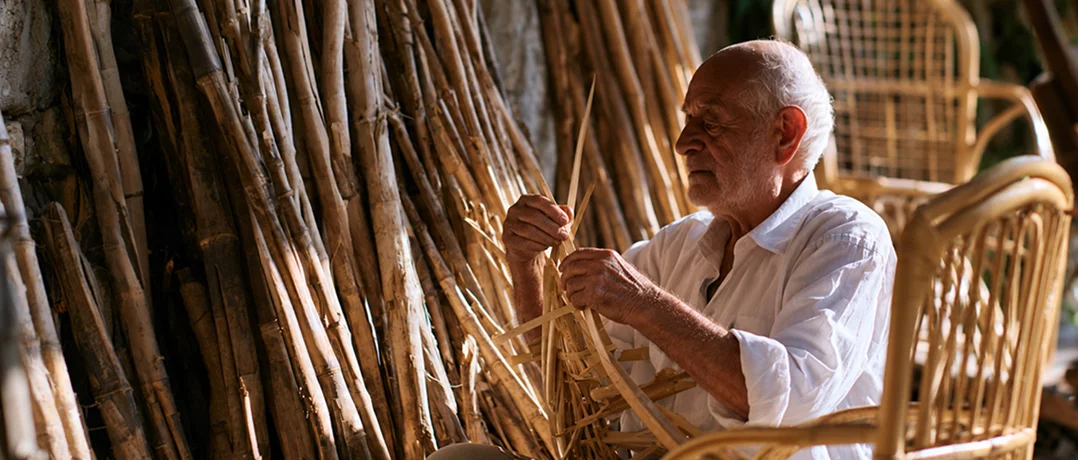
Wicker and rattan chairs, known locally as karaseh el-khayzaran, once furnished nearly every home, café terrace, and village porch in the country. Woven by hand from imported rattan canes and local reeds, these chairs carried an elegance, sturdy frames bent by heat rather than machinery, seats woven strand by strand into patterns passed down through generations of craftsmen. For much of the twentieth century, the craft flourished in workshops scattered across Beirut and its surrounding towns, supplying furniture shops with pieces built to outlast their makers.
Today, only a handful of artisans still carry that tradition forward. In a small workshop where curls of rattan lean against the walls, Rabih Bekhazi is continuing a trade he has practiced nearly his entire life, one he fears may not outlive him.
A craft learned by the hands
Mastering karaseh el-khayzaran was never merely a matter of instruction manuals. "Nobody teaches you this from a book," he explained, running a cane between his fingers to test its flexibility. "You learn it by holding the material until your hands understand it."
He described the process from its very beginning, raw rattan canes, often imported and left to dry, are soaked or steamed until pliable enough to bend without cracking. "The heat is what gives us control," he noted. "Rattan that is too dry will snap. Rattan that is too wet will not hold its shape once it cools. You learn to feel the exact moment it is ready."
Once softened, the canes are shaped into a chair's frame, the legs, the backrest, the seat's supporting structure, bent largely by hand and knee, with simple wooden molds used only for uniform curves. "The frame is the skeleton," Bekhazi continued. "If it is not precise, nothing you weave onto it afterward will sit correctly."
Once the frame is complete, the true artistry begins weaving thinner strands of wicker across the structure in patterns that vary by region and workshop. Bekhazi described this stage as the most demanding, requiring both rhythm and patience. "Every chair has to breathe the same tension throughout," he said. "If one row is looser than another, the seat will sag within a year, and then people say the craftsman was careless."
He estimated that a single chair can take several days from bare cane to finished piece, depending on the intricacy of its weave. Unlike upholstered furniture, a well-made rattan chair is prized for what it lacks, no nails driven through the seat, no glue holding the weave together, only tension, pattern, and the discipline of the weaver's hand. "This is furniture that forgives nothing," Bekhazi added. "Every mistake shows immediately, and every mistake stays there for the life of the chair."
A business built on trust
Unlike artisans who sell directly to customers, Bekhazi has never operated a retail counter. His workshop supplies furniture shops across Lebanon, which then sell his chairs under their own name. "People sit in my chairs in cafés and living rooms without ever knowing my name," he reflected. "That has always been the arrangement. I make, they sell. It was never about recognition; it was about the work being good enough that shops kept coming back."
That relationship, built over years of consistent craftsmanship, has sustained his workshop through economic downturns and shifting tastes, even as demand for handwoven furniture has steadily declined in favor of cheaper, mass-produced alternatives.
It is when the conversation turns to the future that Bekhazi's tone shifts. He has no children, and with them, no clear successor to inherit a trade he has spent his life perfecting. "One day I will be old, and I will have to close this shop," he admitted. "I only have one worker with me who knows this craft. After us, I am not sure who will carry it on."
His concern extends beyond the fate of his own business to the craft itself. He worries that karaseh el-khayzaran risks losing its identity altogether, not simply fading from the market, but being forgotten as a discipline with its own techniques, patterns, and standards. "It's that the knowledge of how to make them properly could disappear with the people who hold it," he explained.
An uncertain future for a living tradition
Bekhazi's story mirrors that of many Lebanese artisans working in trades once essential to daily life, now sustained by aging hands and dwindling apprenticeships. Karaseh el-khayzaran remains, for now, a craft of patience and precision, shaped by heat, tension, and years of muscle memory rather than machines. But without new hands willing to learn it, workshops like Bekhazi's risk becoming the last of their kind, their chairs outliving the very craftsmen who gave them form.
The hope is persistent, that somewhere, someone still values a chair woven by hand enough to want to learn how it is made before the knowledge, like the rattan itself, becomes too brittle to bend.
-
-

-
The Beiruter
-
