



How is the Lebanese Agricultural Research Institute (LARI) modernizing its laboratories, strengthening food safety, and supporting agricultural research across the country.
Cultivating Lebanon’s agricultural scientific future
Cultivating Lebanon’s agricultural scientific future
By The Beiruter | September 25, 2026

Reading time: 5 min
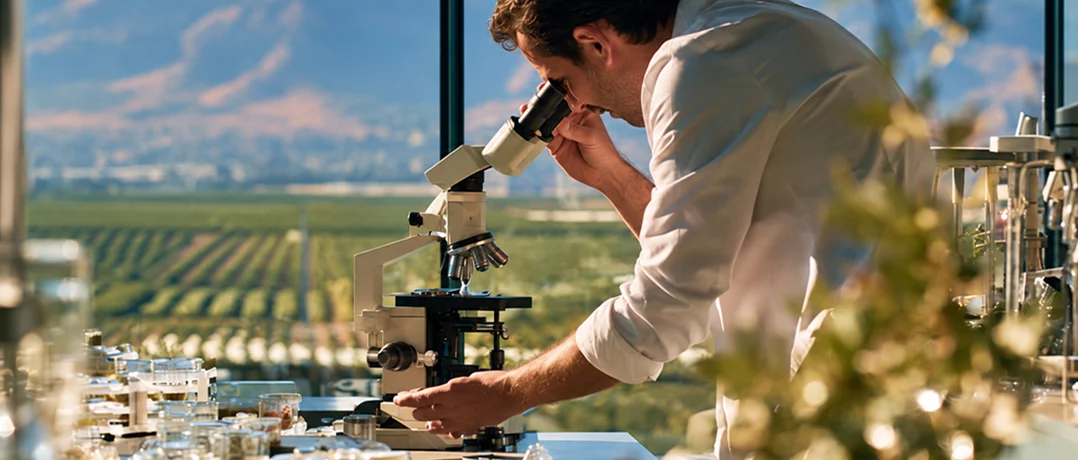
While Lebanon’s public sector has faced years of financial and administrative challenges, some state institutions have continued to modernize and strengthen their performance.
Among them is the Lebanese Agricultural Research Institute (LARI), which has recently accelerated laboratory modernization, administrative reforms, and scientific research while reinforcing its role in supporting agriculture, food safety, public health, and agricultural trade.
Recent modernization and institutional reform
The reform program has focused on reorganizing internal procedures, streamlining laboratory operations, accelerating administrative processes, and strengthening institutional governance. According to the institute, the new management has also introduced measures designed to improve transparency, reduce administrative bottlenecks, and combat corruption through clearer operational procedures and more efficient oversight.
One of the institute’s principal objectives has been to strengthen public confidence in state institutions while enhancing confidence among international partners in the reliability of Lebanon’s scientific laboratories and official testing results. The Council of Ministers has also approved the designation of LARI’s laboratories as the Lebanese state’s primary reference laboratories, reinforcing their position as the official scientific authority for laboratory analyses related to agriculture, food safety, and animal health.
As part of these reforms, the institute has approved the establishment of three new border laboratories at Beirut-Rafic Hariri International Airport, the Port of Beirut, and the Masnaa border crossing, under its Chairman of the Board and Director General Dr. Jad Chayaa. These facilities aim to accelerate laboratory testing associated with imports and exports by allowing samples to be analyzed directly at key entry points, reducing transportation delays, speeding up the issuance of results, and lowering both time and operational costs.
The institute has also intensified efforts to obtain international laboratory accreditation. Several laboratories already operate under internationally recognized standards, while additional facilities are undergoing accreditation procedures to further strengthen confidence in their scientific analyses.
The reforms have also translated into measurable operational gains. According to official figures, LARI’s revenues reached approximately LBP 133 billion as of 21 September 2026, compared with around LBP 40 billion during the corresponding period of the previous year; an increase of more than threefold within several months. The growth reflects expanded laboratory activity, improved administrative organization, faster processing of analyses, and increasing demand for the institute's services.
Supporting agriculture, food safety, and scientific research
LARI’s mission extends well beyond conducting agricultural research. The institute works closely with farmers to identify production challenges and develop applied scientific solutions that improve productivity, sustainability, and rural development while supporting Lebanon's food security.
Today, the institute manages a nationwide network of 12 specialized laboratories and employs more than 30 PhD holders and researchers, supported by specialized technical teams across multiple scientific disciplines.
Its laboratories perform a wide range of analyses, including testing drinking water, bottled water, irrigation water, wastewater, swimming pool water, food products, soils, fertilizers, and agricultural inputs. Specialized departments also conduct plant protection analyses, irrigation research, agricultural economics studies, viticulture research, veterinary medicine, biotechnology, tissue culture, seed development, plant nutrition, and pest management.
Animal health laboratories play a particularly important role by examining imported livestock and testing for diseases at Lebanon’s land and maritime border crossings, contributing to national biosecurity and public health.
Research findings are transferred directly to farmers through agricultural extension services, cooperation with public institutions, and partnerships with the private sector. The institute also works extensively with international organizations, including the Food and Agriculture Organization (FAO), the International Center for Agricultural Research in the Dry Areas (ICARDA), the United Nations Development Programme (UNDP), the World Bank, and regional research networks, to strengthen scientific cooperation, technology transfer, and research capacity.
LARI has also expanded its work into emerging agricultural sectors, including industrial cannabis. Since 2017, researchers have been conducting scientific studies on cannabis cultivation within Lebanon's environmental conditions. As the country develops the legal framework governing medical and industrial cannabis, plans are also underway to establish a specialized cannabis laboratory with international support.
A legacy of agricultural research and future development
Agricultural research in Lebanon dates back to the years immediately following World War II, when the Tel Amara station in the Bekaa Valley was established as an agricultural training center. In 1957, it became the Department of Agricultural Scientific Research within the Ministry of Agriculture before being reorganized in 1964 as an autonomous public institution under the supervision of the Minister of Agriculture, officially becoming the Lebanese Agricultural Research Institute. The latter is considered as Lebanon’s principal governmental institution for agricultural scientific research and laboratory analysis, serving farmers, public authorities, exporters, and consumers alike.
Today, LARI manages eight experimental research stations covering approximately 280 hectares across Lebanon’s principal agricultural regions. Located in areas producing both temperate and subtropical crops, these stations enable researchers to conduct field studies adapted to Lebanon’s diverse environmental and climatic conditions while developing practical solutions to challenges facing the agricultural sector.
The institute’s future is also closely linked to broader efforts to modernize Lebanon’s agricultural administration. Draft legislation has proposed reorganizing both the Ministry of Agriculture and LARI by introducing a clearer institutional structure, establishing a Scientific Council composed of leading researchers and university experts, modernizing procurement procedures, and strengthening research governance. The proposed reforms also seek to expand work in climate adaptation, irrigation technologies, livestock production, seed development, agricultural innovation, and technical training for farmers.
As Lebanon seeks to strengthen food security, improve agricultural competitiveness, and modernize public administration, LARI continues to play an increasingly important scientific and institutional role. Its recent progress demonstrates how sustained investment in scientific expertise and effective public management can strengthen one of the country’s most essential sectors.
-
-

-
The Beiruter
-
