



In an interview with The Beiruter, Lebanese-born transplant surgeon Professor Nadey Hakim reflects on medical firsts, the hand transplant he later had to reverse, and his ambition to make transplantation accessible worldwide.
The surgeon who sees the human body as sculpture
The surgeon who sees the human body as sculpture
By Adella Beaini | September 26, 2026

Reading time: 7 min
When Professor Nadey Hakim looks back at a career that has taken him from pioneering pancreas transplantation in London to the world's first successful hand transplant and kidney transplant programmes across the developing world, there is one operation that stands out.
It was 31 January 1995, when Professor Hakim left home at 3am to perform the first pancreas transplant at St Mary's Hospital, establishing the pancreas transplant programme in south-east England.
“For me personally, it was this point at which I realised transplantation was not simply going to be my specialty, it was going to be my life,” he told the Beiruter.
Three years later, Professor Hakim was part of the international team in Lyon that performed the world's first successful hand transplant, an operation that required surgeons to transplant bone, muscle, tendon, nerves, blood vessels and skin.
“Technically and conceptually, the first hand transplant in Lyon in 1998 was extraordinary because we were transplanting not one tissue but bone, muscle, tendon, nerves, vessels and, most challenging immunologically, skin,” he said.
“We were going into territory where nobody could tell us exactly what would happen."
But the moment that stayed with him most was not the celebrated "first".
In 2001, he was forced to remove the same transplanted hand after the patient stopped taking immunosuppressive medication.
“There is something very sobering about taking away what you had once helped give someone,” he said.
“Surgery teaches you that a “first” is never the whole story. The patient and what happens afterwards matter more than the headline."
From Lebanon to the operating theatre
Professor Hakim's approach to surgery was shaped long before he entered an operating theatre.
As a teenager, he lived through the Lebanese civil war. While bombs and rockets fell around him and schools closed, he found ways to continue learning, by putting on headphones, playing the clarinet, reading and learning languages.
"At that age you are not thinking, “This is training me to become a surgeon”, he said.
“You are simply trying to continue with your life while the world around you has become completely unpredictable."
The experience, he says, taught him something that would later become essential in surgery: how to remain focused when circumstances become unpredictable.
"Surgery is also about what you do when the situation becomes unpredictable. You cannot panic,” he said. “You have to know what matters, concentrate on the problem immediately in front of you and keep moving."
The war also changed his relationship with time.
"When you learn very young that circumstances can change in a second, you stop assuming that you have unlimited tomorrows. That has probably driven the intensity with which I have worked."
A Lebanese connection that travelled with him
Professor Hakim eventually trained and worked across multiple countries, including France, Britain and the United States, and has performed or helped establish transplant programmes in countries including Yemen and Nigeria.
But he says: "You can leave Lebanon, but Lebanon does not very easily leave you.”
His childhood, he says, gave him "language, family, humour, music, friendships and a certain way of looking at the world", as well as an ability to adapt to unfamiliar places.
However, he admits there is also a sadness attached to that connection.
"I saw what war could do to a beautiful country. That makes the connection more powerful, not less,” he said. “I have always wanted Lebanon to be associated not simply with conflict or crisis but with talented people, medicine, education, culture and achievement."
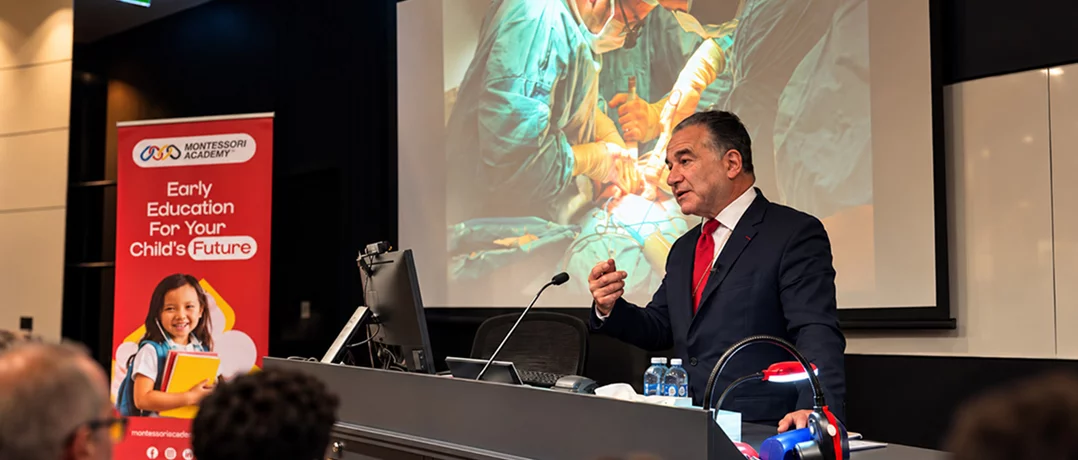
That was part of the message Professor Hakim brought to Sydney this week, when he spoke to members of the Lebanese diaspora at the University of Sydney.
For young Lebanese-Australians considering medicine, science or academia, his advice is direct.
"First, work harder than you think you need to. Intelligence is useful, but persistence is more useful,” he said.
"For a young Lebanese-Australian, I would say you do not have to choose between being Australian and Lebanese. Let having more than one home enlarge you rather than divide you."
The surgeon who became a sculptor
Away from the operating theatre, Professor Hakim has spent decades working with another kind of human anatomy: the face.
His subjects have included Queen Elizabeth II, Pope Francis, French President Emmanuel Macron, Donald Trump, Vladimir Putin and Narendra Modi.
In 2018, he travelled to North Korea after the sculpture he had made of Kim Jong-un was accepted for display at the Museum of Friendship in Pyongyang.
But his interest in sculpture began with a much more personal subject — his father – who he wanted to “immortalise”.
"I have said before that every operation is a form of sculpture,” he noted. “With surgery you separate tissues, identify structures, reconstruct anatomy and put things back together."
"The wonderful advantage in surgery is that the human body participates in the process, you stitch it and the body heals itself. Clay is less forgiving. If you make a mistake, the clay does not heal for you."
When art opens doors medicine cannot
Hakim's sculptures have taken him into rooms that his medical career could not have opened.
His decision to sculpt Kim Jong-un was not initially a commission. He made the decision himself, contacted a North Korean attaché in London and eventually travelled to Pyongyang to present the finished work.
"My view has always been that I am an artist, not a politician. A portrait is not an endorsement of every action or belief of the person represented,” he said.
"What fascinated me about the North Korea episode was also the extraordinary ability of art to open a door that medicine probably could not have opened. A piece of clay and bronze took me somewhere I would otherwise almost certainly never have gone."
The next chapter of transplantation
Now, as he prepares to lead the world's largest international transplantation society, Professor Hakim is looking beyond the operations that defined his career.
The Transplantation Society (TTS) was founded in 1966 and has had scientists and surgeons from around the world at its helm, including Sir Peter Medawar as president from 1966 to 1967.
Medawar, a Nobel Prize-winning British scientist born in Brazil to a Lebanese father and English mother, played a foundational role in understanding immunological tolerance — knowledge that became central to modern transplantation.
Six decades later, another British-Lebanese figure is taking the society into its next era.
At the TTS 2026 Congress in Sydney this week, Professor Hakim was introduced as the incoming president.
"Robotics will change how we operate and AI will increasingly influence matching, imaging, risk prediction, organ allocation and clinical decision-making,” he said. “But I think the most fundamental revolution may be biological rather than mechanical."
Technology, he noted, should not become the point of medicine. "My concern is that technology can become an end in itself. A beautiful robot is of little value to the patient who cannot get onto a transplant programme,” he said.
"I would rather see sustainable transplantation become available in countries that currently have little or no access than put the latest robot into another wealthy centre. That issue of global access matters enormously to me."
"I hope they remember that I was useful"
For someone whose career is filled with "firsts", Hakim is surprisingly reluctant to define his legacy through them.
He sees his greatest contribution not in the operations he performed or the honours he received, but in what remains after he leaves.
"I hope they remember that I was useful,” he said. "The surgeon you trained who becomes better than you; the programme you helped establish that is still transplanting patients 20 years after you have left; the young person who was encouraged rather than discouraged. That matters more to me."
And the final ambition is perhaps the largest of all: a world where transplantation is no longer constrained by geography, wealth, organ shortages or lifelong immunosuppression.
"If I could see that become normal medicine rather than experimental medicine, I would consider that a very good final chapter."
