



As Lebanon weighs a successor to UNIFIL, this analysis asks whether a new international force could support Lebanese-led disarmament and state authority or merely monitor the obstacles to both.
Who will enforce disarmament?

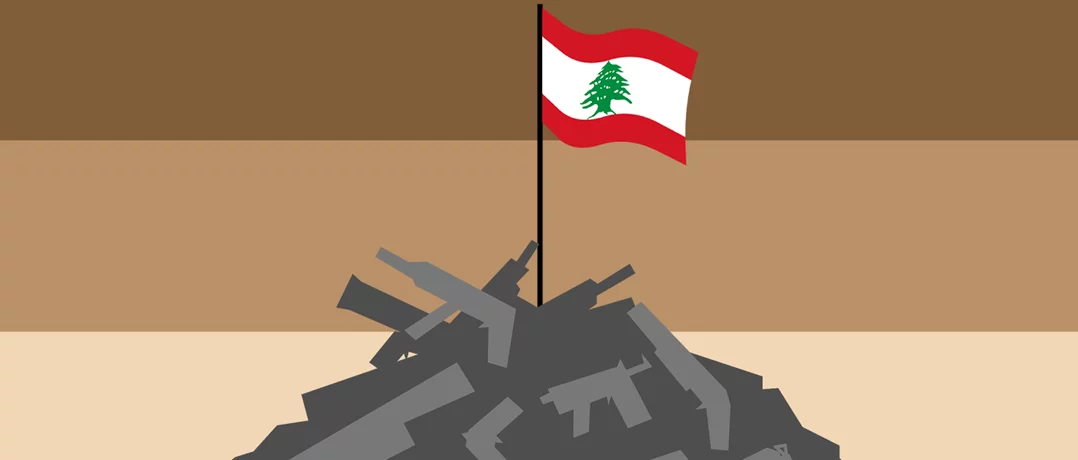
Lebanon is searching for a force to replace UNIFIL. The harder question is whether it is also searching for a way to enforce disarmament. A new international presence could help the state recover authority over its territory. It could also become the latest institution asked to manage the consequences of that authority remaining incomplete.
In New York on September 22, Prime Minister Nawaf Salam and Foreign Minister Joe Raggi pressed for an international presence after UNIFIL’s mandate expires. Salam outlined familiar but essential functions: monitoring, reporting and liaison, alongside support for the Lebanese Army as it extends state authority. The language suggests an effort to preserve the conditions under which Lebanese-led disarmament might proceed. It does not establish a plan for foreign soldiers to disarm Hezbollah themselves.
That distinction should guide the debate. Lebanon needs to know whether its partners are offering witnesses, assistance, protection or enforcement. These functions can complement one another, but none automatically supplies the others. A soldier able to document an armed violation is not necessarily authorized, equipped or politically supported to stop it.
UNIFIL’s existing mandate illustrates the problem. Resolution 1701 gave the force responsibilities supporting the Lebanese Army and a weapons-free area in the south but did not assign it a campaign to forcibly disarm Hezbollah. Its limitations cannot all be explained by its performance. They also reflect the gap between the political settlement it was meant to support and the authority available to implement it.
The approaching deadline makes that gap urgent. Under Resolution 2790, UNIFIL’s mandate ends on December 31, 2026, followed by a drawdown and withdrawal during the next year. President Joseph Aoun still favors an extension. Yet preparations for alternatives acknowledge that Lebanon cannot assume one will materialize, or that preserving the existing mission would resolve the underlying conflict.
Several possibilities are taking shape. UN Secretary-General António Guterres has proposed smaller UN configurations combining military observers with armed protection, with differing capacities to monitor and de-escalate. France and Italy have explored multinational arrangements, while Lebanon’s Foreign Ministry has proposed a three-year European civilian and military mission. According to reporting on September 18, Cabinet had not decided on that proposal. These remain possible arrangements, not an agreed force with settled powers.
The clearest connection to disarmament appears in Italy’s reported proposal. Accounts describe support for future disarmament measures “where agreed politically,” alongside civilian protection, ceasefire monitoring and coordination. An operational component could potentially accompany Lebanese troops. This could be consequential: assistance delivered alongside an army implementing state decisions is different from observing whether those decisions are implemented.
But the qualification carries much of the political weight. Whose agreement is required, and what happens when it is withheld? If assistance depends on the prior consent of the actor expected to surrender its weapons, the international framework may reproduce the veto it is supposed to help overcome. If it does not, participating governments must explain what risks they are prepared to assume.
This does not mean foreign troops should be invited into a war against Hezbollah. It means that an enforceable disarmament policy needs a response to refusal. Verification, restrictions on resupply, political pressure and lawful action by Lebanese institutions must form a credible process. Calling for disarmament while leaving obstruction without consequences allows the armed actor to determine the pace and limits of state authority.
Turkey’s interest makes the question more sensitive. On July 30, President Recep Tayyip Erdoğan publicly expressed readiness to participate in initiatives supporting Lebanon’s security after UNIFIL’s departure. This gives the Turkish possibility a firmer basis than speculation. It does not confirm an agreement to deploy Turkish troops to the Bekaa or a Turkish commitment to forcibly disarm Hezbollah.
The concern raised by that possibility remains relevant. A reduction in Iranian influence would not, by itself, transfer power to Lebanese institutions. Another regional actor could acquire influence over the arrangements that follow. Any Turkish participation should therefore be assessed through its mandate, command structure and political conditions, including whether it could draw Lebanon further into Turkish-Israeli rivalry. Military capability alone cannot answer those questions.
The same test must apply to European or Arab participation. Foreign assistance is not inherently incompatible with sovereignty. An under-resourced army may need it to become effective. The danger begins when assistance leaves an outside government able to determine which Lebanese decisions can be implemented. Success should mean that international support progressively makes itself less necessary.
The Lebanese government’s challenge is therefore larger than finding willing contributors. It must connect disarmament to an arrangement that protects the people being asked to accept the state’s exclusive authority. Israeli withdrawal, the end of attacks and credible Lebanese deployment are central to that task. Monitoring violations can support it, but recording an attack is not the same as preventing the next one.
This is where the political psychology of disarmament becomes decisive. A community can lose confidence in an armed movement’s capacity to protect it and still fear what follows its retreat. That uncertainty can preserve dependence even after devastating failure. Hezbollah need not persuade everyone that its military strategy has succeeded if it can persuade enough people that surrendering its weapons would leave them exposed.
Recognizing that mechanism does not grant Hezbollah a permanent entitlement to arms. It clarifies what the state must replace: the expectation, however contested or disappointed, that security depends on belonging to an armed community. That expectation will be harder to sustain if residents experience reliable protection, a credible return home and reconstruction through institutions that do not demand political loyalty in exchange.
Disarmament presented as the humiliation of a constituency risks strengthening the identification that sustains resistance to it. A credible state-led process should make a different proposition: political participation and physical safety do not depend on retaining a separate army. Shiite citizens must be addressed as citizens whose rights the state is obliged to protect, not as a population whose security is conditional on its political choices.
That obligation also exposes the inadequacy of treating Israeli conduct as a secondary issue. An international arrangement cannot credibly demand compliance from Lebanese actors while accepting repeated violations of Lebanese sovereignty as unavoidable. Unequal enforcement would give Hezbollah an argument against the settlement, even though Israeli violations cannot justify its indefinite control over decisions of war and peace.
The government should therefore make the practical questions public. Who verifies weapons removal? What follows blocked access or renewed armament? What action follows an Israeli violation? Who funds the Lebanese Army’s expanding responsibilities, and how will progress be measured? A mission’s geographical reach matters too: arrangements for the south cannot be assumed to resolve independent military power elsewhere in Lebanon.
These are the terms on which international involvement becomes useful. Lebanon does not need another promise that the state will eventually become sovereign. It needs a process through which each deployment, verified withdrawal and weapons transfer increases the authority of accountable Lebanese institutions.
The decisive moment will come when that process meets refusal. If obstruction merely produces another indefinite negotiation, a successor mission will have inherited the central weakness of the arrangement it replaced. Lebanon may have changed the uniforms watching over the south without changing who can prevent the state from governing it.
-
-

-
Dr. Ramzi Abou IsmailWriterPolitical psychologist and commentator on politics, identity, and conflict.
-
