



The return of the record, Lebanon’s vinyl shops
The return of the record, Lebanon’s vinyl shops
By The Beiruter | September 27, 2026

Reading time: 3 min
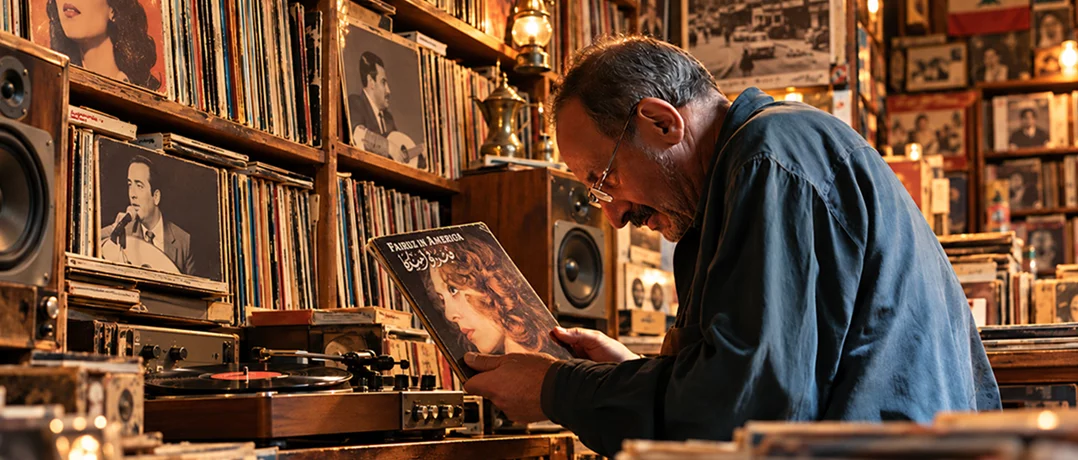
The appeal of a record often begins before the music plays. It is in recognizing an old album cover, finding a familiar name in a stack of records or hearing the first few seconds of a song through the crackle of a turntable. For many, vinyl is tied to memories of childhood homes, family collections and songs that once filled living rooms. Now, that nostalgia is finding its way back into Lebanon's music scene, as a new generation joins longtime collectors in searching through crates, building collections and bringing record stores back into the spotlight.
George Farah: From hobby to storefront
George Farah, owner of one of Beirut's longest-running vinyl outlets, told The Beiruter that the love affair started young and never really stopped. "I started as a hobby with vinyl, since I was young," he explained. Even as electronic streaming took over, “Vinyl remained special. You can hold it in your hands, and you can collect it just like you collect books."
Farah rode the format through its leanest years, moving fully online in 2010 and only opening a proper storefront years later. "The first place I opened was more like an office between an online business and a physical store," he confessed. Four years later, that office became a real shop. Today, the business is increasingly becoming a family affair. Farah's son, a music producer and DJ, is involved in the business, while his wife also helps out, adding another generation to a venture that began as a personal hobby.
The shift in demand has been dramatic. "Year after year, demand for vinyl keeps increasing... it has become something that actually affects the market." Looking at the industry now, in 2026, he expressed, "Vinyl is, if I can put it this way, absolutely taking over."
Karim Abi Lama: A newer face on the scene
Karim Abi Lama opened his corner shop in 1995, after what he describes as an accidental obsession. "I bought my dad's old turntable just to see if it still worked," he explained. "Three years later I had four hundred records and no space left in my apartment."
His approach leans heavily into curation. "I don't want a warehouse. I want twenty records that mean something, and twenty customers who trust my taste," he detailed. His shelves favor Lebanese and regional pressings, Fairuz reissues sit beside imported jazz and 90s trip-hop. "People come in looking for one thing and leave with three, because they trust that I've already done the filtering."
Abi Lama now represents vinyl’s newest wave, younger, more online, but chasing the same physical thrill. "Everyone my age grew up with everything instant," he said. "Vinyl allows you to sit with the album and let the music touch your soul. That's the whole point."
Chadi Alaeddine: Meeting the singer
Chadi Alaeddine’s passion a way of experiencing music that cassettes and CDs never quite allowed. “Vinyl records were an exceptional discovery for me because they allowed me to experience what I call ‘meeting the singer,’” he explained. “When I first heard my favorite singer on vinyl, I felt that his voice was present in front of me in a way that evoked a live performance.” That feeling eventually turned a personal passion into a business.
Chadi first opened his store in Verdun, but rising rents forced him to rethink the model. He eventually moved the business into part of his home on Makdoun Street in Hamra. The unusual setting has become part of the experience. “Some feel as though they are guests in a home while others see the visit as an exploratory adventure that opens the door to new musical worlds.”
His collection draws from both Lebanon and abroad. Older and Arabic pressings often come from families selling inherited collections or from furniture dealers who happen upon boxes of records. For new releases, Chadi and his wife, who co-runs the project, travel abroad to select titles across rap, indie, pop, metal and jazz. The result is a mix of eras, from rare Oum Kalthoum records from the 1960s to releases by Gorillaz and BTS. What has surprised him most is the interest among younger generations. “Younger generations are also drawn to records and want to discover music through them,” he detailed. He believes reviving that culture is an opening for something educational, commercial, and even touristic, rooted firmly in Lebanon's own musical past.
The collectors: Why they keep coming back
Behind every record store are the people who keep it alive, the collectors. Ask any of them why they do it, and the answers tend to circle the idea that vinyl is a relationship with the music.
Nour, a 29-year-old graphic designer has been collecting for six years. "It started with my grandmother's old Oum Kalthoum records," she said. "I inherited a crate of them and just never stopped adding to it." For Nour, the ritual is what matters most. "Streaming is background noise. Vinyl makes you actually sit down and listen, cover in your hands, needle dropping. It's a whole event." She organizes her collection by mood rather than genre, "one shelf is for rainy days, one is for driving", and estimates she now owns close to 200 records.
Then there is Rami, a retired engineer who has been collecting since the 1970s and never quit. "I have records I bought before some of these young collectors were born," he joked. Vinyl is about permanence in a world of disappearing files. "A hard drive dies, a streaming service shuts down, but a record just sits there and waits for you." Rami hunts for rare regional pressings at flea markets across Beirut and Tripoli, calling it "treasure hunting for adults."
Beirut's vinyl revival is a hunger for the tangible in an increasingly weightless digital world. As The resurgence keeps getting stronger and stronger.
A record is an object to hold, a cover to unfold, a needle to place and a sound that carries the character of the medium itself. The ritual brings back a sense of nostalgia and intimacy that can be difficult to replicate through a screen or a streaming playlist. Vinyl is a reminder to slow down, listen closely and let the music stay with you.
-
-

-
The Beiruter
-
