



The Gulf energy crisis is accelerating a global turn toward biofuels, but replacing imported oil with domestically produced fuel is putting new pressure on agricultural land.
The fight for land on one line

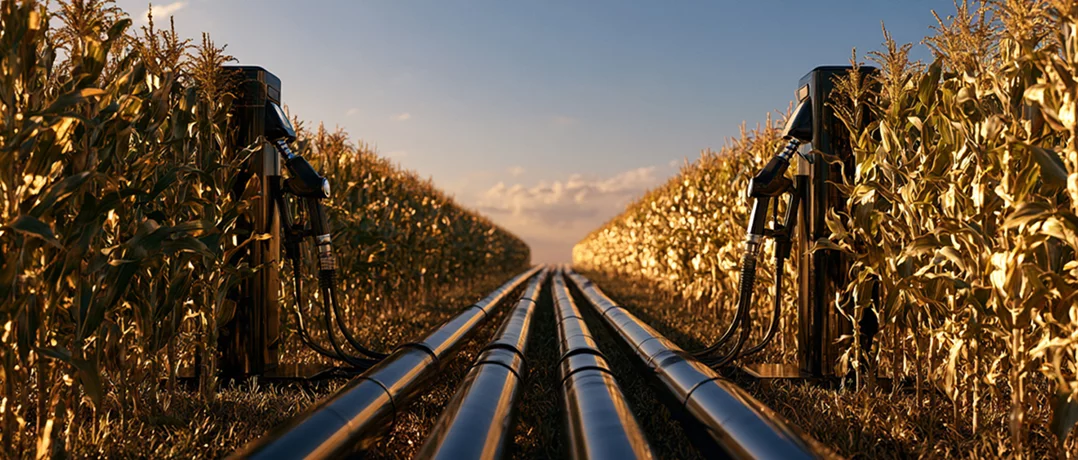
As disruption in the Gulf put oil supplies at risk this year, governments turned to an alternative that could be grown rather than drilled: biofuels. Produced from crops and organic waste, fuels such as ethanol and biodiesel can be blended into petrol and diesel using existing infrastructure. Brazil, China, India, Indonesia, the United States and the European Union have since proposed or pursued higher requirements for blending biofuels into conventional fuel. According to a September 2026 Chatham House analysis drawing on national blending mandates and International Energy Agency projections, global biofuel production could rise from around 105 million tonnes of oil equivalent in 2025 to 176 million by 2030, an increase of 68%. Before the crisis, annual growth of only 0.9% to 1.4% had been projected. But the faster countries replace imported oil with fuel grown at home, the more one resource-security problem risks colliding with another. Producing substantially more biofuel ultimately puts more pressure on agricultural land. Biofuels can be deployed quickly during a supply shock and often produced domestically, but much of their raw material comes from the same agricultural system that feeds people and livestock. The Organisation for Economic Co-operation and Development (OECD) and UN Food and Agriculture Organization's (FAO) Agricultural Outlook 2025–2034 shows how heavily biofuels depend on major crops. The United States, which produced 45.7% of the world's ethanol during 2022–24, relies predominantly on maize. Brazil, responsible for another 25.3%, uses sugarcane, maize and molasses. India's ethanol industry draws on sugarcane, molasses, rice, maize and wheat, while Indonesia, which accounted for 18.5% of global biodiesel production, relies on palm oil. Even before the latest energy shock, biofuel demand was absorbing a substantial share of some crops. According to the OECD-FAO outlook, around half of Brazil's sugarcane production has been used to produce ethanol over the past decade, while the share of India's sugar production used for ethanol is projected to rise from around 9% to 22% by 2034. Expanding biofuels therefore also changes demand for crops, agricultural inputs, and land. India has already demonstrated how quickly the balance between imported oil and domestically produced fuel can shift. Little more than a decade ago, ethanol made up less than 1.5% of the petrol sold in the country. By 2025–26, the blend had reached 20%, five years ahead of the government's original target, as ethanol production capacity climbed nearly fivefold from 4.21 billion litres in 2014 to around 20 billion litres in 2026. The government has explicitly tied that expansion to reducing crude-oil imports and conserving foreign exchange. Indonesia is pursuing a similar objective through palm oil on an even larger blending scale. After introducing B40 diesel, containing 40% palm-based biodiesel, in 2025, Jakarta revived plans to increase the share to 50% following oil-supply disruptions linked to the conflict with Iran. The government estimated that operating B40 during the first half of 2026 and B50 during the second could save 157.28 trillion rupiah, about $8.9 billion, in fuel-import costs. Palm-based biodiesel demand could reach 17.6 million kilolitres this year. Higher crude prices also made palm-based diesel relatively cheaper, reducing Indonesia's estimated biodiesel subsidy requirement from 47 trillion rupiah to 32 trillion, although that advantage narrowed when oil prices subsequently fell. Producing more fuel from crops ultimately requires agriculture to provide more raw material. Higher yields, more intensive cultivation and crops redirected from food or animal feed can meet some additional biofuel demand. Beyond that, expanding supply can require bringing more land into production. The potential increase is substantial. Around 32 million hectares worldwide were used to grow biofuel feedstocks in 2023, according to the Chatham House analysis. Before the Gulf crisis, projections implied another 20 million hectares would be needed by 2030. If the higher mandates proposed since the crisis are fully implemented, the additional requirement could instead reach around 36 million hectares, an area roughly the size of Germany. The 36 million hectares represent additional land demand, not equivalent forest clearance, and could be met through new cropland, higher production on existing fields or crops diverted from other uses. Those trade-offs also complicate the climate case for biofuels. World Resources Institute analysis published in February 2026 found that cropland generated nearly 5% of net human-caused greenhouse-gas emissions in 2020. Four crops accounted for 67% of those emissions: rice, maize, wheat and oil palm. All four are also used as biofuel feedstocks. Indonesia is therefore a particularly important test. Higher palm demand does not automatically produce deforestation, but plantation expansion can put forests under pressure directly or displace other agriculture onto new land. With biodiesel overwhelmingly dependent on palm oil, the shift toward B50 could intensify that pressure. Not every biofuel carries the same land cost. Used cooking oil, agricultural residues and other waste materials reduce the need for purpose-grown crops, but supplies are finite and multiple industries compete for the same biomass. Limited supply therefore raises another question about where biofuels are most useful. Road transport can shift toward electric vehicles, while aviation has fewer alternatives to liquid fuels because batteries remain too heavy for most commercial flights. Biofuels can offer governments something valuable during an oil shock: a relatively fast way to substitute domestic resources for imported petroleum. But producing fuel domestically does not eliminate resource constraints. It shifts part of the challenge from securing enough oil to securing enough crops, waste and land to replace it.Fuel from the field
An energy-security race
The land equation
A bridge, not a destination
-
-

-
The Beiruter
-
