



Melhim Bou Alwan, an Atlanta-based doctor and avid traveler, has visited 193 countries and is now three away from completing his journey to every country in the world.
The Lebanese explorer who has seen the world
The Lebanese explorer who has seen the world
By The Beiruter | September 29, 2026

Reading time 4 min
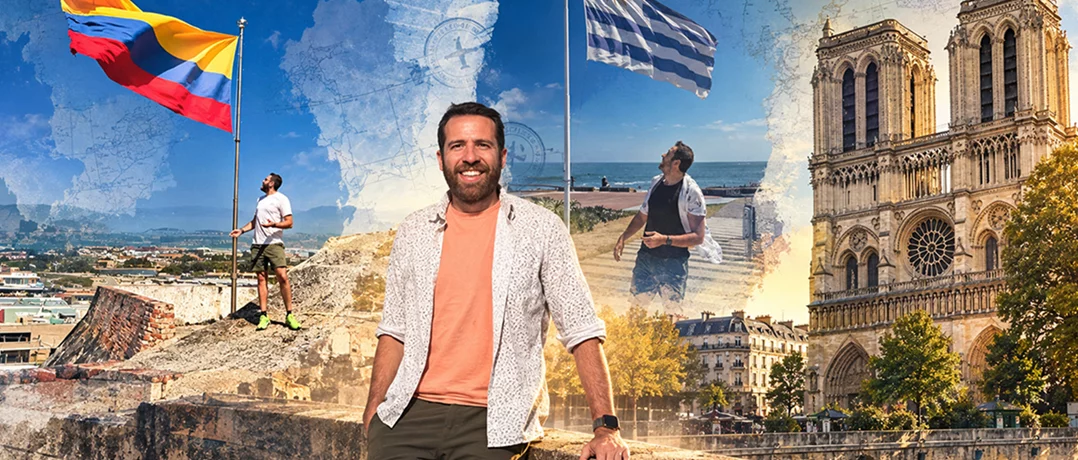
Melhim Bou Alwan, a doctor and passionate explorer, has visited 193 of the world’s 196 countries and is now just three away from completing the full list. The Atlanta-based internal medicine doctor has stamped his passport in almost every country, having only three left.
Bou Alwan’s journey began in Abu Dhabi, “I was 18 and I went to visit my sister, he told The Beiruter. In order to save up for the trip, he was tutoring students after university classes. He did not set out to do this. "Nobody starts from zero thinking they want to visit every country in the world," he explained. He simply traveled until he reached country number 100. The turning point came soon after. "After country number 100, I met a group of people who travel a lot, and they brought this goal closer to me," he recalled. The journey was a long one. “The first 100 countries took 22 years the second 93 took 3 years.”
Places he had written off because of security risks, visa barriers and danger, such as Yemen and Afghanistan, suddenly looked possible, because the people around him were going there. "I felt that it could actually be done."
He is firm that this is not a box-ticking exercise. Every country counts only if he spent real time in it. "I always spend time in the country," he explained. Stays range from two days to ten, and some places he has returned to several times. He added, "there is no country where I just touched down and left."
Two passports and endless paperwork
Bou Alwan became American about five years ago, but more than half of his countries were reached on his Lebanese passport, which made the logistics punishing. "Visas, visas and more visas," he said with a laugh. "I have become an expert on visas."
Now the passports are being used strategically. The final countries on his list are the hardest, and several are closed to Americans. "Americans are prohibited from entering many of these countries," he explained, citing Mali and Burkina Faso as examples. Iraq is far easier on the Lebanese passport, and he used it for Iran and Yemen as well. He is even flying back to Lebanon specifically to apply for a Venezuelan visa, since the American passport makes that one difficult.
Bou Alwan still works full time. When we asked how he balances medicine with a life on the road, he laughed, "I do not know." What he does have is a routine, about two weeks abroad each month, then roughly ten days to two weeks of shifts in the United States. Only two days before our conversation he had wrapped up ten days of work in a row.
The surprise element of his travels
Out of all the countries that left an impact on him, the place surprised him most is one he had postponed for a long time. "I do not know why I loved Iraq so much," he explained. "I consider it one of the five most beautiful countries."
Part of it was the welcome. "People there really like Lebanese people. Everyone was so nice." Part of it was the history, Mesopotamia, the cradle of human civilization, along with Baghdad and the Abbasid Caliphate that generations of Arab schoolchildren study. He also saw a country slowly recovering. "It is very nice to see that after everything that happened, a country is trying to get back on its feet."
Not every stop on his journey was gentle. In South Sudan, the world's youngest country, born in 2011, photography is strongly disliked. While he was traveling with a group, a Greek member snapped a picture of an empty farm.
After the driver turned the car around, about 50 people appeared in the dark, with motorcycles blocking the road as they banged on the vehicle and tried to break in. "It was a little scary." What saved them was language. The locals spoke Arabic, and Bou Alwan improvised. He told them the photographer was a foolish European who knew nothing, and the crowd started laughing. "We managed to smooth things over in Lebanese," he said. "Otherwise, we really would have been stuck."
Food also became an important part of Melhim’s travels, with some destinations standing out for their culinary traditions. “Japan, Thailand, Peru, Mexico all have great food,” he said. His travels have also pushed him well beyond familiar dishes and ingredients. “I’ve eaten all kinds of animals,” including “ostrich, alligators, worms and crickets.” He has even tried more unusual meats, including “bears” and “horses.”
The less-touristic and more remote countries can be some of the most difficult and expensive places to reach. “They are super expensive to fly to because there are limited flights and they are less connected,” he explained. “Sometimes, just getting there can be one of the biggest expenses of the trip.”
The final three
The remaining countries are Venezuela, North Korea and Palestine. Venezuela is a paperwork problem he can work on. The other two are largely out of his hands. North Korea, he noted, is "one of the most difficult countries," and there are travelers who have seen nearly everywhere else yet remain stuck on it.
"I feel this is a lifelong journey," he said, "trying to show people around the world not just through the labels of religion, country, political system, skin color, race, or things like that." He wants viewers to separate the human beings from the assumptions attached to them.
As for what comes next, even his closest friends are asking. His medical career sits far from the travel world, and he has not found a way to merge the two. "I still do not really know," he admitted. But one thing is settled: "Travel will definitely remain a big part of my life." Countries he loved deserve return visits, and the big ones deserve several.
Reaching the end raises an odd feeling. "I do not know what I am going to do with myself," he joked. "But yes, it is a big accomplishment." The real mission starts once the list is complete. Over the past year of posting on social media, he has seen how many misconceptions people hold about other countries, often shaped by a political system, a religion or a nationality. He hoped that he can play a part in showing the true beauty of every human.
-
-

-
The Beiruter
-
