



Lebanese Prime Minister Nawaf Salam and U.S. Secretary of State Marco Rubio discussed security, reforms, sovereignty, and Lebanon’s recovery in Washington.
Salam meets Rubio in key Washington talks

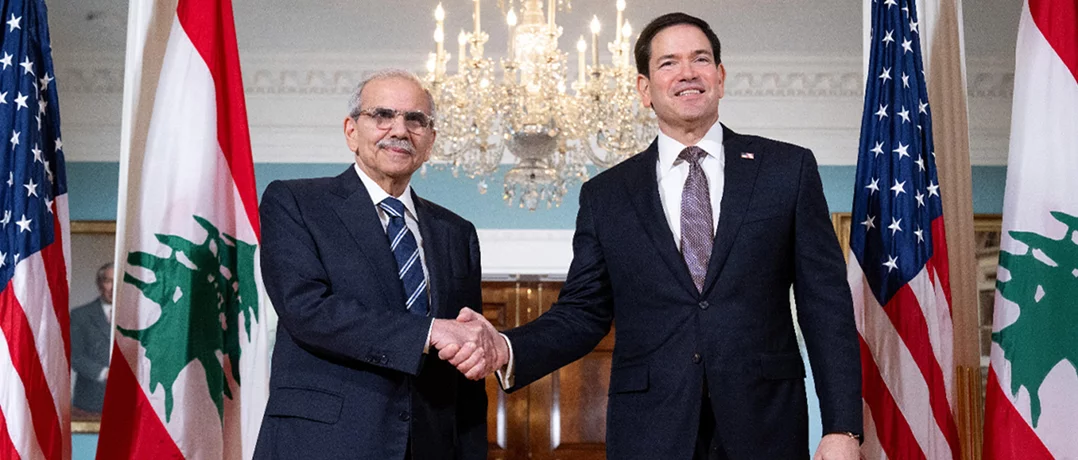
Lebanese Prime Minister (PM) Nawaf Salam held high-level talks with United States (U.S.) Secretary of State Marco Rubio in Washington on Monday, placing security, sovereignty, economic recovery, and bilateral cooperation at the center of discussions.
The meeting, one of the most significant diplomatic engagements of Salam’s visit to the U.S., came amid ongoing negotiations concerning southern Lebanon (including the upcoming third round of the Rome talks with Israel), the future of the ceasefire implementation process, and international efforts to strengthen the Lebanese state.
Focus on implementing the tripartite framework
The meeting took place at the U.S. State Department and was attended by Lebanese Foreign Minister (FM) Youssef Raggi, U.S. State Department Counselor Dan Holler, Lebanese Ambassador to the U.S. Nada Hamadeh Mouawad, and U.S. Ambassador to Lebanon Michel Issa.
According to the Lebanese PM’s Office, the discussions focused on developments in Lebanon and the wider region, as well as efforts to restore Lebanon’s full sovereignty. Salam stressed that Lebanon seeks a renewed partnership with the U.S. that supports the government’s state-building agenda and strengthens legitimate national institutions. Central to his message was the need to move from political understandings to practical implementation of the tripartite framework.
He highlighted translating the principles of reciprocity and gradual implementation into concrete steps that would lead simultaneously to a full Israeli withdrawal from Lebanese territory, the extension of state authority across the country, and the exclusive possession of arms by the Lebanese state. U.S. officials reportedly stressed their commitment to preserving the framework as the main available path forward, with Rubio conveying to the Lebanese delegation that “if the framework fails, there is no alternative.”
The prime minister also called for a clearly defined timetable governing implementation of the framework, arguing that parallel progress on Israeli withdrawal and the expansion of state authority would help sustain momentum and prevent delays.
Verification mechanism and parallel implementation
A key issue raised during the discussions was the establishment of a credible verification mechanism to monitor implementation by all parties.
Salam proposed that implementation proceed on a reciprocal basis, whereby Israeli withdrawals from specific areas would coincide with measurable Lebanese steps to consolidate state authority and implement commitments related to the state’s monopoly over weapons.
The discussions also explored possible international participation in a future monitoring mechanism under a United Nations (UN) umbrella, with several countries reportedly mentioned as potential contributors to verification efforts. However, no official announcement was made regarding the composition or mandate of such a mechanism.
The Lebanese government has consistently argued that credible monitoring arrangements are necessary to ensure commitments are implemented simultaneously and to avoid either side citing delays as justification for suspending the process.
Security, reconstruction, and the Lebanese Armed Forces
Salam underlined that the tripartite framework extends beyond military arrangements and should also support Lebanon’s post-conflict recovery.
He highlighted the need for international assistance in reconstruction, rehabilitation of damaged infrastructure, restoration of essential public services, and the creation of conditions enabling displaced residents to return to their communities safely.
The prime minister also appealed for continued U.S. support for the Lebanese Armed Forces (LAF), describing the military as the primary institution responsible for extending state authority throughout Lebanese territory.
For its part, the U.S. reaffirmed its commitment to supporting Lebanon’s legitimate institutions and maintaining assistance to the LAF. Rubio also reiterated Washington’s support for advancing implementation of the tripartite framework as a means of promoting stability and security.
FM Youssef Raggi also played an active and central diplomatic role during the visit. Following the Salam-Rubio meeting, Raggi remained at the U.S. State Department for additional discussions with Ambassador Michel Issa, reportedly continuing talks with American officials before a separate set of meetings scheduled in Washington, including engagements at the White House.
After the meeting, Salam offered only a brief public assessment, describing the talks as “good.”
Southern Lebanon and the future of UNIFIL
The meeting came as southern Lebanon remains the principal focus of Lebanese-American consultations.
Beirut continues to seek a complete Israeli withdrawal from Lebanese territory while stressing the importance of strengthening the Lebanese state’s presence in the south through the deployment of national institutions, particularly the LAF.
The future of the United Nations Interim Force in Lebanon (UNIFIL) also remains under discussion internationally. Under United Nations Security Council (UNSC) Resolution 2790, adopted in 2025, UNIFIL’s mandate continues until 31 December 2026, after which the mission is scheduled to begin a phased, orderly withdrawal over the following year rather than ending immediately.
Lebanon and France, along with several other European countries, have advocated maintaining an international presence in southern Lebanon beyond the current mission, while discussions continue regarding possible arrangements to support the LAF after UNIFIL’s existing mandate concludes.
Economic reform and financial cooperation
Outside the agreed-upon agenda, Salam also met U.S. Treasury Secretary Scott Bessent alongside Lebanese Finance Minister Yassine Jaber. The discussions focused on economic and financial relations between Lebanon and the U.S., as well as the government’s progress on financial and banking sector reforms.
Salam presented the steps taken by his government to advance banking sector restructuring and address the consequences of Lebanon’s prolonged financial crisis. The talks also covered negotiations with the International Monetary Fund (IMF) and cooperation with the World Bank, with the Lebanese prime minister requesting continued U.S. support for Lebanon’s reform program and broader economic recovery efforts.
Additional discussions addressed measures to reduce the size of Lebanon’s cash-based economy, strengthen financial transparency, combat money laundering and terrorist financing, and improve compliance with international financial standards; reforms viewed as essential for restoring confidence in Lebanon’s financial sector and reintegrating it into the global financial system.
Although no major policy breakthroughs were announced, the visit reaffirmed ongoing U.S. engagement with Lebanon at a critical juncture. For Beirut, the priority remains translating diplomatic understandings into concrete implementation, while simultaneously securing international support for reconstruction, institutional strengthening, and long-term economic recovery.
-
-

-
The Beiruter
-
