



Researchers in eastern Türkiye say radar scans and drill cores from a boat-shaped mound could offer new clues to Noah’s Ark, though archaeologists stress that the evidence remains unconfirmed and requires further testing.
Could new evidence finally reveal Noah’s Ark?
Could new evidence finally reveal Noah’s Ark?
By The Beiruter | September 30, 2026

Reading time 4 min
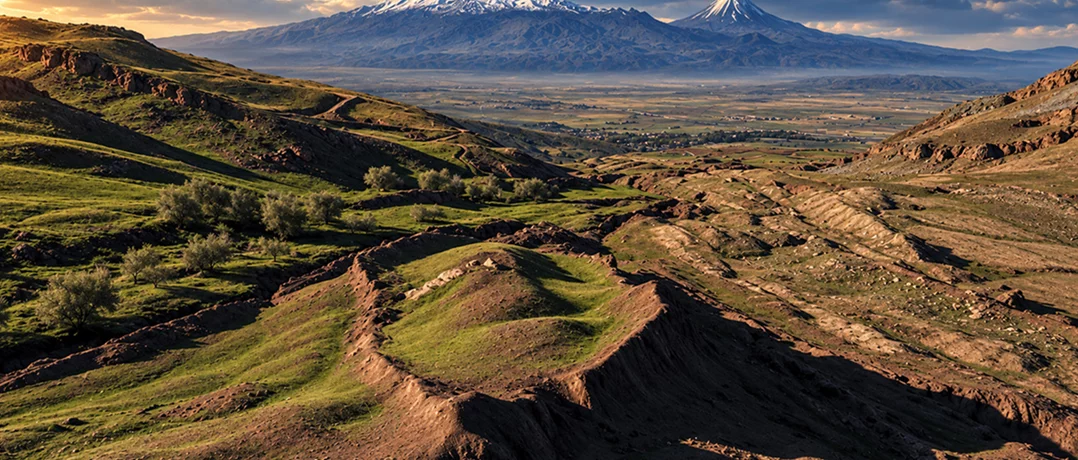
For thousands of years, one question has followed the story of Noah's Ark, where is the boat? This year, a team working in eastern Türkiye announced that scans and drill cores beneath a ship-shaped mound might finally point to an answer.
The Ark first appears in the Book of Genesis. God, grieved by human violence, instructed Noah to build a vessel of "gopher wood," measuring 300 cubits long, 50 wide and 30 high, roughly 137 by 23 by 14 meters, with three decks. Noah gathered his family and pairs of animals, survived the flood, and, according to Genesis, the Ark came to rest on "the mountains of Ararat."
The Bible names a mountain range, not a peak, which matters to everything that followed. The flood narrative also has older cousins. Mesopotamian texts, including the Epic of Gilgamesh and the Atrahasis, describe a wise man warned by the gods, a boat sealed with pitch and a great deluge.
A long history of sightings
Ancient writers such as the Babylonian priest Berossus and the historian Josephus mentioned local traditions of Ark remains in the Armenian highlands. Medieval travelers repeated similar tales, and explorers kept climbing Mount Ararat, a 5,137-metre volcano, in search of proof.
The modern era produced a string of dramatic claims. French explorer Fernand Navarra brought back timber from the mountain in 1955, but later dating placed the wood far too recently to belong to the biblical Ark. In 2010, a Hong Kong-based group announced it had found the vessel on Ararat, and critics later alleged the wood had been planted.
The Durupınar Formation, about 20 miles south of the mountain, entered the story in 1959, when a Turkish army captain, İlhan Durupınar, spotted a boat-shaped outline in aerial photographs. Amateur explorer Ron Wyatt promoted it from the 1980s, but geologists repeatedly concluded it was a natural feature shaped by mud and rock movement. Even some early supporters eventually changed their minds. The formation's roughly 157-metre length also exceeds the biblical dimensions.
In September 2026, an international team led by Professor Cenker Atila of Sivas Cumhuriyet University reported ground-penetrating radar readings suggesting straight lines, right-angle intersections and hollow spaces beneath the mound. Drill cores reaching about 18 meters brought up organic-rich layers, and one drill bit reportedly snapped against an extremely hard layer. Team member Andrew Jones has suggested petrified or mineralized wood as one possibility. The researchers plan to send a small robot into the boreholes, and laboratory results are pending.
An archaeologist’s perspective
To understand how a specialist reads such claims, The Beiruter spoke with Claire Tarabay, an archaeological researcher in the Texas Archeological Exploration Laboratory
Her first caution concerned the radar. "Ground-penetrating radar does not photograph a room," Tarabay explained. "It records changes in material and density. A straight line on a screen can be a wall, but it can just as easily be a fracture, a layer of sediment or a buried stone seam."
She was equally careful about the drill cores. "Organic material is not the same as wood, and wood is not the same as a ship," she noted. "Mud, roots and ancient vegetation all produce organic layers. Until someone dates that material and identifies it, it tells us very little."
The hard layer that broke the drill bit did not persuade her either. "Bedrock breaks drill bits all the time," she said. "It's an interesting anecdote, but it isn't a finding." The most serious problem, she argued, was the language surrounding the project. "When a team announces that something is '100 percent confirmed' before peer review, I become skeptical," Tarabay stated. "Confirmation in archaeology means independent laboratories, published methods and other researchers reaching the same conclusion.”
She acknowledged the site was not worthless. The pottery, ranging from the Chalcolithic period to the Iron Age, shows people used the area for a very long time. "That's genuinely useful for understanding the region," she observed. "But it's evidence of ordinary human occupation, not of Noah yet."
What would change her mind is “dated timber with tool marks and joinery, recovered under controlled excavation, then published so others can test it," she said. "Extraordinary claims need exactly that kind of evidence." "If the results hold up, I'll be the first to say so," she said. "If they don't, we will still have learned something real," she concluded.
The Ark may remain out of reach, yet the search reveals something about human curiosity. Radar images, core samples and a robot exploring narrow boreholes may finally yield data that can be tested.
-
-

-
The Beiruter
-
