



On World Vegetarian Day, the humble bean makes its case against beef, not for eliminating meat, but for what happens when a little more of the world’s protein comes from plants.
What if we all ate a few more beans?

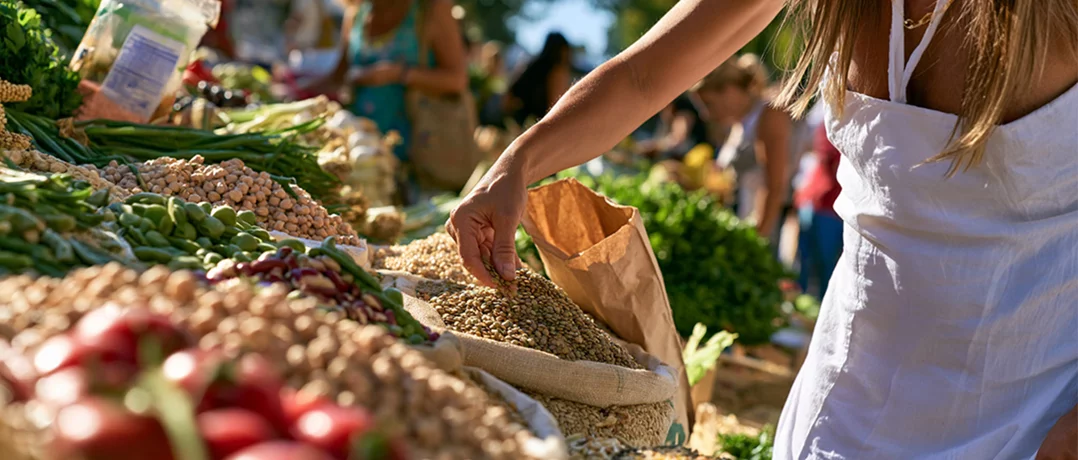
A steak and a bowl of beans can offer the same promise on a nutrition label — protein — while making very different demands on the planet. Producing 100 grams of protein from beef generates about 25 kilograms of greenhouse-gas emissions, according to Our World in Data, a research publication based at the University of Oxford. The same amount of protein from beans generates just 0.65 kilograms, falling to 0.4 kilograms for peas. The disparity does not mean that the world’s eight billion people must, or are inclined to, abandon meat. Quite the opposite. The Organization for Economic Co-operation and Development (OECD) and the United Nations Food and Agriculture Organization (FAO) expect consumption of livestock and fish products to rise sharply in many lower-income countries as incomes increase, even as scientists argue that populations with high meat consumption should move in the other direction. Yet despite the world’s enduring appetite for meat, on World Vegetarian Day, the humble, often underappreciated bean offers a useful way into a much larger question. What would happen if the world did not become vegetarian, but simply ate somewhat more like one? Not all protein arrives with the same environmental bill. The difference begins long before dinner, with land, animal feed and other farm inputs. Food production accounts for roughly 26% of global greenhouse-gas emissions, according to Our World in Data, with livestock and fisheries responsible for 31% of food-system emissions and land use another 24%. The estimates draw in part on research by environmental scientists Joseph Poore and Thomas Nemecek covering 38,700 farms in 119 countries. Even among beef producers, emissions vary substantially, from 9 to 105 kilograms of CO2-equivalent per 100 grams of protein. There is another surprise hiding in those numbers: transport accounts for only about 5% of food-system emissions, while air freight represents just 0.16% of global food miles. In climate terms, what is on the plate can matter considerably more than how far it travelled. World Vegetarian Day, in other words, need not require a solemn farewell to hamburgers or a lifetime commitment to lentil soup. Moving a few meals down the emissions ladder can already make a difference. If the future of sustainable eating sounds as though it should involve laboratories and futuristic imitation meat, agricultural projections suggest looking somewhere rather less glamorous. The lentil is doing rather well. Global consumption of pulses, including lentils, chickpeas, beans and peas, reached 101 million tonnes in 2024, according to the 2025 OECD-FAO Agricultural Outlook, and is expected to keep rising. Average consumption is projected to reach 8.6 kilograms per person by 2034, while global supply is forecast to expand by 26 million tonnes, around 40% of it from Asia. Pulses have an agricultural advantage as well as a nutritional one. Leguminous plants can fix atmospheric nitrogen through relationships with soil bacteria, helping reduce dependence on synthetic fertilizer and making them useful in crop rotations. Yet despite the growing appetite for pulses, the world is hardly marching toward vegetarianism. The same 2025 OECD-FAO outlook finds no fundamental move away from meat in high-income countries, where plant-based substitutes remain a small share of consumption. As diets become richer, the picture changes. Per-person consumption of livestock and fish products in lower-middle-income countries is projected to rise by about 25% over the coming decade. Among the poorest countries, however, nutrient-rich animal foods are expected to provide just 143 calories per person per day by 2034, less than half the 300 calories used in the FAO's Healthy Diet Basket. Cutting meat is therefore a very different proposition in a wealthy country consuming it in abundance than in a household where access to protein and micronutrients remains inadequate. In Lebanon, a more plant-heavy diet hardly requires inventing a new cuisine. Lentils, chickpeas and grains already anchor dishes from mujaddara and hummus to soups and stews. Ali Chalak, a professor of applied economics in the Faculty of Agricultural and Food Sciences at the American University of Beirut, sees potential in those familiar foods. “A Lebanese diet-modelling study found that a diet with 50% more legumes could reduce food-related greenhouse gas emissions by 24% without increasing its estimated cost,” Chalak told The Beiruter. Lebanon’s reliance on imports adds another constraint. “Lebanon’s Ministry of Agriculture estimated in its 2020 strategy that imports accounted for 75–80% of food consumption,” he said. Lebanon also sits within a region where diet and environmental impact do not always move together. A July 2026 study published in npj Science of Food, a peer-reviewed Nature Portfolio journal, compared 21 Eastern Mediterranean countries with global trends. It found that average diet-related emissions in the region rose from 2,228 grams of CO2-equivalent in 1990 to 2,370 grams in 2018, compared with a global increase from 1,929 to 2,309 grams, with red meat accounting for roughly one-quarter of the region's emissions and one-third globally. The case for plant-rich diets is not a demand for universal vegetarianism. The 2025 EAT-Lancet Commission, a group of international experts on food, health and sustainability, proposes a Planetary Health Diet dominated by whole grains, fruits, vegetables, nuts and legumes while leaving room for moderate quantities of animal products. Its modelling puts an extraordinary number on the potential health effect. The Commission estimates that adopting the Planetary Health Diet could prevent roughly 27% of global mortality associated with dietary risks and undernutrition. The diet is also less austere than its name suggests, allowing some fish, poultry and dairy while treating red meat as an occasional food rather than a daily default. The world is unlikely to collectively order the lentils. Nor would the same dietary prescription make sense everywhere. In poorer countries, greater access to animal-source foods can still improve nutrition, while in wealthier populations the environmental gains from reducing high levels of meat consumption can be substantial. The more plausible change is less dramatic. Some beef becomes beans. Chickpeas take another turn at dinner. Lentils gain a little more acreage. The diet of the future, it turns out, may depend less on inventing new foods than finding more room on the plate for some of humanity's oldest ones.The beef and bean problem
The revenge of the lentil
Lebanon already knows its beans
The challenge is making that shift work for everyone. Farmers need reliable water and viable markets, while households need affordable, varied food.
Strengthening local production matters as much as changing what we eat.
Nobody has to confiscate the steak
-
-

-
The Beiruter
-
