



The cup that says "Welcome"

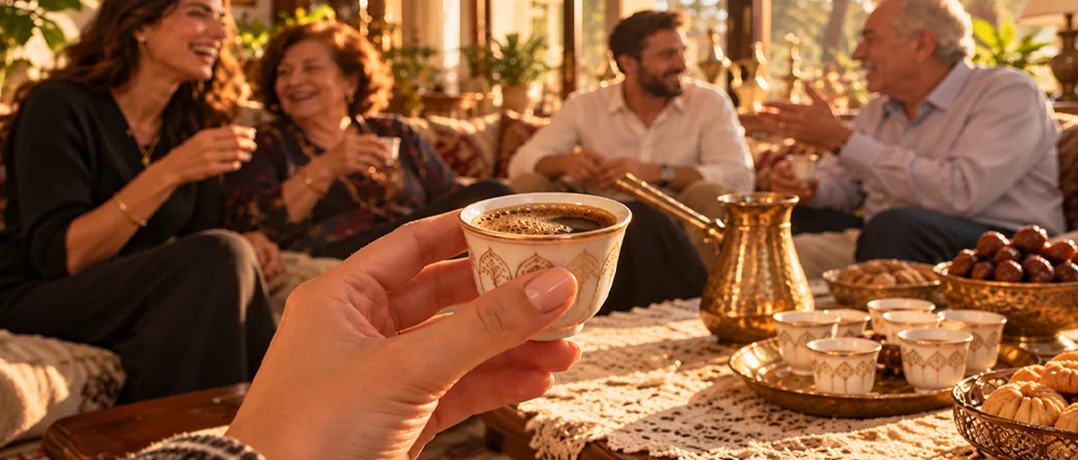
In Lebanon, coffee is what we offer before we ask a question, what we pour when someone brings news, and what we share when there is nothing to say. Before the first sip, it already means "you are welcome here."
For generations, the small, dark, foamy cup we drink every morning was listed on menus as "Turkish coffee." The history explains why. The drink reached Istanbul from Yemen, where it had been consumed since the 15th century, and came to the Levant the following century as the Ottoman Empire expanded.
That is changing. In February 2026, the Syndicate of Restaurant, Café, Nightclub, and Pastry Owners in Lebanon urged establishments to use "Lebanese Coffee" on menus, promotional materials, and in how staff speak to customers. The syndicate framed it as preserving Lebanese identity. Names matter because they tell us whose story is being told, and this one is ours.
The rakwe, where it all begins
Every Lebanese kitchen has one. The rakwe is a small, long-handled pot, traditionally brass or copper, and it is where the ritual happens. The coffee is prepared in it and poured directly into the cup.
Making coffee in it takes attention. The water, coffee and sugar rise together, and the pot has to come off the heat at the right moment. Lifting it while it is boiling but before it boils over helps settle the grounds and gives a smoother texture. Nobody can rush it, and anyone who has walked away from a rakwe knows what happens next. A rakwe is also an heirloom. It is often the pot a grandmother used, and it is a common gift for a new home. Its dents and darkened metal carry years of mornings and visits.
Ask for a coffee in Lebanon and you will be asked how you take it. You may request for “ziyede sukkar” (very sweet), “wasat” (medium), and “sada” (plain). Then there is the one many people love most, the “murra”, from the Arabic word for bitter. This is the coffee of long conversations, and its sharpness is the point. A bitter cup is often served at moments that call for gravity, from condolences to family talks. Then there is the foam, the face of the coffee, which we treat as the prize. The first cup, with the most foam, usually goes to an honored guest or the head of the household.
The cup as canvas
The Lebanese cup has also become a work of art. The traditional cup is small. It holds only about 60-90 ml and is usually decorated with a pattern. It is served without a handle, with a small glass of water on the side.
Today, designers and ceramic artists are turning that small surface into something bigger. Cups are hand-painted with arabesques, Beirut skylines, cedars, calligraphy and abstract color. Some are gold-rimmed, some are minimalist, and some are collectible. A set now often comes with a matching tray, a sugar pot and a box for storage.
That is why a coffee set makes such a meaningful gift. A rakwe, six cups and a beautiful box are a piece of the home, chosen with the same care as the coffee itself. They are given at housewarmings and farewells to those leaving for abroad, so they carry a bit of Lebanon with them.
Reading the Cup
When the last sip is gone, the ritual is not over. Someone swirls the grounds, flips the cup onto its saucer, and waits for it to cool. The “tefl”, the coffee residue and sediments left clinging to the cup, becomes the canvas for “tobsir”, the reading. Squinting into the dark trails left behind, the reader finds a bird, a road, a ring, a mountain, and says what they mean, a journey, good news, a wedding, a worry that will pass. Nobody takes it too seriously, and everybody leans in anyway. It is less about prediction than about laughter, closeness, and the pleasure of being looked at with curiosity, one cup at a time.
Coffee culture has grown well beyond the home. Specialty roasters, artisan cafés, and young Lebanese baristas now treat the local cup with new pride, alongside the lattes and flat whites. Old and new can share a table, and often do.
Lebanese coffee has held us together through a lot. It is served at joyful gatherings and at funerals, on balconies and in shelters. During hard years, a small pot on a small flame has meant that life goes on and that you are not alone. So, on World Coffee Day, raise a “finjen ahwe” to the rakwe on the stove, the hand that pours, and the person who says "come, sit, I'll make you a coffee." In Lebanon, that is a full welcome.
-
-

-
The Beiruter
-
