



A shifting Shiite landscape in Lebanon’s South as calls for state authority, stability, and reconstruction challenge long-standing political dynamics.
Are Lebanon’s southern Shiites turning toward the State?
Are Lebanon’s southern Shiites turning toward the State?
By Nakhle Odaime | October 05, 2026

Reading time: 5 min
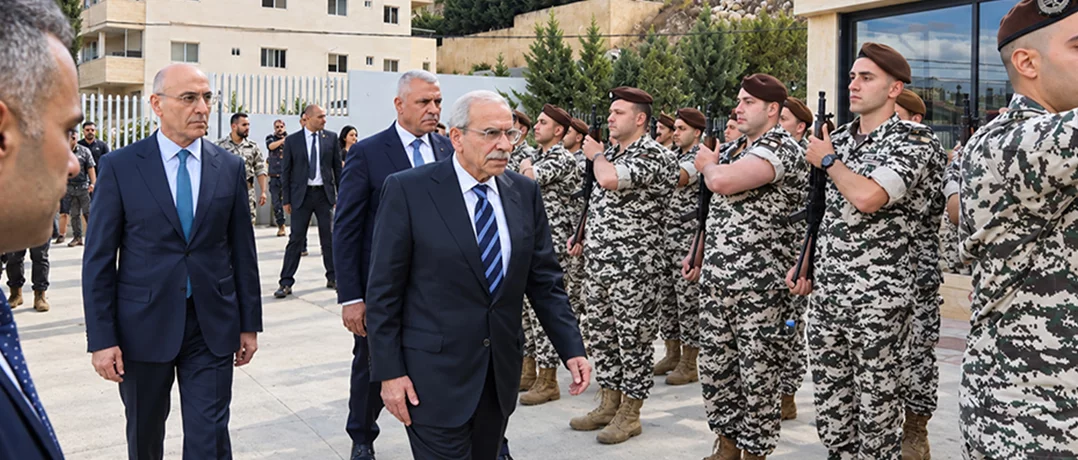
Prime Minister Nawaf Salam’s third visit to Nabatieh was not merely a routine official tour between a government headquarters and security facilities. The most notable scene did not take place within the framework of the official agenda, but rather in the streets: residents surrounding the Prime Minister and chanting in his support: “We stand with you, with you until our last breath.”
The Shiite community in Lebanon, particularly in the South and the Bekaa, appears to be facing pivotal questions that had not been raised with such intensity in previous years.
For decades, the presence of the Shiite Duo expanded into most aspects of life in these areas, from political representation to social, healthcare, and economic services, extending even to issues of security, war, and peace. Meanwhile, the state’s presence gradually declined under the dominance of influential political forces.
However, the consequences of Hezbollah’s actions (including war, destruction, repeated displacement, the exploitation of residents, and the use of civilians as human shields) have created a different reality. The cities and villages of Jabal Amel have paid heavy human, economic, and urban costs, while tens of thousands of their residents have found themselves facing the simplest yet deepest question: When will normal life return?
From this perspective, Salam’s visit to the city of Nabatieh carries a political significance that goes beyond protocol. The striking aspect is not merely a visit to the heart of Jabal Amel, but rather that Salam heard from its residents demands centered on stability, livelihoods, reconstruction, and the return of the state.
Here lies the political paradox: citizens who had grown accustomed to turning to local political forces to meet their needs are now addressing the Lebanese government, asking it to provide protection, stability, services, and the rebuilding of what the war destroyed. In other words, they are returning, in one way or another, to addressing the state as the natural authority responsible for these duties.
If this shift extends beyond the immediate emotions resulting from the war, it raises difficult questions for the Shiite Duo itself: How do its lawmakers, ministers, and leadership interpret the growing calls from their own supporters for a stronger state presence? And how will they deal with a community exhausted by war, displacement, and constant uncertainty, whose primary demand has become the ability to live safely and normally in its towns and villages?
This is not a political transformation that can be declared based on a single scene, nor should public sentiment be reduced to one visit or one chant. Yet it is a sign carrying significant implications. Destructive wars do not merely reshape urban landscapes; they also alter people’s relationship with politics, the state, and the forces representing them, while exposing the extent of the responsibility and failures of those who led to this destructive path, foremost among them Hezbollah.
The clearest political test, however, will come with the upcoming parliamentary elections, particularly if the residents of the devastated South are granted the freedom to vote without the influence of threats and weapons, unlike the patterns of voting they have experienced under such pressures in the past.
The major question remains: How will Nabatieh and the wounded cities of Jabal Amel vote? Will they reproduce their previous electoral patterns, or will years of war, displacement, and destruction leave a different impact?
In any case, the scene of Nabatieh’s residents welcoming the Prime Minister, along with their expression of support “until the last breath,” did not go unnoticed by Hezbollah, which reacted strongly, with its media apparatus and allied voices launching accusations and promoting the claim that the event had been orchestrated.
More concerning is that portraying every expression of support for the state as a “staged performance” or “fabrication” raises another question: Are southerners allowed to express a different opinion without being accused of being paid actors or having a predetermined agenda?
The chants, the warm reception, and the visible enthusiasm in welcoming Salam remain a painful blow to those who have used residents for years as fuel for their objectives, a reservoir for their weapons, and a ground for their tunnels.
Nabatieh is not just geography: It is a message
The chants of a group of residents should not be turned into a comprehensive referendum. However, the scene reveals, at the very least, that there are southerners who want their relationship with the state to be direct, rather than mediated through any political or military actor.
This may be the most troubling aspect of the scene for forces that have long sought to monopolize the definition of the South and its demands.
The South, which has suffered from Israeli occupation, wars, destruction, displacement, and weakened institutions, may have begun asking a different question: What if the priority this time is life before war, the state before weapons, and reconstruction before slogans?
Salam’s visit to Nabatieh did not answer this question. But it demonstrated that the question itself is now being raised at the heart of the South, and loudly. The Nabatieh visit may simply be another stop in the government’s work, or it may signal a deeper trajectory: the return of the state to the South, and the return of southern citizens to the state.
