



Syria’s crackdown on Hezbollah-linked networks highlights Damascus’ efforts to restore state authority, counter foreign influence, and reshape post-Assad security dynamics.
Inside Syria’s crackdown on Hezbollah networks
Inside Syria’s crackdown on Hezbollah networks
By The Beiruter | October 06, 2026

Reading time: 5 min
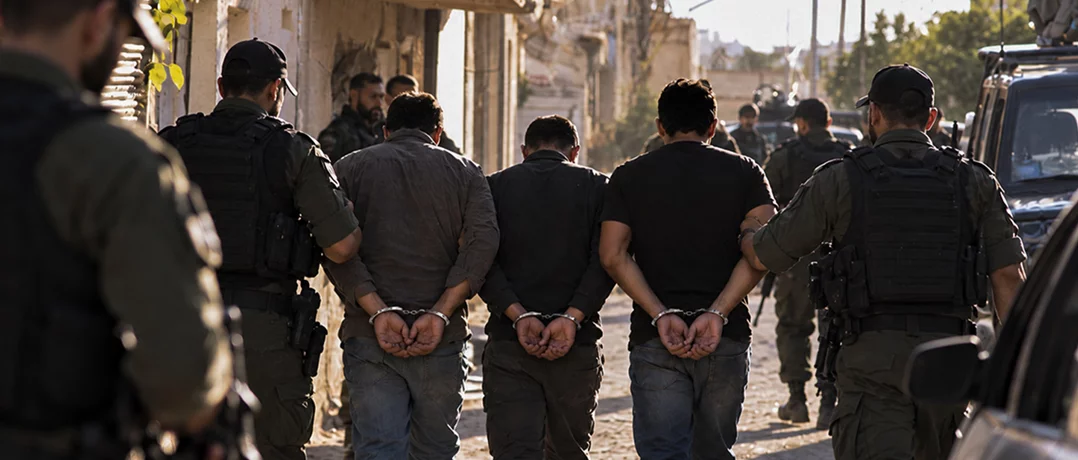
Last week, Syrian authorities announced that they had arrested a three-member cell allegedly affiliated with Hezbollah in the southern province of Daraa, accusing the group of preparing rocket launch platforms near the occupied Golan Heights for attacks intended to destabilize security. The operation marks the latest in a series of security actions by Syria’s post-Assad government against networks it says remain connected to Hezbollah and Iran’s former military infrastructure inside the country.
The announcement comes as Damascus continues to distance itself from the regional alliances that characterized the rule of former President Bashar al-Assad, whose government relied heavily on Iranian-backed forces, including Hezbollah, throughout much of Syria’s civil war.
Security operation in southern Syria
According to a statement issued by Syria’s Internal Security Forces (ISF) and broadcast by state television, the arrests resulted from a pre-emptive intelligence operation carried out jointly with the General Intelligence Directorate in the Yarmouk Basin in Daraa province.
Authorities said the three suspects had been attempting to prepare rocket launch platforms intended for future attacks, in an attempt to “undermine security and stability.” Security forces reportedly dismantled the launch sites before they became operational, while investigations into the detainees remain ongoing ahead of their referral to the judiciary.
The government did not disclose additional operational details or specify the intended targets. However, the location of the launch platforms, near the occupied Golan Heights, raised questions about the possibility of being directed toward Israel.
The latest arrests add to several similar announcements made by Syria’s new authorities over recent months, during which officials said they had dismantled Hezbollah-linked cells and intercepted weapons shipments allegedly destined for the group. Hezbollah has consistently denied those accusations.
Legacy networks remain despite reduced presence
Speaking to The Beiruter, Syrian political analyst Moudar Debis argued that there is no longer an organized Hezbollah presence inside Syria comparable to previous years. However, he cautioned against assuming that all of the group’s former infrastructure has disappeared.
Debis said Hezbollah had spent years recruiting local Syrians and establishing social and logistical networks that cannot simply vanish overnight. Some individuals recruited during the conflict may still maintain contact with the group, allowing remnants of its previous infrastructure to remain available despite the absence of an overt military deployment.
In his assessment, the incident illustrates the importance of consolidating Syria’s internal cohesion as part of the country’s broader stabilization process.
State institutions and the monopoly on the use of force
He stressed that decisions concerning war and peace should rest exclusively with official state institutions rather than non-state armed actors. In his view, allowing independent groups to determine military escalation poses risks not only for Syria but also mirrors challenges that Lebanon has long faced regarding competing centers of military authority.
This is precisely the challenge Lebanon has long faced, and it is one Syria must avoid.
Relations through states, not armed groups
Commenting on the wider political implications, Debis argued that future Syrian-Lebanese relations should be conducted exclusively through their respective governments.
He expressed concern over reports suggesting possible contacts between Syrian officials and Hezbollah representatives, saying that Syria’s priority should be strengthening cooperation with the Lebanese state while respecting Lebanon’s sovereignty.
The relationship should not be between Syria and Hezbollah; it should be between Syria and Lebanon.
He also rejected speculation about any Syrian role in addressing Hezbollah’s weapons inside Lebanon, arguing that such matters remain domestic Lebanese issues. Instead, he maintained that both countries should focus on building long-term state-to-state relations based on mutual respect for sovereignty and institutional cooperation.
Talk of Syrian intervention to disarm Hezbollah is neither realistic nor appropriate.
According to Debis, both Syria and Lebanon continue to face significant internal challenges, making the strengthening of state institutions the only sustainable framework for achieving long-term stability.
A changing security landscape after Assad
The security operation reflects the dramatic shift in Syria’s political and strategic orientation since the collapse of the Assad regime in late 2024.
Under Assad, Syria formed a central pillar of the Iran-led “Axis of Resistance,” serving as a logistical corridor connecting Tehran to Hezbollah in Lebanon. During the Syrian conflict, Hezbollah deployed thousands of fighters in support of Syrian government forces, beginning in al-Qusayr in 2013, establishing extensive military infrastructure and cultivating networks of local allies across several regions.
Since taking power, Syria’s new leadership has adopted a markedly different position toward Iranian influence and Hezbollah’s activities. Officials have repeatedly pledged to dismantle unauthorized armed networks operating within Syrian territory and to restore the state’s monopoly over security and military affairs.
While Damascus seeks to dismantle the remnants of networks established during the civil war, analysts caution that ideological and local support structures built over many years cannot be eliminated immediately. Debis thus conclude that
The only viable path forward is the model of institutions and the state; even if those institutions remain weak.
-
-

-
The Beiruter
-
