



As Lebanon’s population ages and care systems struggle to keep pace, The Beiruter investigates the growing pressure on elderly-care homes, the financial challenges threatening institutions, and the question of who will care for Lebanon’s elderly in the years ahead.
One million seniors: Who will care for Lebanon’s ageing population?
One million seniors: Who will care for Lebanon’s ageing population?
By Michella Rizk | October 07, 2026

Reading time: 8 min
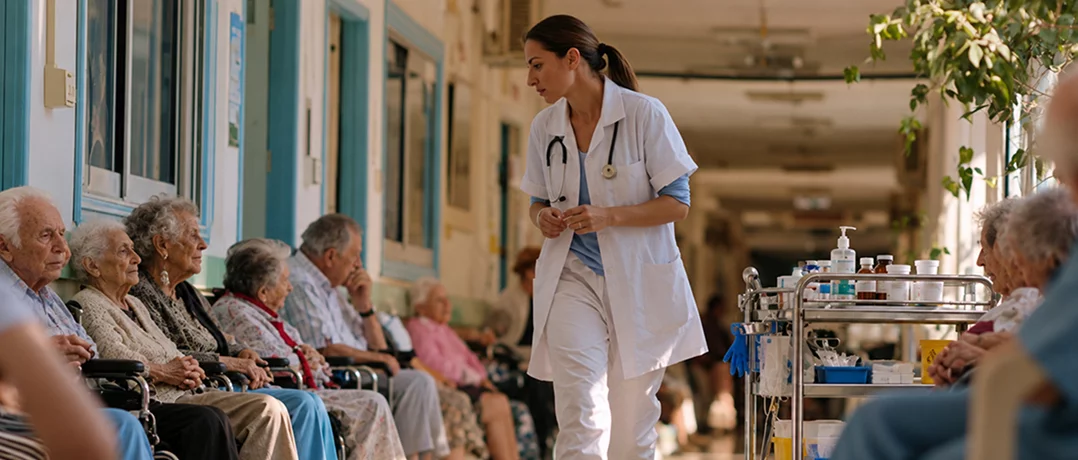
Lebanon is growing older, and faster than the systems meant to care for its elderly are adapting.
According to UNFPA Lebanon, around 765,000 people in the country were aged 60 or above in 2020. By 2030, that number is projected to pass one million, reaching 17.4 percent of the population. By 2050, more than one in four people in Lebanon could be over 60. At the same time, the country’s younger population is shrinking, with the number of 15- to 24-year-olds projected to fall by roughly a third.
For a country where ageing has traditionally happened at home, surrounded by children and extended family, that shift raises a difficult question: who will provide the care?
The answer is becoming harder. Years of economic crisis have strained household finances, while younger Lebanese continue to leave the country and those who remain are often working to keep their own households afloat. Caring for an ageing parent can become a full-time responsibility, particularly when dementia, paralysis, chronic illness or reduced mobility enter the picture.
For some families, an elderly-care home becomes less a choice than the only workable option.
Yet the institutions expected to fill that gap are under pressure themselves. The cost of providing round-the-clock care has risen, public funding has struggled to keep pace, and electricity, diesel and staffing consume already strained budgets. When families can no longer pay, the cost of care does not simply disappear.
When public funding fell
Lebanon’s National Strategy for Older Persons 2020–2030 covers healthcare, social protection, economic security and family support. In January 2025, the Ministry of Social Affairs, UNFPA and ESCWA launched an action plan to implement it.
Elderly care is divided between ministries: Social Affairs oversees social care and ageing policy, while Public Health contracts with medical and residential institutions. Its records list 28 elderly-care centers under contract and seven more in the contracting process, though these do not represent every facility in Lebanon.
The network has also faced conflict. Dr. Joseph Helou, adviser to the health minister for healthcare and hospital affairs, said in an interview with The Beiruter that residents were moved after facilities in the south closed, requiring alternative accommodation in Beirut.
Funding, meanwhile, collapsed.
The Ministry of Public Health’s budget for medical care and hospitalization fell from approximately $485 million before 2019 to around $23 million during the crisis, remaining severely reduced for several years.
Reimbursements have since increased. Dr. Helou said tariffs for Category Two institutions, including elderly residential centers, have doubled, risen by around two-and-a-half times or tripled, depending on the service, to reduce what patients and families pay.
But providers say rising costs still leave a substantial gap between state reimbursement and the actual cost of care.
Dar Al-Ajaza: more demand, fewer patients
At Dar Al-Ajaza Al-Islamia, demand for care is not the problem.
The institution currently cares for around 250 patients, approximately 150 in geriatric care and 100 in psychiatric care, general manager Dr. Bader Zaidan told The Beiruter. Both its private and ministry-supported sections are full, and new admissions often have to wait for a bed to become available.
Dar Al-Ajaza once cared for more than 500 patients. The decline, Dr. Zaidan said, does not reflect a decline in demand. The institution simply no longer has the financial capacity to operate at the scale it once did. Donations and zakat have fallen since Lebanon’s financial crisis, while public reimbursements lost much of their value.
The economics explain why.
Dar Al-Ajaza spends an estimated $55 to $60 per patient per day, while the Ministry of Public Health contributes around $7 for an elderly patient and $15 for a psychiatric patient.
Depending on the type of care, Dr. Zaidan said ministry reimbursements cover only 12 to 30 percent of the actual cost.
Around 60 percent of patients are financially vulnerable and receive ministry support, leaving Dar Al-Ajaza to cover the shortfall through donations, zakat and its own charitable resources. Another 20 percent are private patients and 20 percent are supported by NGOs or international organizations.
"The gap widened during the financial collapse. Ministry coverage for a psychiatric patient fell from around $40 a day before the crisis to 50 cents or less at one point", Dr. Zaidan said. It has since risen to approximately $15, but operating costs have also climbed.
Diesel-related expenses have increased by more than 120 percent. Dar Al-Ajaza also operates a reverse-osmosis system producing around 11 cubic metres of water an hour, with chemicals alone costing approximately $15,000 a month, excluding maintenance and membrane replacement.
These are fixed pressures in a facility providing continuous care. Electricity and water cannot simply be cut when budgets tighten. Nor can the institution stop buying medicine and food or paying the doctors, nurses and other employees responsible for its patients.
Dar Al-Inaya: Money can be late. Care cannot.
At Dar Al-Inaya in Hboub, Jbeil, around 220 to 230 elderly people are currently in care. Sister Georgette Antoun, Superior of the Our Lady of Deliverance Convent – Dar Al-Inaya, says that number is not going down.
“On the contrary,” she told The Beiruter. More families are struggling financially, and the home is seeing more people who need help because they can no longer manage on their own.
Sometimes, a family brings an elderly relative to Dar Al-Inaya and agrees to pay for their care. Months later, they may return with a different message: they can no longer afford it.
The resident stays.
Dar Al-Inaya then has to find a way to cover the cost. That can include medication, diapers and other everyday needs. For Sister Georgette, sending someone away because their family has run out of money is not an option. “The elderly person”, she said, “is not responsible for the family’s financial situation”.
There is no fixed cost for every resident because the level of care varies. Some can eat and move around on their own, while others need help eating or require more intensive assistance, including syringe feeding. But the basics remain the same: more than 200 residents need meals throughout the day, clean clothes, medication, hot water and someone there to care for them.
Keeping all of that running has become increasingly expensive.
Sister Georgette said Dar Al-Inaya pays around $10,000 for diesel every ten days. The home has solar panels, but generators are still needed when there is not enough sun, particularly during winter. Without electricity, there is no reliable water or hot water and basic services cannot run.
The home has gone into debt to keep going, including debt owed for diesel.
There are also constant smaller expenses: washing machines break, water equipment needs repairs, and cleaning products and other supplies have to be replaced.
Government money has not always arrived on time either.
Dar Al-Inaya works with both the Ministry of Public Health and the Ministry of Social Affairs, each in a different capacity. She recalled payments owed for 2019, 2020 and 2021 arriving years late. By then, the Lebanese pound had lost much of its value. The money eventually received could no longer buy what it would have when it was first owed.
The bills, meanwhile, do not wait. That is where the financial crisis becomes very simple: the money can be late. The care cannot.
Holmona: Caring for the elderly outside the city
At Holmona, a small home in Bzebdine, with 22 residents, the pressures facing elderly care take a different shape.
Residents cannot always afford the full cost of their care, while winter brings higher heating bills on top of salaries, food and other daily expenses. But staffing remains the more persistent challenge, Holmona founder Rania Bou Nassar told The Beiruter.
Finding people willing to work in elderly care is difficult; finding them in a mountain community is harder.
Bou Nassar said there are fewer people nearby working in the field, leaving Holmona with a limited pool from which to find employees who can handle the demands of the job and are willing to stay.
Elderly care requires patience and stamina, particularly when residents are living with physical illnesses or cognitive decline. Based on her experience, Bou Nassar estimates that around 70 percent of people who might seek this kind of work are not suited to it.
Qualifications alone are not enough, Bou Nassar said. “New employees are closely monitored, including how they interact with residents in their rooms.” A supervisor helps oversee their work, and those who prove unsuitable are not kept on.
For a small home in the mountains, the pressures therefore come from several directions at once: residents who cannot always afford their care, higher heating costs during difficult winters, and a limited local workforce from which to recruit people suited to a job that demands patience and constant attention.
When care becomes a shared responsibility
More than one million people over 60 does not mean one million will need a nursing home. Many will remain independent, while others will need different levels of support as they age.
Money is only part of that care. The state can contribute to treatment and accommodation, but it cannot replace family attention or a sense of belonging.
Residents need “a little life,” Bou Nassar said. At Holmona, music, activities and visits are part of providing it.
The question is not simply whether Lebanon has enough elderly-care homes, but whether families, institutions and the state can support people through different stages of ageing, from those who need help at home to those who eventually require round-the-clock care.
-
-
-
Michella RizkContent Manager/WriterFocusing on social affairs.
-
