



Tripoli’s waste crisis raises urgent questions over Lebanon’s failed management policies, Akkar’s capacity, and the search for sustainable solutions.
Could Tripoli’s waste dilemma reach Akkar?

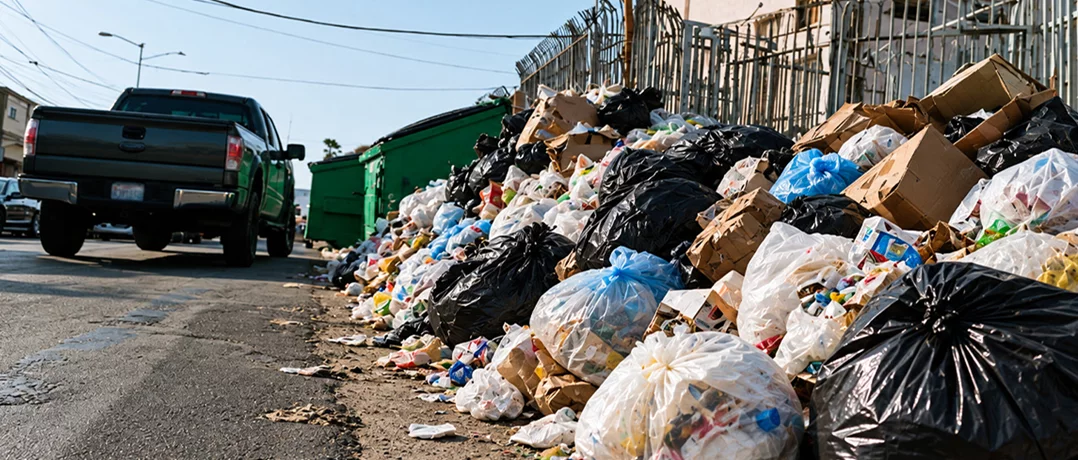
Tripoli is once again facing a familiar yet increasingly severe crisis: waste accumulating across streets, overflowing containers, and growing concerns over environmental and public health risks as winter approaches. The city’s waste problem, which has persisted for years, has reached a critical stage, forcing local authorities to consider emergency measures, including the possibility of transferring part of Tripoli’s waste to the neighboring Akkar district.
The debate, however, goes beyond the question of where the waste should be transported. It raises broader questions about Lebanon’s long-standing approach to waste management, the missed opportunities for developing sustainable treatment solutions, and the balance between addressing one city’s emergency and avoiding the transfer of environmental burdens to another region.
A crisis years in the making
Tripoli’s waste crisis has not emerged overnight. For years, the city has relied heavily on landfill-based solutions, with limited progress in developing integrated systems combining sorting, recycling, treatment, and reduced dumping.
Lebanese Member of Parliament (MP) General Ashraf Rifi, speaking to The Beiruter, said the waste file had historically been managed mainly through central authorities rather than locally. “The waste issue was essentially a centralized decision-making matter in Beirut. The municipalities did not have full control over it,” Rifi said, adding that the current situation reflects years of accumulated problems.
He pointed to the expansion of Tripoli’s waste mountain as one of the clearest signs of the crisis, noting that the landfill had reached alarming levels and that continuing the same approach was no longer sustainable.
The waste mountain has become extremely high, and we cannot allow this situation to continue for a long period.
According to Rifi, the immediate challenge is not only collecting waste but finding a long-term treatment mechanism. He argued that Lebanon must move toward solutions based on internationally recognized standards, including properly managed waste-to-energy facilities, provided they are operated according to European or American environmental criteria.
The lost opportunity of local treatment
The current debate over transporting Tripoli’s waste to Akkar has revived questions about why the city did not advance earlier plans aimed at treating waste within its own boundaries.
In 2018, Tripoli explored a project supported by French expertise that sought to establish an integrated waste treatment system inside the city’s area rather than relying on external disposal. A delegation from the French Senate visited Tripoli and met with local officials and specialists to discuss environmental solutions.
The initiative was also discussed during a conference held at the Lebanese Parliament focused on transforming Tripoli into a greener city. Later that year, a municipal delegation visited France, where it examined the “3WAYSTE” waste treatment technology.
The proposed system relied on sorting waste at the source of treatment, transforming organic materials into compost for agricultural use, recovering recyclable materials such as plastic, glass, and cardboard, and minimizing the amount sent to landfill.
Supporters of the project argued that it represented more than an environmental solution. It was also viewed as an economic opportunity, allowing Tripoli to recover value from its waste rather than treating it solely as a financial burden.
According to estimates shared by supporters of the initiative, recovering recyclable materials and reducing landfill costs could have generated significant savings for the city over several years.
However, the project did not move forward, leaving Tripoli dependent on temporary measures and landfill expansion.
Akkar rejects becoming a substitute solution
The possibility of transporting Tripoli’s waste to Akkar has generated concern among officials and residents of the northern district, who argue that Akkar itself faces limitations in capacity and infrastructure.
Lebanese MP Sajih Attieh told The Beiruter that relations between Tripoli and Akkar should not be viewed as a competition, emphasizing the close social and economic ties between the two areas. “There are around 200,000 people from Akkar living in Tripoli, and cooperation between the two regions has always existed,” Attieh said.
However, he explained that the issue is not simply about whether the landfill is public or private, but whether Akkar has the capacity to absorb additional waste. “The facility’s capacity is around 250 tons per day, which is approximately the amount Akkar itself produces daily. The landfill and treatment facility are not prepared to receive additional quantities,” he said.
Attieh also highlighted infrastructure concerns, warning that transporting large volumes of waste from Tripoli to Akkar would place additional pressure on already limited road networks.
He added that local communities surrounding the proposed site had expressed conditional positions, requesting adequate environmental guarantees, infrastructure improvements, and benefits for surrounding municipalities.
The intention to cooperate exists, but practically speaking, the capacity is not available.
Searching for a sustainable solution
Both Rifi and Attieh stressed that Lebanon’s waste crisis cannot be solved through temporary transfers between regions.
Rifi argued that responsibility must be shared among all stakeholders, including municipalities, ministries, parliament, and society. “We should not avoid responsibility. Everyone bears part of it,” he said, stressing that Lebanon needs to move from repeated discussions to concrete decisions.
He also pointed to modern waste treatment facilities abroad as examples of how technology can be used safely when properly regulated. He cited Vienna’s waste-to-energy plant as an example of a facility that integrates environmental management with energy production.
Attieh similarly argued that Lebanon must reconsider decentralized waste management and scientifically managed waste-to-energy solutions. “The waste file has consumed enormous state resources and hundreds of millions of dollars from the municipal fund,” he said, calling for a more sustainable approach rather than repeated emergency measures. He added that “when you arrive in Vienna, the first glass building you see is one of the most beautiful buildings in the city. It is a waste incineration plant.” Attieh even noted that upon a visit with a municipal delegation to Saint-Pépin in France, they had lunch inside the facility itself.
Political pressure as winter approaches
The urgency of the crisis has increased as Lebanon approaches the winter season, when heavy rainfall could worsen the situation by spreading accumulated waste and obstructing drainage networks.
Rifi warned that continued delays could lead to serious environmental and health consequences.
Every day of delay increases the danger.
He thus called on the government, Tripoli Municipality, and the Federation of Al-Fayhaa Municipalities to act immediately while developing a permanent solution.
For Tripoli residents, the immediate priority remains clear: removing waste from streets and restoring basic services. But the larger challenge remains unresolved: whether Lebanon can finally establish a sustainable waste management system that prevents one region’s crisis from becoming another region’s burden.
-
-

-
The Beiruter
-
