



Once a major part of Lebanon’s Mediterranean trade, cotton continues to survive through local farmers, factories and generations of workers keeping the country’s textile heritage alive.
The cotton thread that connected Lebanon to the Mediterranean
The cotton thread that connected Lebanon to the Mediterranean
By The Beiruter | October 07, 2026

Reading time 4 min
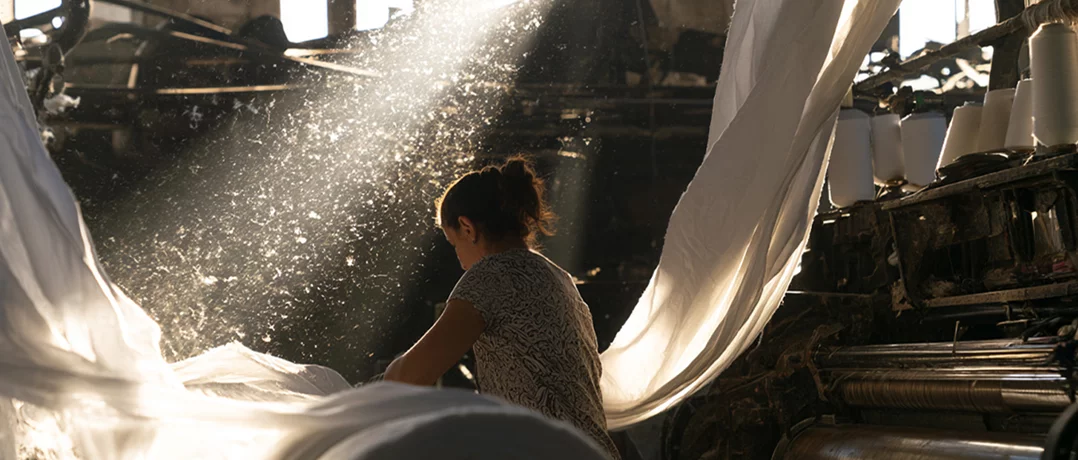
Cotton has become a global commodity that once interlaced Lebanon into the economic life of the Mediterranean. Medieval traders carried raw cotton from the Levantine coast to northern Italy, where it was spun into the famous fustians of Lombardy. By the Ottoman era, cotton cultivated on Mount Lebanon and in the Galilee passed through the ports of Saida and Tripoli, feeding the textile workshops of Marseille and helping establish France's own cotton-printing industry. For centuries, bales shipped from these shores clothed markets an ocean away, long before "Made in Lebanon" meant anything at all.
That agricultural thread thinned considerably under the weight of Ottoman taxation and shifting trade routes, and later gave way to silk as Mount Lebanon's dominant export. Yet cotton never disappeared entirely. Today, it still grows in the plains of Akkar, and in a handful of factories across the country, workers continue to transform raw fiber into finished thread and cloth, a less celebrated inheritance than silk, but no less rooted in Lebanon's long relationship with the Mediterranean textile trade. On World Cotton Day, two of those workers, Najwa Ward and Tony Abou Fadel, opened the doors of their factories to describe a craft that still runs through the region's economic memory.
Najwa Ward: Forty years at the spinning frame
Ward has worked the cotton floor since she was a teenager, and at nearly sixty, she remains known throughout the plant for a skill none of her younger colleagues have fully mastered, she can hear a thread break before it shows.
"The machines are loud, everyone around me says they can't tell one sound from another," Ward tolf The Beiruter. "But after so many years, your ear learns the rhythm of the machine the way it learns a song. The moment one thread snaps, the sound changes, just slightly, and I am already moving toward it before the light even blinks."
That instinct developed almost by accident during her earliest years on the floor, when supervisors assigned her to the most temperamental machines precisely because she caught breakages faster than anyone else. Years later, the skill has become something of a signature. "Younger workers watch me and think I have some kind of secret," she said. "The only secret is that I have stood in front of this frame since before some of them were born."
Ward walked through the stages that bring raw cotton to her station. Bales arrive compressed and full of impurities, seeds, leaf fragments, dust, and are first fed through ginning and cleaning machines that separate the usable fiber from debris. From there, the cotton passes through carding machines, which comb the tangled fibers into straight, parallel strands, before being drawn out and twisted into yarn at the spinning frames where Ward has spent most of her working life. "Each stage makes the cotton a little more honest," she reflected. "A little more itself, until finally it becomes thread strong enough to be woven into something useful."
Despite the physical demands of standing for hours amid noise and lint, Ward expressed no desire to have spent her life elsewhere. "This factory raised me as much as my own family did," she noted. "I came here as a girl who knew nothing, and the cotton taught me everything there is to know about life, before anything else did."
Tony Abou Fadel: Minding the machines
Abou Fadel, who oversees a Tripoli factory's carding and quality-control lines, approaches the craft with an engineer's precision. Now in his fifties, he has spent much of his career ensuring that the fiber moving through each stage of production meets the consistency the final fabric demands.
"People think cotton production is simple because the raw material looks simple," Abou Fadel observed, describing rows of carding machines drawing loose fiber into even sheets. "But at every stage, something can go wrong, uneven thickness, broken strands, contamination from foreign fiber. My job is to catch these problems before they reach the loom."
He described quality control as an almost constant act of touch and sight, checking sample strands for strength and evenness throughout the day. "A good yarn should feel uniform from one end to the other. If you feel a thin patch, you already know where in the process something slipped."
Abou Fadel also spoke to the broader fragility of Lebanon's cotton industry, caught between cheaper imported fabric and a shrinking base of skilled workers willing to learn the trade. "This used to be a proud industry in this country," he remarked. "Today, we are fewer, but the standard has not dropped. If anything, those of us still here feel we have more to prove."
On a day meant to honor cotton's global importance, Lebanon entails a special chapter to the story, shaped by patient, hands-on labor. Their work nonetheless carries forward a trade that once linked Lebanon's coast to ports across the Mediterranean. In their hands, cotton stays what it has always been in this country, essential and persistent.
-
-

-
The Beiruter
-
