



Israel’s “Sufa 53” expansion in Quneitra raises concerns over border security, Syrian sovereignty, land access, and future regional negotiations.
Syria’s Quneitra at the center of Israel’s “Sufa 53” expansion
Syria’s Quneitra at the center of Israel’s “Sufa 53” expansion
By The Beiruter | October 07, 2026

Reading time: 5 min
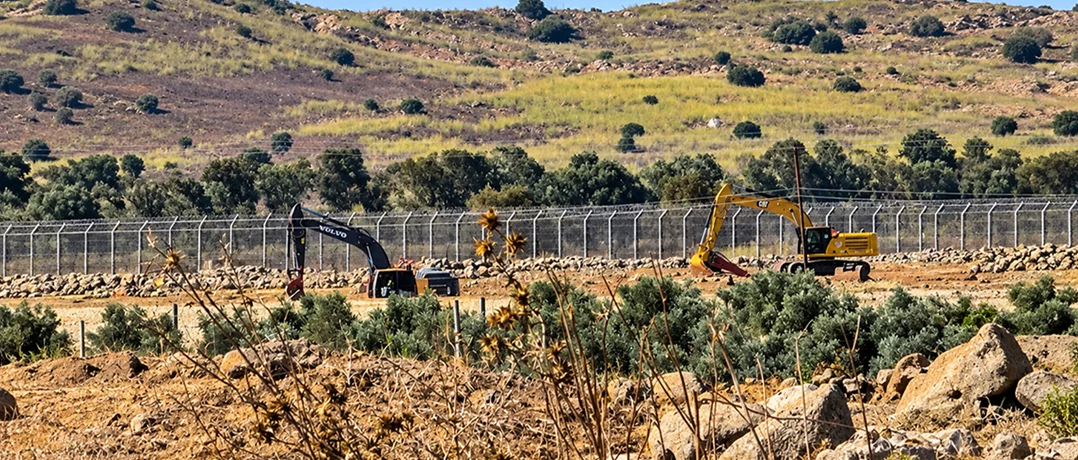
Israel has resumed work on the final phase of its controversial “Sufa 53” engineering project in Syria’s southern Quneitra province, extending construction into the southern sector of the United Nations (UN)-monitored disengagement zone bordering the occupied Golan Heights.
The latest activity, which includes excavation works, road construction, trenches and fortified positions, has reignited concerns over the future of the 1974 Disengagement of Forces Agreement, the humanitarian impact on local communities, and the broader security dynamics along the Israeli-Syrian frontier.
A project with multiple dimensions
Syrian political analyst Yasser Najjar told The Beiruter that the “Sufa 53” project carries broader political, territorial, and negotiation-related implications.
Najjar noted that the project extends along a roughly 70-kilometer route bordering the occupied Golan Heights, from the area of Hader in northern Quneitra to al-Asha near the southern part of the province. While Israel has presented the initiative as a security measure aimed at strengthening its border defenses, he argued that the project serves several objectives.
According to Najjar, one of these dimensions relates to the transformation of the physical and demographic conditions of the area. He pointed to the impact of land excavation, the construction of trenches, changes to water pathways, and the destruction of grazing areas, arguing that such measures could limit farmers’ and livestock owners’ ability to continue using their lands.
Najjar argued that the project also carries a political dimension, particularly in relation to potential future negotiations between Syria and Israel over security arrangements and the 1974 Disengagement of Forces Agreement. The Syrian Ministry of Foreign Affairs and Emigrants argued that continued Israeli construction, military incursions and engineering works violate both the disengagement agreement and international law.
He suggested that expanding infrastructure and establishing new positions on the ground could provide Israel with additional leverage in any future talks by strengthening its negotiating position. According to Najjar, the project could be used as a means of creating “facts on the ground” before diplomatic discussions over border security arrangements take place, thus complicating efforts aimed at maintaining calm along the ceasefire line.
Najjar also linked the timing of the project’s expansion to broader regional developments, including shifting priorities among international actors. He argued that Israel may be seeking to consolidate its position while attention remains focused on other regional crises and security issues.
Concerns over rising tensions along the disengagement line
Najjar warned that restrictions imposed on local communities could have security consequences by increasing dissatisfaction among residents affected by the project.
“The areas being excavated and seized amount to thousands of dunams,” Najjar said, adding that many landowners could lose access to agricultural fields that represent their primary source of income. He warned that preventing farmers from accessing their lands and limiting traditional grazing areas could create conditions of prolonged instability, particularly if residents feel they have lost peaceful avenues to recover access to their property.
According to Najjar, this could contribute to greater tensions along the Syrian-Israeli frontier rather than enhancing long-term security. He stressed that stability in southern Syria depends not only on military arrangements but also on addressing the conditions of communities living near the disengagement line.
Najjar further highlighted that Syria’s international position has changed following its removal from the list of State Sponsors of Terrorism (SST), arguing that violations of Syrian territory are increasingly viewed by Damascus and other actors through the framework of state sovereignty and international law. He said that while regional and international actors have expressed concern over Israeli actions, Washington remains a key player capable of influencing Israeli policy due to its strategic relationship with Israel.
What is the “Sufa 53” project?
“Sufa 53,” also referred to as “Great Storm,” is a large-scale military engineering project launched by Israel in mid-2022 along the Syrian side of the disengagement line established under the 1974 agreement following the 1973 Arab-Israeli War.
The approximately 70-kilometer route stretches from the vicinity of Hader in northern Quneitra before reaching al-Asha in southern Quneitra and continuing toward the Yarmouk Basin in western Daraa. The project consists of an eight-meter-wide military road reinforced by earthen berms, accompanied by trenches, observation posts and additional defensive infrastructure.
Additionally, the project lies within or adjacent to the area governed by the 1974 Disengagement of Forces Agreement, which established a demilitarized buffer zone monitored by UN Disengagement Observer Force (UNDOF) following the 1973 Arab-Israeli War. Recent coordination meetings between Syrian officials and UNDOF leadership have focused on improving communication and enabling the mission to continue carrying out its monitoring responsibilities amid persistent tensions along the disengagement line. UNDOF, however, is a monitoring mission rather than a combat peacekeeping force. Its mandate focuses on observing developments, documenting violations, and facilitating liaison between the parties rather than intervening militarily.
Although construction began before the fall of the Assad regime, activity has accelerated considerably since late 2024 as Israel expanded its military presence across parts of southern Syria.
Construction advances into southern Quneitra
Israeli engineering units began excavation and fortification work west of al-Asha village in the al-Rafid area of southern Quneitra, including locations near UNDOF Position 80. The construction represents the southern extension of the “Sufa 53” line after similar work had already been completed in the northern and central sectors of the province.
The latest phase affects a cluster of villages, including al-Muallaqa, al-Mushayda, al-Zaaroura, al-Ramthaniya, al-Razaniya, Abu Madhra, Ain al-Qadi and al-Asha. An estimated more than 1,000 dunams of privately owned agricultural land could be incorporated into the project, affecting farmers and livestock owners whose livelihoods depend on access to these areas.
The expansion follows previous phases that reportedly resulted in the seizure of approximately 4,000 dunams in central Quneitra and between 8,000 and 10,000 dunams around Jubata al-Khashab in the province’s northern sector.
With construction advancing into southern Quneitra, project “Sufa 53” has become not only a military undertaking but also a focal point in the wider debate over sovereignty, international law, border security, and the future of Syrian-Israeli relations.
-
-

-
The Beiruter
-
