



An AUB student project selected for the São Paulo International Architecture Biennial reimagines Bahrain’s Tubli Bay through biodiversity, public space and climate resilience.
From Beirut to Brazil: Lebanese architecture takes on a hotter world
From Beirut to Brazil: Lebanese architecture takes on a hotter world
By Mirella El Howayek | October 11, 2026

Reading time: 5 min
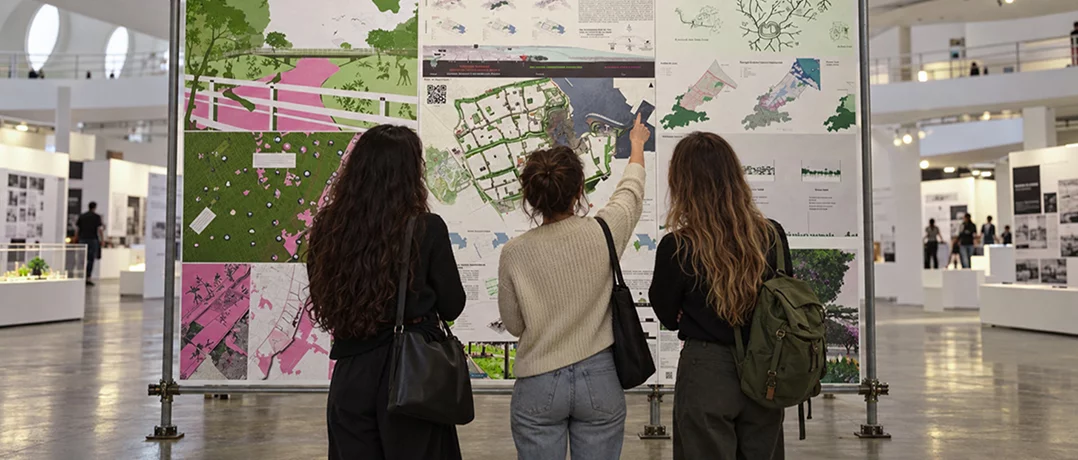
A project developed by architecture students at the American University of Beirut for Bahrain has reached the international stage at the São Paulo International Architecture Biennial, bringing a Lebanese perspective to the global debate on climate resilience, biodiversity and the future of urban life.
From Beirut to São Paulo, and ultimately to Bahrain, a Lebanese architectural project is travelling across borders with a question that is becoming increasingly urgent for cities around the world: how should we design urban environments for a hotter, more unpredictable climate?
Developed by undergraduate students at the School of Architecture and Design at the American University of Beirut (AUB), “Eco Commons: Seeding Urban Biodiversity for Climate and Social Resilience in Tubli Bay, Bahrain” was selected for the 14th São Paulo International Architecture Biennial in Brazil.
The project places Lebanon at the intersection of an international conversation that extends well beyond architecture. As cities confront rising temperatures, water scarcity, flooding and pressure on natural ecosystems, the relationship between urban development and the environment is becoming a central question for governments, planners and developers alike.
For its creators, the setting could hardly be more relevant. Designed in Beirut for Bahrain and exhibited in Brazil, the project connects three very different contexts through a shared challenge: how to make cities more resilient without sacrificing their relationship with nature.
The project is the work of Lebanese students Maya Haïdar and Clara Saliba, under the guidance of architect and educator Sandra Frem. Its destination is Tubli Bay, south of Manama, Bahrain—a coastal environment whose marine and terrestrial habitats have come under increasing pressure despite the area's historical importance to surrounding communities and fishing activity.
Reimagining Tubli Bay
At the heart of the proposal is a simple but ambitious idea: reconnect the city with its waterfront while restoring the ecological systems that support it.
The students envision a linear park along Tubli Bay, creating public access to the shoreline while integrating urban mobility and providing shaded microclimates for birds and other wildlife.
The proposal treats the waterfront not simply as a recreational space, but as part of a larger urban ecosystem.
Its ambition is to allow people and nature to occupy the same landscape—an increasingly important principle as cities across the Gulf confront the challenges of heat, water management and biodiversity.
In this sense, the project speaks directly to a broader regional question: how can cities continue to grow while remaining environmentally resilient?
Water at the center
Water emerged as one of the defining themes of the São Paulo Biennial.
The exhibition examined both extremes: water arriving in excess through floods and disappearing through drought and scarcity. Renato Anelli, one of the exhibition's curators, described water as central to human survival as climate change alters patterns of rainfall.
Several projects presented at the Biennial explored the relationship between urban environments and water. Among them was the concept of the “sponge city,” developed by Chinese architect Kongjian Yu, which advocates designing cities to absorb and retain rainwater rather than attempting simply to channel it away.
The Tubli Bay proposal approaches the same challenge from another perspective: using landscape, vegetation, public space and ecological restoration as tools for climate adaptation.
For Anelli, the Lebanese project was particularly notable because it applied principles similar to those being explored in Brazil.
The connection is significant.
From Beirut to São Paulo and Bahrain, cities separated by geography and culture are increasingly confronting a common reality: climate change is transforming the relationship between urban development, water and the natural environment.
A Lebanese perspective with regional relevance
The project's international journey also highlights the role of Lebanese architectural education in addressing challenges that extend well beyond Lebanon's borders.
Designed in Beirut for a Gulf environment, the project demonstrates how architectural ideas developed in one part of the region can respond to the needs of another.
That regional exchange is particularly relevant as Gulf cities invest heavily in urban development while simultaneously confronting some of the world's most demanding climatic conditions.
For Bahrain, where heat, coastal ecosystems and water management are increasingly important urban considerations, Tubli Bay offers a setting in which environmental restoration and public infrastructure can be considered together.
The proposal does not treat climate resilience as an isolated engineering problem. Instead, it brings together biodiversity, mobility, public space, shade and access to the waterfront within a single urban vision.
Architecture after the climate emergency
The Tubli Bay project formed part of a broader conversation at the São Paulo Biennial.
Thirty projects were selected for the Schools Competition, alongside 179 other works presented through invitations and an open call. Across the exhibition, architects and students explored ways to adapt buildings and cities to extreme heat while reducing the emissions associated with construction and urban development.
The exhibition was organized around five broad themes: protecting forests and bringing nature back into cities; living with water; renovating rather than simply building anew; improving mobility through renewable energy; and advancing climate justice and social housing.
Together, they reflect a fundamental change in architectural thinking.
The challenge is no longer simply how to build more.
It is how to build differently.
From the Gulf to the world
The Tubli Bay proposal may be a student project, but the questions it raises are increasingly relevant to governments, developers and investors across the Middle East.
As cities invest in new districts, waterfront developments and large-scale urban projects, climate resilience is becoming an increasingly important part of long-term planning.
The most successful urban environments of the future may not be those that attempt to isolate themselves from nature, but those that learn to work with it.
That is the idea at the heart of the Lebanese project in Bahrain.
By bringing together architecture, ecology and public life, two young Lebanese designers and their mentor have proposed more than a park.
They have offered a different way of thinking about the Gulf city—one in which the waterfront is not merely a development opportunity, but an ecological asset; where shade becomes infrastructure; and where biodiversity becomes part of urban planning.
From Beirut to an international architecture exhibition in São Paulo, the Tubli Bay project carries a distinctly regional idea onto a global stage:
the future of architecture may depend not on conquering extreme environments, but on learning how to live with them.
