



Lebanon’s IMEC ambitions hinge on infrastructure, governance, regional stability, and strategic decisions despite joining the corridor’s Ports Club.
Can Lebanon find its place in IMEC?
Can Lebanon find its place in IMEC?
By Anthony Chamoun - Nathalie Durham | October 09, 2026

Reading time : 6 min
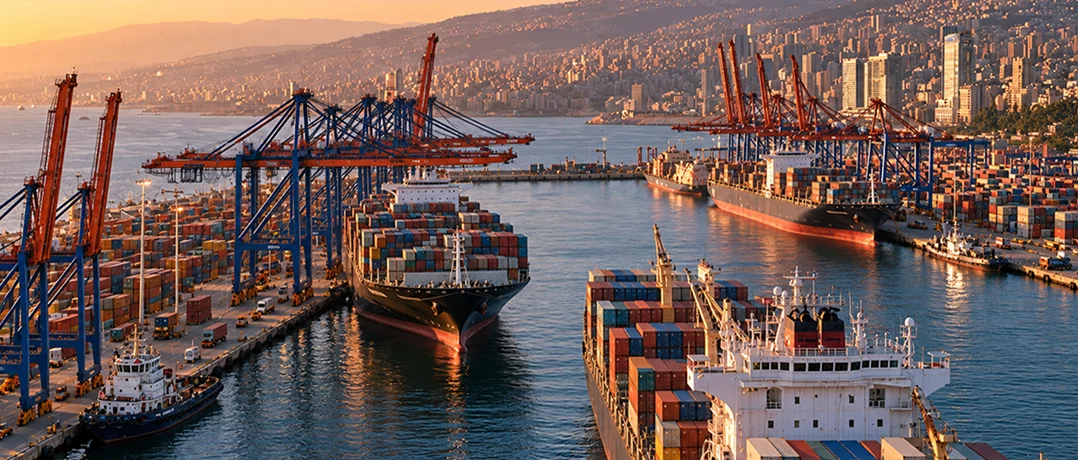
Lebanon has taken a new step toward the India-Middle East-Europe Economic Corridor (IMEC), with the ports of Beirut and Tripoli officially joining the IMEC Ports Club on 6 October 2026. The move opens the door to greater cooperation with regional and international ports, but Lebanon’s ability to benefit from the project will depend on its infrastructure, political decisions, and regional stability.
The agreement was signed in New Delhi, India by the heads of the Beirut and Tripoli port authorities, Marwan Naffi and Iskandar Bandali, respectively. The Ports Club aims to strengthen cooperation in trade, logistics, supply chains and digital connectivity. However, joining the club does not mean that Lebanon has formally become part of the corridor itself.
What could Lebanon gain?
In an interview with The Beiruter, Regional and International Affairs Cluster Coordinator at the Issam Fares Institute for Public Policy and International Affairs (IFI) at the American University of Beirut (AUB) Yeghia Tashjian explained that Lebanon’s participation in IMEC, or other regional connectivity projects, could bring both economic and geopolitical benefits.
Lebanon integrating in IMEC, or any actually regional interconnectivity project, would be not just geopolitical, but also carry significant geoeconomic leverage for Lebanon.
According to Tashjian, participation could strengthen Lebanon’s regional position and attract foreign direct investment (FDI) into its infrastructure. He also pointed to the potential reopening of Qleiat Airport in northern Lebanon as another project that could support the country’s connectivity.
Beyond these opportunities, Lebanon’s participation could create between 4,000 and 5,000 direct and indirect jobs, while generating between $3.5 billion and $4.5 billion in annual economic gains and tax revenues once the project becomes operational. The same estimates put the cost of Lebanon’s participation at €170 billion to €190 billion, with an implementation period of 8 to 10 years.
Lebanon could also benefit from its two main commercial ports. Tashjian suggested that Beirut could become a hub or secondary route for IMEC, while Tripoli could explore connections with a separate Turkish-backed initiative aimed at reviving railway links between Turkey, Syria, Jordan, and Saudi Arabia.
This would allow Lebanon to explore more than one regional trade project rather than depending on a single corridor.
Which route could connect Lebanon to IMEC?
One of the biggest questions is how Lebanon could physically connect to the corridor.
Tashjian explained that IMEC serves American strategic interests, particularly by strengthening Washington’s position in the Middle East, connecting India to European markets through the Gulf, and limiting China’s regional influence. The corridor is therefore viewed as an alternative to China’s Belt and Road Initiative (BRI), serving as a geopolitical counterweight to the aforementioned route to advance Western influence and benefits. For Lebanon, this means that participation would require American approval and a foreign policy that takes United States (U.S.) interests into account.
Tashjian outlined two possible routes: a connection through Jordan and Syria, or one passing through Israel’s Haifa port. The second option, he explained, would require normalization between Lebanon and Israel, making it highly unlikely under current circumstances.
I think the second option is still out of the question.
The route through Syria, however, could also allow Damascus to participate in the corridor. Tashjian described this possibility as an “IMEC 2.0,” involving additional trade routes connecting the Levant to the wider project and potentially benefiting several regional countries. It would be a “win-win solution for both regional actors, local actors, and also the U.S.” he said.
Is Lebanon ready?
Beyond political considerations, Lebanon faces practical challenges that could delay its integration into IMEC.
Tashjian identified infrastructure, governance, stability and logistical capacity as the main obstacles. Lebanon currently lacks an operational national railway network capable of transporting large quantities of cargo. Its road infrastructure would also require improvements to support a major international trade corridor.
Tashjian also questioned how the corridor would physically reach Lebanon, particularly if the connection were to pass through Syria. While road connections already exist, he stressed that transporting large volumes of goods would require railway infrastructure, which Lebanon currently lacks. He also noted that Lebanon’s infrastructure remains less developed than Israel’s, while Syria’s railway network and transport infrastructure have suffered extensive damage during the war.
Lebanon’s infrastructure is still not ready.
Governance is another challenge. Tashjian stressed the need for reforms, particularly in customs procedures. He also pointed out that IMEC is not yet an established institution and that some of its signatory countries have strained diplomatic relations with one another, citing Saudi Arabia and the United Arab Emirates as an example. Such differences, he explained, could complicate coordination and highlight the need for a clearer governance framework.
Security and stability are equally important. According to Tashjian, investors would need guarantees that the Lebanese government can exercise full authority over its territory, rather than allowing non-state actors to hold greater influence.
Lebanon also faces competition from neighboring countries. Israel is developing its role as a trade connection between the Middle East and Europe, while Syria is seeking to restore its position linking Turkey to the Gulf, despite the damage to its infrastructure during the war.
We should not romanticize that Lebanon is a bridge between the East and the West. Israel is also becoming the bridge. We should be very realistic.
Lebanon’s geographical position alone, therefore, will not be enough to secure a place in these emerging trade networks.
What is IMEC?
The India-Middle East-Europe Economic Corridor (IMEC) was announced on September 9, 2023, during the G20 Summit in New Delhi, with the aim of connecting India, the Gulf and Europe through transport, energy and digital infrastructure.
Although Lebanon was not part of the original agreement, French presidential envoy Gérard Mestrallet visited Beirut in February 2026 and met with President Joseph Aoun to discuss the country's potential participation.
For now, the inclusion of Beirut and Tripoli in the IMEC Ports Club represents an opportunity for greater international cooperation. Whether this develops into a wider role for Lebanon will depend on the country’s ability to improve its infrastructure, address political obstacles, and turn regional connections into concrete projects.
-
-

-
Anthony ChamounResearcher/WriterFocusing on Political Science and International Affairs.
-
-
-

-
Nathalie DurhamResearcher/Writer
Junior research writer focusing on politics, public policy and international affairs.
-
