



The Beirut bartender, who topped a field of up to 19 finalists, is now bound for Edinburgh and the World Class Global Final with a cocktail inspired by tabbouleh.
Simon Obegi takes Lebanon to the world stage of bartending
Simon Obegi takes Lebanon to the world stage of bartending
By The Beiruter | October 13, 2026

Reading time 4 min
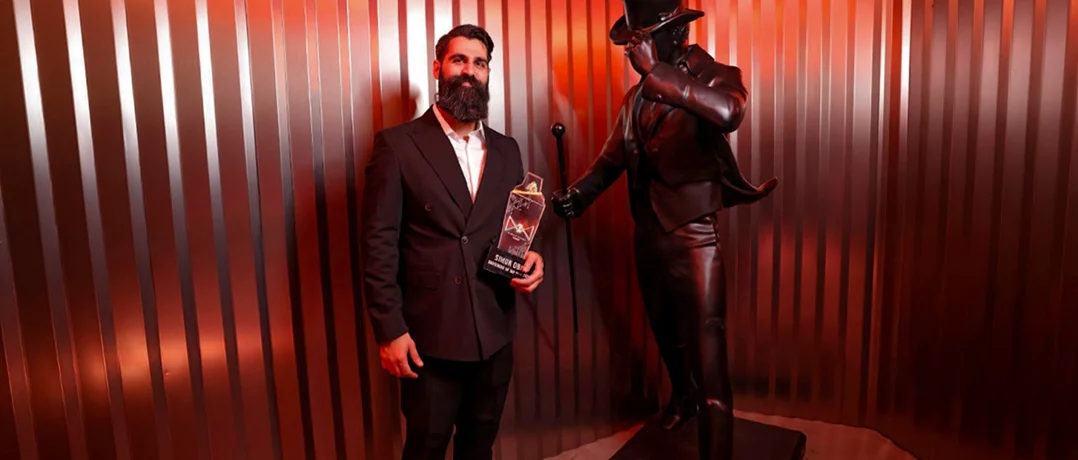
Simon Obegi’s path to the top of Lebanon’s bartending scene began at 9 years old, when he took over a bar for a night because no one else could. His older brother worked as a bartender at a venue that served no alcohol but kept a serious bar. Young Simon spent his shifts watching. “I was doing the impossible just to get behind that bar,” he recalled. “I had barely started in hospitality and I knew nothing, but I wanted to push my way into the middle of it.”
His chance came on a packed Saturday, when a refrigerator being moved toppled onto his brother’s hand. With the injured bartender unable to work, Simon stepped in. “Every time I stood at the bar, I was memorizing what he did,” he explained.
The service was rough, and the next morning the manager convened a meeting. Simon remembers the verdict, out of a floor team of twenty, nobody else had stepped forward the way he had. “Nobody had done what Simon did, two weeks into hospitality, running the bar on a Saturday night.”
Learning the art
The road that followed was not a straight line. After stints at multiple cafes and restaurants, Simon wanted to return to the scene he loved. “I find myself at home behind the bar,” he says.
A colleague introduced him to a circle of regulars, among them an opportunity came along. His first shift, at a large wedding with music and a crowd, settled the question. He was around 25. When management asked what he wanted, he was direct. “I told them, ‘I’m not looking for money, I’m looking for experience.’ I wanted to learn.”
Training followed, then a promotion to bartender, then a move to a new bar project under a bar director named Angelo. “We became good friends, and I worked as hard as I could to learn from him,” Simon said. Angelo’s successor, Ayman, was another formative influence. When Ayman left, Simon was named beverage director, a role he initially doubted he could fill.
“I told them I’m only a bar manager and I still have a lot to learn,” he recalled. “They said, ‘Don’t worry. You can do it. I’m right here, whatever you need, just tell me. The most important thing is that you work on yourself.’”
A company-funded training trip to London had already exposed the team to advanced mixology, laboratory techniques and distillation. “These were techniques we didn’t have,” Simon noted. “I was still at the beginning of my career, learning how to create a cocktail.”
The competition
For years, his employer discouraged competitions, believing Lebanese bartenders already operated at a high level. “We were very fast, always on point,” he said. That changed with World Class, the Diageo-backed contest. Company leaders urged him to enter, and he was invited to witness the Global Final in Shanghai, where one bartender emerges as the best in the world.
“They explained to me how hard World Class is,” he explained. “It’s not just about creating cocktails. It’s about the journey.” At 35, with deep experience in drinks and service, he decided the timing was right.
The Lebanese edition tested range. Simon first built a three-cocktail menu for Tanqueray and pitched it to judges in ten minutes. A seminar on carbonation followed, then a surprise outing to Spinneys, where each finalist received $60 and thirty minutes to shop before preparing a two-liter drink with a story. The speed test required six classic cocktails in six minutes. A guest shift for Johnnie Walker closed the program, with a new menu and a five-minute presentation. Between around 19 bartenders, “I came first,” he told The Beiruter.
Edinburgh awaits, where roughly 51 or 52 national champions will compete. Simon credits a support network spanning Diageo’s MENA team and his chaperone, Jad Balout, a figure “very well known in the global bartending scene.” Their central lesson, “a drink alone isn’t enough. It needs a story, a concept. Once you have those, the drink comes last. The easiest part for us is creating the drink.”
His story is built around the “destination drink” challenge, a cocktail meant to represent one’s country. Distilling Lebanon into a glass proved daunting. “We have so many flavors, thyme and herbs and spices, and our ingredients are different from every other country’s,” he explained. After a month of research, he arrived at Zoom.
The name carries two meanings, a zoom on Lebanese hospitality, and the Lebanese word for the juice left at the bottom of a tabbouleh bowl. “The idea was to share with the world something we actually do,” he expressed, picturing a Sunday family lunch where someone drinks the last of the tabbouleh juice. The cocktail combines Tanqueray No. Ten, lemon and simple syrup with a distillate of onion and sweet pepper. It is served in a glass shaped like a lettuce leaf, echoing how tabbouleh is eaten.
Simon is passionate about his love for bartending. “Bartending is a true career. Some people think it’s a phase, something you do behind the bar until you graduate. It’s a great career. It’s never boring, because it’s based on human interaction.” He sees it as an art form. “It’s easy to serve a good drink. It’s very hard to create a good concept and a great drink.”
-
-

-
The Beiruter
-
