



18 years after establishing diplomatic ties, Lebanon and Syria face a historic opportunity to redefine relations beyond conflict, sovereignty disputes, and past tensions.
18 years later, Lebanon and Syria at a historic crossroads
18 years later, Lebanon and Syria at a historic crossroads
By The Beiruter | October 14, 2026

Reading time: 5 min
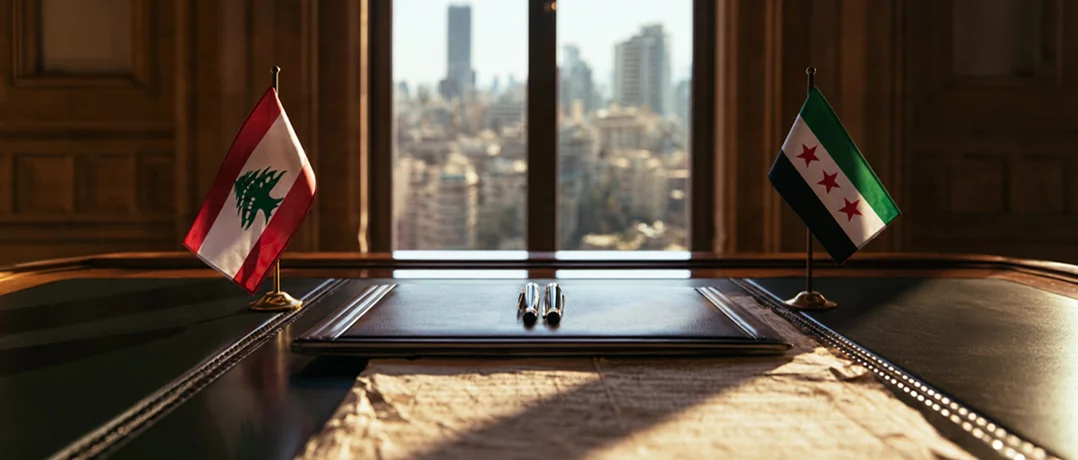
18 years after Lebanon and Syria established formal diplomatic relations and opened embassies for the first time since independence, the significance of that step remains closely linked to the unresolved history between the two neighboring countries.
The opening of the Syrian embassy in Beirut in 2008 was considered a major diplomatic milestone, as it represented an official transition from a relationship managed largely through political and security channels to one based, at least formally, on state-to-state relations.
However, according to Lebanese-Syrian journalist and activist Alia Mansour, who spoke to The Beiruter, the establishment of diplomatic relations did not fully transform the nature of bilateral ties.
A long-awaited diplomatic step
For years, establishing official diplomatic relations had been a central demand among many Lebanese political forces, particularly those calling for a relationship between two independent states based on mutual recognition. Mansour noted that the demand was also raised by segments of the Syrian opposition at the time, which viewed diplomatic normalization as necessary to correct the imbalance that had characterized relations between Beirut and Damascus. The opening of embassies was therefore viewed by many as an important step toward recognizing Lebanon’s sovereignty and restructuring relations on a diplomatic basis.
Diplomatic relations were a long-standing demand to correct the imbalance between the two countries.
She recalled that those advocating for diplomatic ties were often accused of undermining the historical relationship between the two countries, while the Syrian leadership and its Lebanese allies resisted the idea. When Damascus eventually accepted the establishment of diplomatic relations in 2008, Mansour argued that the decision came largely under regional and international pressure rather than as part of a fundamental change in the bilateral relationship. Therefore, she asserted that
It did not fundamentally change the nature of the relationship.
Embassies open, but relations remain incomplete
Despite the establishment of the Syrian embassy in Beirut, the diplomatic relationship remained incomplete in practice.
Lebanon appointed its first ambassador to Damascus, Michel Khoury, following the 2008 agreement, marking the beginning of official Lebanese representation in Syria. He was later succeeded by Saad Zakhia, whose mandate ended before Henry Kastoun presented his credentials and assumed his duties as Lebanon’s new ambassador to Damascus in 2025.
On the Syrian side, Damascus previously appointed Abdul Karim Ali as its ambassador to Beirut, a position he held until the end of 2022. Since his departure, the embassy has operated under a chargé d’affaires, with Iyad al-Hazaa assuming the role in December 2025.
Mansour stated that initial explanations focused on Syria’s lack of experienced diplomatic personnel and the need to rebuild its foreign service structure. However, she noted that the absence of ambassadors extends beyond Lebanon, as several Syrian diplomatic missions abroad have faced similar vacancies.
Lebanon is not an exception; Syria’s diplomatic vacancies reflect a broader institutional challenge that affects many Syrian diplomatic missions abroad.
More recently, discussions have pointed to possible internal administrative disagreements within Syria’s governing institutions. While Mansour did not confirm these reports, she stressed that the limited diplomatic representation reflects broader institutional challenges facing Syria during its political transition.
A historic opportunity after the Assad era
The fall of the Assad regime on 8 December 2024 created a new regional context and opened discussions about rebuilding Lebanese-Syrian relations on a different foundation.
For Mansour, the current moment represents the first genuine opportunity since independence for relations between the two countries to be structured around equality and mutual respect. However, she stressed that political intentions must be matched by concrete actions.
While Syrian President Ahmad al-Sharaa has expressed a commitment to maintaining positive relations with Lebanon and respecting its sovereignty, Mansour warned that developments on the ground, on both sides of the border, must reflect these declarations. “The opportunity exists,” she explains, but the key question remains whether there is sufficient political will on both sides to transform this opportunity into a sustainable framework.
Sounding the alarm at an early stage may prove wiser than waiting until it is too late.
A relationship shaped by conflict and interdependence
The history of Lebanese-Syrian relations has been defined by both deep connections and major disputes. Following independence in the 1940s, relations were shaped by competing views over sovereignty, regional identity, as well as economic and security interests; with Syria refusing to acknowledge Lebanese independence (reflected with official diplomatic relations being established only in 2008).
During the Lebanese War (1975-1990), Syria became a central actor in Lebanese affairs after deploying forces in 1976. Its influence, and eventually occupation, expanded during the post-war period, particularly after the 1991 Treaty of Brotherhood, Cooperation, and Coordination, which institutionalized extensive Syrian political and security domination over Lebanon.
The assassination of Lebanese Prime Minister (PM) Rafic Hariri in 2005 and the withdrawal of Syrian troops from Lebanon marked a major turning point, ending nearly 30 years of direct Syrian military occupation. The establishment of diplomatic relations in 2008 followed this shift, representing a formal acknowledgment of Lebanon and Syria as separate states.
Relations were again transformed after the outbreak of the Syrian conflict in 2011. Lebanon faced major humanitarian and security challenges due to the arrival of large numbers of Syrian refugees, while Hezbollah’s military involvement in Syria further connected and complicated the relationship between both countries.
“The relationship has always combined deep ties with unresolved political disputes,” as noted by Mansour. Nevertheless, recent contacts between the two governments have focused on rebuilding communication channels and addressing long-standing disputes.
Building a relationship beyond the past
According to Mansour, the main challenge ahead is finding a balance between addressing historical grievances and creating a forward-looking relationship.
She argued that neither side can build a sustainable partnership by ignoring difficult chapters of the past. Lebanon and Syria must simultaneously address unresolved issues while developing new mechanisms for cooperation based on sovereignty, institutional relations, and mutual interests.
A balanced relationship cannot be built if one side ignores the past, or if the other focuses only on one part of it.
The opening of the Syrian embassy in Beirut in 2008 was intended to mark the beginning of a new diplomatic era. Yet, the years that followed demonstrated that formal recognition alone was insufficient to overcome years of political complexity. The future of Lebanese-Syrian relations will depend on whether both countries can move from historical dependency and confrontation toward a model of cooperation between two sovereign neighbors.
-
-

-
The Beiruter
-
