



Europe is stepping into the South China Sea, but its warships answer to national priorities. Can influence endure without a unified fleet?
Europe’s South China Sea test

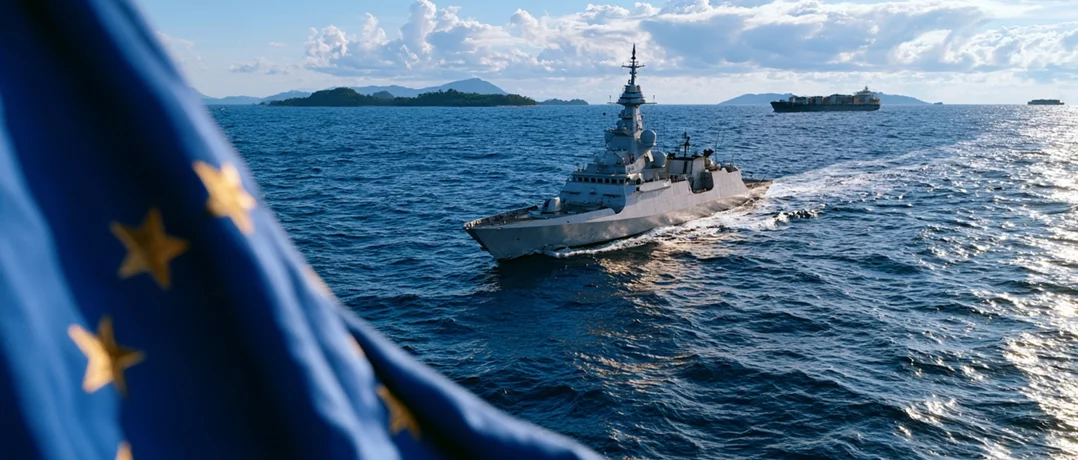
“Europe is stepping up as a security partner in the region.” When EU foreign policy chief Kaja Kallas made that declaration in Manila on 24 July, she was announcing a €15 million commitment to strengthen Philippine maritime surveillance. By October, Brussels and Manila had moved closer to a free trade agreement.
These developments mark a practical expansion of European involvement in waters where Chinese patrols routinely challenge Philippine vessels. Brussels can finance equipment and mobilize diplomatic pressure while individual European states can deploy warships. But the question remains: can those instruments produce enduring strategic influence?
International law meets maritime coercion
A decade after an arbitral tribunal established under the UN Convention on the Law of the Sea rejected the legal basis for China's expansive historic-rights claims in the South China Sea, tensions with the Philippines continue to escalate. The 2016 ruling did not determine sovereignty over disputed islands, and Beijing has consistently rejected its authority.
In early October, Chinese and Philippine forces experienced at least six dangerous encounters across contested waters. On 8 October, Chinese coast guard vessels obstructed a Philippine operation to evacuate a sick sailor from the BRP Sierra Madre, a World War II-era warship deliberately grounded at Second Thomas Shoal to maintain Manila's presence there. Days earlier, a Chinese J-16 fighter intercepted a Philippine surveillance aircraft over Scarborough Shoal, while Chinese vessels interfered with a Philippine law enforcement operation in the Spratlys islands.
The EU reaffirmed in July that the arbitral award remains final and legally binding on both countries. Yet Chinese coast guard vessels and maritime militia continue to restrict Philippine access through water cannons, dangerous maneuvers, and aggressive interception tactics. In August 2025, a Chinese coast guard vessel collided with a Chinese navy destroyer while pursuing a Philippine patrol boat near Scarborough Shoal, severely damaging the coast guard ship's bow and killing at least two Chinese sailors.
From diplomatic statements to maritime surveillance
Approved on 13 July, the EU’s first European Peace Facility assistance measure in Asia will provide coastal radar, electro-optical and infrared surveillance systems, radar electronic support equipment, and technical training. Its purpose is maritime domain awareness: identifying vessels, tracking their movements, and enabling authorities to respond with better information.
The challenge extends far beyond occasional clashes. According to the Asia Maritime Transparency Initiative, Chinese coast guard vessels logged 933 ship-days (a ship-day represents one vessel patrolling for one day) around Scarborough Shoal in the first half of 2026, approaching the 1,099 recorded throughout 2025. Chinese forces have also deployed floating barriers and buoys at the shoal, alongside a temporary research platform installed in May and subsequently removed.
Further south, Philippine investigators attributed damage to approximately 465 square meters of coral near Pag-asa Island in June 2025 to an anchor deployed by a Chinese maritime militia vessel. The incident also illustrates how improved surveillance could help Manila document environmental damage alongside coercive maritime activity.
The EU’s 36-month program could strengthen Manila’s ability to monitor such activities and coordinate its response. However, identifying and documenting Chinese operations does not necessarily give Philippine authorities the means to prevent them.
Europe's economic interests in Asian security
Europe's interest in the South China Sea is also economic. A 2022 European Parliament resolution estimated that 40% of the EU's foreign trade passes through these waters, connecting European markets to Asian manufacturing centers. Prolonged maritime disruption could increase shipping costs, delay deliveries, and strain European supply chains. With the ongoing crisis in the Strait of Hormuz already driving up energy prices and disrupting global trade, Europe can ill afford another major maritime chokepoint coming under pressure.
The Philippines also represents an opportunity to diversify Europe's economic partnerships in Southeast Asia. On 22 September, Brussels and Manila reached substantial agreement on a free trade deal, although negotiations remain unfinished. The proposed agreement would liberalize more than 94% of tariff lines, covering over 97% of bilateral trade, while opening Philippine government procurement to foreign bidders and strengthening rules governing digital commerce, intellectual property, energy, and raw materials.
Yet the economic relationship remains modest compared with China's. EU–Philippines goods trade reached €17.6 billion in 2025, against €759 billion in total EU–China goods trade. Brussels therefore has an interest in protecting maritime access and expanding regional partnerships while preserving extensive commercial ties with Beijing. These competing interests complicate Europe's efforts to translate its economic influence into a stronger regional security role.
One European policy, several national navies
Europe's expanding security role in the Indo-Pacific raises a question of coordination among its member states. While Brussels can finance maritime assistance and coordinate diplomatic policy, military deployments remain decisions of individual governments whose strategic priorities differ.
France has established one of the strongest European military relationships with Manila. It maintains approximately 7,000 personnel across the wider Indo-Pacific, while its Charles de Gaulle carrier group exercised with Philippine forces in February 2025. A visiting-forces agreement signed in March and ratified by the Philippine Senate on 8 October could deepen military cooperation, although French ratification procedures remain pending.
Germany deployed a frigate to the Indo-Pacific in 2024 but announced no equivalent naval deployment for 2026, although it continued military exercises and sent a maritime patrol aircraft to the region.
The Netherlands also expanded its regional presence. In May 2026, the Dutch frigate De Ruyter visited Manila before operating in the South China Sea, where Beijing accused it of entering disputed waters illegally. The Netherlands maintained that its vessel operated in international waters. However, on 19 June, while the frigate was in Tokyo, the Dutch government canceled its planned participation in naval exercises near Hawaii and redirected it toward the Strait of Hormuz for a possible maritime security mission.
The redeployment illustrates the difficulty of sustaining Europe's naval presence in the Indo-Pacific when competing crises demand the same military resources. Although European governments broadly support freedom of navigation, their deployments remain subject to national priorities, leaving Brussels without a unified naval strategy for the region.
Between Washington and Beijing
Manila’s security architecture still rests primarily on the United States. The 1951 Mutual Defense Treaty extends to armed attacks against Philippine armed forces, public vessels, and aircraft, including coast guard vessels, anywhere in the South China Sea. American forces, exercises, and defense arrangements give that commitment a weight European partners cannot match.
But many daily confrontations involve obstruction, dangerous approaches, or water cannons rather than armed attacks. Manila must maintain access and defend its positions during incidents that may remain below the treaty’s threshold.
Cooperation with Japan, Australia, France, and the EU broadens Manila’s security partnerships and reduces its dependence on Washington in managing everyday maritime confrontations. These relationships provide additional resources and diplomatic support, although they do not offer the same military guarantees as the American alliance.
In a major military confrontation, however, the balance would still be determined chiefly by Chinese forces, Philippine defenses, and American decisions. Brussels has neither a unified regional fleet nor an obligation to defend Manila. Its influence will instead be measured by what Philippine authorities can accomplish with European assistance, particularly when no European warship is nearby.
-
-

-
Nami El KhazenJournalistFocusing on geopolitics and international affairs.
-
