



After footage from Sabra and Shatila slaughterhouses raised concerns about unsafe meat, The Beiruter examines Lebanon’s food safety oversight, meat traceability and what consumers can do.
Rotten meat, hidden slaughterhouses: What Sabra reveals
Rotten meat, hidden slaughterhouses: What Sabra reveals
By Vanessa Kallas | October 19, 2026

Reading time: 5 min
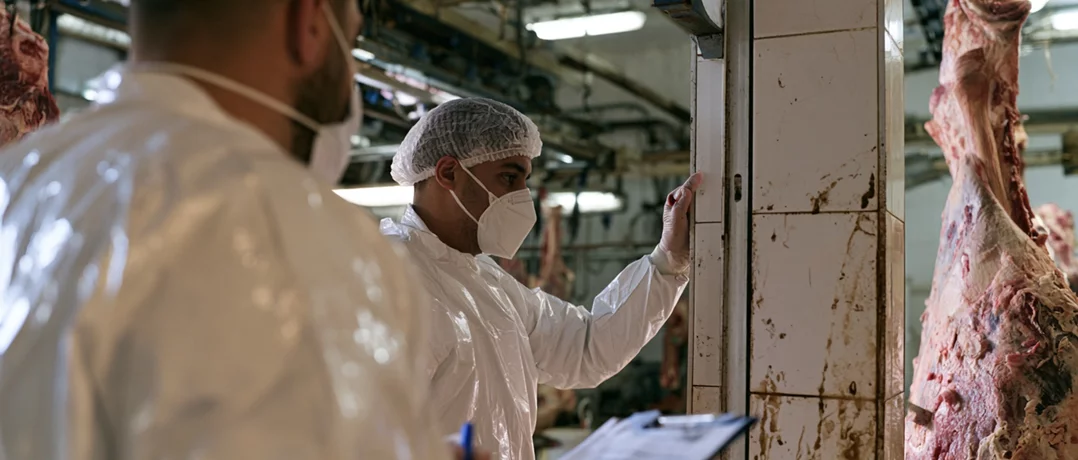
Lebanon’s State Security published footage on October 2 from inside meat slaughterhouses in Sabra and Shatila and declared food safety standards there “nonexistent.” Its officers had accompanied Ministry of Agriculture inspectors on a tour of the area’s slaughterhouses and meat shops, checking whether they met basic health requirements.
The footage spread quickly. According to reports on the inspection, the teams found a complete absence of the hygiene and storage conditions required for cutting and keeping meat. State Security said legal and health measures had been taken against the violators.
For many Lebanese, the images raised a more uncomfortable question than what was happening inside a handful of rooms in a crowded Beirut neighborhood: where does that meat end up?
From Sabra to restaurant tables
The claim that slaughterhouses in Sabra were supplying meat unfit for human consumption to some of Beirut’s well-known restaurants has circulated widely since, although it remains hard to verify.
Zouheir Berro, president of the Consumers Protection Association of Lebanon, told The Beiruter that complaints alone cannot confirm it.
“It is difficult to confirm this through complaints alone,” he said. “However, these practices certainly exist.”
The association is run by volunteers and receives consumer complaints through a hotline. For about two months, it has been passing those complaints on to the Ministry of Economy for follow-up. “We are volunteers, so we have neither the capacity nor the authority to carry out inspections ourselves,” he said. “That is the responsibility of state institutions.”
Asked whether other warehouses or facilities had been discovered since the Sabra raid, he claimed that “there are certainly a number of them. We are receiving many complaints.”
He pointed to poverty and the economic crisis as drivers, with expired food often recycled rather than destroyed. “Spoiled food is almost never thrown away,” he said. “Instead, it is recycled and put back on the market in different ways, as some producers operate unlicensed makeshift slaughterhouses.”
Not an isolated case
Sabra is the latest in a string of seizures this year. In late September, Beirut Municipality’s slaughterhouse department inspected butcher shops in Hamra, Aisha Bakkar, Zuqaq al-Blat, Tariq al-Jdideh and Barbir. Inspectors found frozen meat thawed in unsanitary ways and then sold as fresh, at fresh-meat prices. They also found leftover meat mixed with material unfit for human consumption and used to make various processed meat products. The shops were shut down and their owners referred to the courts.
In February, a joint patrol of Economy Ministry inspectors and Tyre’s municipal health inspector, backed by State Security, raided a frozen-meat warehouse in Tyre. They seized about 150 kilograms of rotten meat and sealed the warehouse with red wax.
In April, Beirut’s crisis management unit reported about 250 cases of food poisoning in schools being used as shelters for displaced families. Health inspectors from the Beirut and Ghobeiry municipalities traced the problem to a catering company’s warehouses. There, they found frozen meat that failed health requirements in color, smell and storage time, along with signs that unfit material was being reused. The meat was destroyed and the violators were reported.
Berro said passing off frozen meat as fresh is widespread. “Many butchers sell frozen meat as fresh, because fresh meat sells for double the price or more,” he said.
He also raised concern about transparency in imports. According to Berro, Lebanon imports large quantities of Indian meat that restaurants serve without disclosing its origin, because its low price makes the margins very high. “No shop openly states that it sells Indian meat,” he said. In his view, the problem is not limited to cheap eateries, and only official agencies can trace where restaurant meat really comes from.
A law that exists on paper
In 2015, Lebanon passed Food Safety Law No. 35, which created a Lebanese Food Safety Commission meant to unify oversight that is currently scattered across ministries, customs and municipalities.
“We have been working on this issue for more than twenty years,” Berro said. “The law was issued in 2015, yet it has still not been implemented, because successive governments have chosen to neglect consumers in favor of traders’ interests.”
The fragmentation, he argued, means that no single body follows food from its source to the consumer’s plate. “No administration can solve this problem on its own,” he said. “Food safety responsibilities are divided among many bodies, including customs and the ministries of economy and health.”
There has been one step forward. On February 4, 2026, the government appointed the commission’s first board, headed by Professor Elie Awad. Seven months later, Awad was reportedly working from a room in his home with no salary, office or budget. He had requested LBP 99 billion in the 2027 budget as the minimum needed to operate and had heard the figure might be cut to 49 billion.
Berro believes the delay is political. “Traders exert considerable pressure, and some politicians in Lebanon and their families are involved in trade,” he said. “As a result, they do not want anyone interfering with their business.”
He noted that Lebanon relies heavily on imported cattle and sheep, which makes that tracking all the more important. “Without a traceability system, there is no way of knowing where our meat comes from. Any other measure is nothing more than a temporary fix.”
What consumers can do
Berro is clear that the burden should not fall on shoppers. “Consumers cannot monitor or trace the meat they buy,” he said. “That is the role of the state and its official institutions.”
Until changes are made, he offered practical advice: check the meat’s color and smell, look at how clean the shop is, and never buy minced meat unless it is ground in front of you. “Minced meat is often tampered with, and it can contain questionable mixtures,” he said. If a butcher’s shop looks dirty, he said, customers should simply walk away.
In the meantime, consumers have a role to play. Anyone who spots spoiled meat or unsanitary conditions at a butcher shop or restaurant can report it to the Ministry of Economy and Trade’s consumer protection hotline at 1739. Every report helps inspectors act before the next shipment reaches Lebanese tables.
-
-

-
Vanessa KallasJournalistCovering socio-political, environmental, and human rights issues.
-
