



The Beiruter joined Dr. Fouad Abou Nader on the ground in South Lebanon, witnessing Nawraj Association’s efforts to turn emergency relief into lasting economic recovery through local projects, job creation and sustainable opportunities that help border communities rebuild and remain in their villages.
Rebuilding from within: Nawraj’s economic vision for South Lebanon
Rebuilding from within: Nawraj’s economic vision for South Lebanon
By The Beiruter | October 20, 2026

Reading time: 7 min
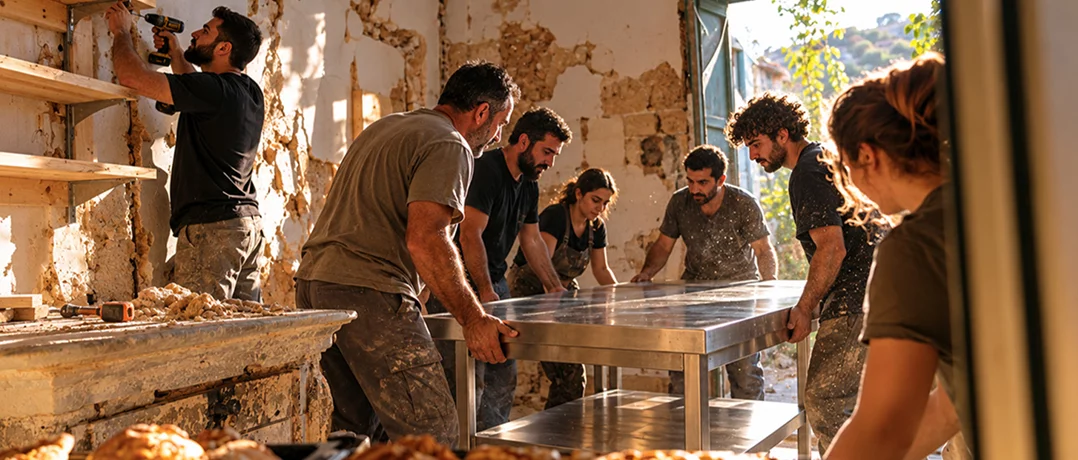
As part of his latest tour of South Lebanon, Dr. Fouad Abou Nader, president of the Nawraj Association, visited Deir Mimas, Burj al-Muluk, Klayaa and Jdeidet Marjeyoun, where he met with municipal leaders to discuss the economic and living conditions facing communities along the southern border. The Beiruter accompanied Abou Nader on an exclusive field visit, documenting the association’s efforts to support local communities and witnessing firsthand its transition from emergency relief to long-term development.
During the visit, Abou Nader, alongside Kawkaba Mayor Elie Abou Naoul and Hasbaya District Governor Rawad Salloum, inaugurated the Lady of Haramoun Food Court in Kawkaba. The project forms part of the third phase of Nawraj’s initiative to support southern border villages through economic development, job creation and sustainable livelihood opportunities.
The inauguration marks a shift from emergency humanitarian assistance toward long-term recovery in a region where insecurity, displacement and economic disruption have threatened the ability of residents to remain in their homes.
For Nawraj, the challenge extends beyond helping communities survive the immediate crisis. It is about creating the conditions necessary for families to continue living, working and building their futures in their villages.
From humanitarian assistance to job creation
With the launch of its third phase, Nawraj is placing greater emphasis on economic recovery and sustainable livelihood opportunities.
The Lady of Haramoun Food Court in Kawkaba is among the first initiatives introduced under this strategy. Designed to stimulate local economic activity, the project also seeks to promote the area’s religious and tourism potential while creating employment opportunities for residents.
Speaking during his latest visit to South Lebanon, Abou Nader outlined the three priorities guiding the association’s work.
We need to focus on three things: education, healthcare and job opportunities. This is what we have already done in many places.
Abou Nader stressed that the initiative’s significance extends beyond Kawkaba itself.
“I believe this project is bigger than Kawkaba. It will eventually reach all the neighboring villages. We are providing people with the means to live, bringing them together and creating spaces where they can connect. This is how we will bring Lebanon together tomorrow.”
He also emphasized the importance of protecting younger generations from the psychological and social consequences of the ongoing crisis.
“We will not allow the difficult circumstances we are experiencing today to affect us or undermine the morale of our children,” he added.
His remarks reflect Nawraj’s approach to economic development as both a source of income and a means of strengthening social cohesion among neighboring communities.
Another initiative in Klayaa involves providing an ice cream production machine to Saint George Parish, supporting seasonal economic activity while creating employment opportunities for local youth.
Although modest in scale, these projects illustrate the association’s effort to create local sources of income and reduce dependence on temporary humanitarian assistance.
Four economic zones for southern development
Nawraj’s longer-term vision proposes establishing four economic zones encompassing 15 southern border villages.
The plan seeks to integrate education, healthcare, employment and rural development projects into a coordinated regional framework, encouraging neighboring communities to cooperate economically rather than operate independently.
The association also aims to promote collaboration between residents from different religious backgrounds through shared economic initiatives, strengthening social interaction and community relations.
Ultimately, Nawraj envisions connecting the four zones into a larger South Economic Zone, intended to form part of a future regional development framework.
Priority investments would include healthcare centers, rural development and ecotourism projects, with the objective of generating sustainable income and strengthening the economic resilience of border communities.
Fifteen villages facing an uncertain future
The latest economic initiatives build on an emergency response launched as the conflict began affecting southern communities in October 2023.
According to Nawraj’s 2026 emergency response plan, approximately 17,950 residents across 15 frontline villages in South Lebanon are affected by the crisis.
These communities, including Ain Ebel, Debel, Rmeich, Deir Mimas, Burj al-Muluk, Kawkaba, Klayaa and Jdeidet Marjeyoun, face mounting challenges related to security, economic activity and access to essential services.
Since October 2023, Nawraj has maintained a field presence in southern Lebanon, delivering emergency assistance to vulnerable families and displaced residents.
Its initial response focused on essential supplies, including medicine, fuel, drinking water, food products, flour, infant formula and hygiene items. The organization also provided a generator to Deir Mimas to help address local electricity needs.
However, emergency relief represented only the first stage of a broader strategy.
Nawraj identifies the growing isolation of border villages as a major concern, warning that maintaining their connection to the rest of Lebanon is essential to preserving their social fabric and long-term viability.
The association has consequently worked with religious, political and security authorities to advocate for the continued presence of the Internal Security Forces and reliable satellite communication systems in vulnerable communities.
Keeping schools open to keep families home
Beyond immediate humanitarian needs, the second phase of Nawraj’s strategy focused on education and healthcare, two essential services that can influence whether families remain in their villages or seek stability elsewhere.
In partnership with MTV Lebanon, L’Œuvre d’Orient and the General Secretariat of Catholic Schools in Lebanon, Nawraj launched a fundraising campaign to support students whose education has been affected by the conflict.
According to the association, $300,000 in financial assistance was distributed to seven schools over three months, benefiting approximately 1,347 students.
The broader campaign targets 2,500 students enrolled in nine schools serving Ain Ebel, Debel, Marjeyoun, Klayaa, Rmeich and surrounding communities.
Beneficiary institutions include Saint-Joseph schools in Debel and Rmeich, the Antonine School in Klayaa, Saints-Coeurs School, the Orthodox School and Marjeyoun National College, as well as Lebanese Modern School in Hasbaya.
The initiative reflects Nawraj’s conviction that access to education is directly linked to the survival of rural communities.
As the association states in its development plan, “When the school remains, the family remains; and when the family remains, the village remains.”
Healthcare as a condition for remaining
Healthcare represents another pressing concern, particularly in geographically isolated communities where access to medical services remains difficult.
Nawraj has identified Ain Ebel, Debel and Rmeich as particularly vulnerable because of their geographic isolation and the prevailing security conditions.
In partnership with HMO-Inaya (UFA), the association is working to extend its affordable health insurance program to families living in conflict-affected areas.
The initiative aims to ease the financial burden of medical treatment, strengthen household resilience and provide residents with greater security.
For communities facing an uncertain future, access to reliable healthcare is not merely a basic necessity but a factor in determining whether families can continue living in their villages.
Preventing isolation through a humanitarian corridor
Alongside its humanitarian and development initiatives, Nawraj has called for the establishment of a humanitarian corridor serving southern border villages.
According to the association, consultations with municipalities, the Lebanese Army and the United Nations Interim Force in Lebanon (UNIFIL) have highlighted the need for safe passage to deliver humanitarian assistance, provide emergency medical care, evacuate civilians and protect essential infrastructure.
The proposed corridor would aim to prevent vulnerable communities from becoming isolated during periods of insecurity while ensuring continued access to basic services.
For Nawraj, humanitarian assistance and economic development are closely connected. Long-term projects cannot succeed without safe access to communities, while emergency relief alone cannot provide the economic foundations necessary for their survival.
The inauguration of the Lady of Haramoun Food Court therefore represents more than the opening of a local development project. It reflects an attempt to address one of South Lebanon’s most pressing challenges: preserving the presence of communities whose future has been repeatedly threatened by conflict, economic instability and geographic isolation.
For families living along Lebanon’s southern border, remaining on their land requires more than determination. It requires functioning schools, accessible healthcare, employment opportunities and reliable connections to the rest of the country.
Through its three-phase strategy, Nawraj is seeking to transform that determination into a sustainable future, ensuring that southern villages are not only supported through the crisis but also equipped to recover beyond it.
-
-

-
The Beiruter
-
