



The collectors who turn souvenirs into memories
The collectors who turn souvenirs into memories

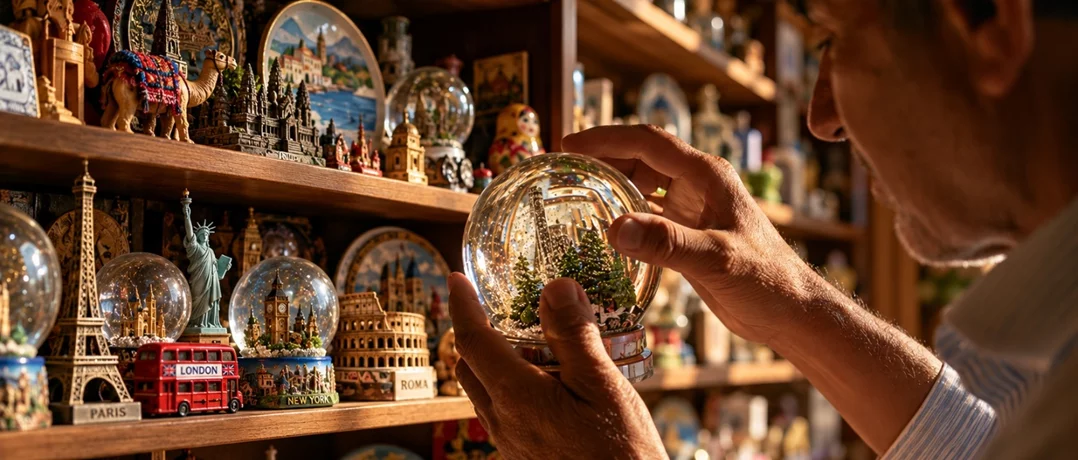
Travel rarely ends when the suitcase is unpacked. A small object on a shelf can bring a whole journey back, the weather, the food, the stranger who made you laugh. For many travelers, souvenirs work as anchors for memory, small and portable proof that a place was visited and felt. Snow globes, fridge magnets and mugs are all chosen with care, and every piece comes with a story.
The snow globe collector: Maya Chbeir, 32, Beirut
Maya’s collection began at nine, beneath the Eiffel Tower. Her father bought her a small snow globe in Paris, and she shook it all the way back in the taxi. It still sits in her collection, its plastic base faded and its glass scratched. “It reminds me of being a child and discovering that the world was much bigger than Beirut,” she told The Beiruter.
Her hobby turned serious when she began travelling alone in her twenties. Each new country meant hours searching for a globe that could “bring back a particular memory,” not necessarily the prettiest or the priciest. Her Colosseum globe, bought after an afternoon among the ruins and a carbonara in a tiny restaurant, shows how the system works. “I remember the smell of the restaurant, the sound of scooters outside and how tired my feet were.”
Her Vienna globe, with its miniature Christmas market, holds a similar paradox. It cannot capture the cold air or the scent of roasted almonds, and that is exactly the point, “it reminds me of everything that is not actually inside it.”
Even breakage has not shaken her. When her Santorini globe shattered during unpacking, she was upset for about ten minutes before realizing the memory had survived. Today the globes fill a glass cabinet in her living room, arranged by destination rather than size. Next on her list is Kyoto in cherry blossom season, though she knows the best moments will be unplanned. “You can buy a souvenir, but you cannot plan the memory that will eventually become attached to it,” she reflected.
The fridge magnet collector: Karim Barhouche, 38, Jounieh
Karim’s story started with a red double-decker bus. He was 17 on a school trip to London, proud to be choosing something for himself, and he bought the magnet near Piccadilly Circus. His mother dismissed it as useless. He disagreed, and the bus stayed on the fridge. She still retells the story to visitors.
A trip to Barcelona with friends turned one magnet into a habit, and the refrigerator started to resemble a little map. Karim does not follow strict rules. He sometimes buys several magnets from one country, and he often skips the obvious landmark for something more personal. His blue scooter from Rome comes from a street crossing, where an elderly man shook his head at the endless traffic and the two of them burst out laughing. “The scooter makes me think of that moment much more than a picture of a landmark would,” he explained.
Other pieces carry similar memories: a Turkish coffee cup from the Grand Bazaar, a plate of olives from a seaside meal in Athens, a bicycle from Amsterdam bought after he nearly collided with one. A yellow tram from Lisbon recalls an afternoon of sightseeing and a warm pastéis de nata eaten too quickly.
The result is a crowded fridge. “Opening the refrigerator is almost like opening an album of my life,” he laughed. Friends now bring him magnets from their own trips, but he always wants the story behind each one. He also refuses to buy from places he has not visited, and he leaves the gaps on his fridge as reminders of destinations still ahead. “I would rather return home with one magnet and ten good stories than ten magnets and barely remember the trip,” he told The Beiruter.
The mug collector: Rita Aoun, 29, Batroun
Rita sees a mug as a window into everyday life. “For me, a mug is connected to the way people live,” she explained, pointing to the small rituals travelers notice, how people take their coffee, what they eat for breakfast, whether they linger or rush.
Her collection began at 22 with a white London skyline mug, bought after a trip with her cousin whose mornings were spent in a neighborhood café. Back home, every cup of coffee from it brought those mornings back. When her mother wondered why she had carried a mug across Europe, Rita responded, “I could buy a mug in Lebanon, but I could not buy that particular morning in London.”
Her shelves now hold a Duomo mug tied to a perfect Florentine lunch of pasta with butter and sage, a Cretan piece recalling a long seaside meal, and a Viennese coffeehouse design linked to a slice of Sachertorte. Her latest addition, a pale blue ceramic cup from Copenhagen, carries no monument or city name, only the calm of slow mornings and cardamom buns.
Unlike many collectors, Rita uses her pieces daily. She once kept them on display for fear of breakage, then realized “I had bought these mugs because I wanted to use them.” Collecting has made her a more curious traveler who seeks out local ceramics and asks artisans about their work. She also gives herself permission to return empty-handed. Her dream is a Kyoto pottery workshop, where she hopes to bring home a handmade cup with an uneven rim and a story attached.
A snow globe, a magnet or a mug is only a trigger for the afternoon, the meal or the conversation that came with it. A good souvenir gives an ordinary object a story that you can keep telling.
-
-

-
The Beiruter
-
